


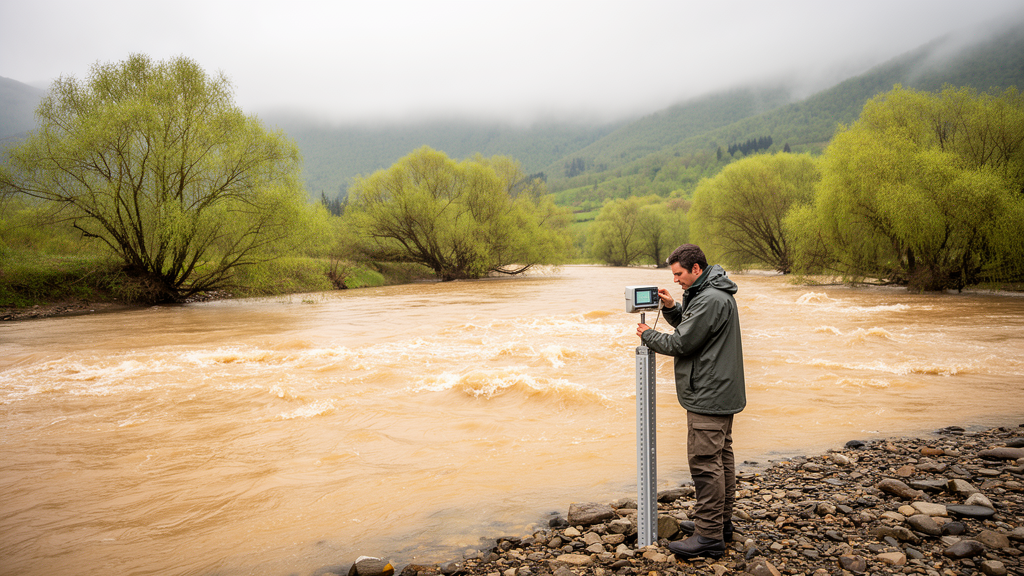
Estimating the frequency and severity of extreme flood events is a foundational requirement for municipal infrastructure design, floodplain mapping, dam safety protocols, and regional risk assessment. However, civil engineers and hydrologists routinely confront severe observational data scarcity, as systematic river gauging records across most catchments span fewer than thirty years. Standard at-site statistical flood frequency analysis typically fits parametric probability distributions, such as the Generalized Extreme Value distribution, directly to observed annual maximum peak flows or peaks over threshold. When observational records are short, statistical fitting procedures suffer from high sampling variability and wide parameter uncertainty. The resulting confidence intervals for rare design floods, including the fifty-year and one-hundred-year events, can become so extraordinarily wide that they offer little practical guidance for engineering decisions. Practitioners facing short historical series must often choose between accepting impractically broad statistical uncertainty bounds or relying on regional pooling and paleoflood reconstructions that introduce unquantified spatial or dating assumptions.
To overcome the physical and statistical constraints of brief gauging histories, hydrologists have increasingly evaluated continuous process-based simulation frameworks. In these numerical workflows, stochastic weather generators simulate long synthetic sequences of precipitation and temperature, which are subsequently routed through deterministic rainfall-runoff models to generate extensive synthetic streamflow series. Unlike conventional design-storm techniques that presume rainfall and peak runoff share identical exceedance probabilities, continuous simulation directly represents meteorological and terrestrial interactions, including soil moisture depletion, antecedent storage, snowpack accumulation, and seasonal snowmelt dynamics. Furthermore, continuous process-based modelling can yield synthetic records spanning thousands of years, significantly reducing numerical sampling uncertainty relative to short historical samples. Despite these advantages, process-based hydrologic models present an intrinsic calibration mismatch. Hydrologic models are conventionally calibrated against continuous daily hydrographs using summary performance metrics, such as the Kling-Gupta Efficiency, which prioritize overall water balance and seasonal recession trends rather than annual peak discharges. Consequently, models that replicate daily streamflow dynamics with high fidelity frequently exhibit persistent systematic bias and suppressed variability when simulating extreme annual flood peaks.
Addressing this structural limitation, a research team from the Department of Civil and Environmental Engineering at the University of Waterloo introduced UQ-flood, an integrated uncertainty quantification framework for process-based flood frequency analysis. As detailed in their published study in Natural Hazards and Earth System Sciences, the researchers coupled three distinct components: a process-based hydrologic model, a stochastic weather generator, and a residual error model formulated directly at the annual-maximum scale. Rather than attempting to correct errors at the daily time step or relying solely on parameter adjustments, UQ-flood targets the specific design variable governing flood frequency estimation: the annual maximum discharge. By analysing the statistical discrepancies between observed and simulated annual flood peaks, the residual error model calculates systematic model offsets and propagates predictive uncertainty into synthetic annual maximum sequences, aligning continuous process-based simulation with empirical flood estimation benchmarks.
The procedural workflow of the UQ-flood framework operates across two distinct sequential phases: model parameter estimation followed by long-term continuous simulation. During the initial parameter estimation phase, researchers establish a lumped conceptual hydrologic model and calibrate its parameter set over an isolated thirty-year observational window. Simultaneously, parameters for a stochastic weather generator are inferred from thirty years of daily precipitation, maximum temperature, and minimum temperature measurements. The team then constructs the residual error model by evaluating paired differences between recorded and simulated annual maximum discharge across that identical thirty-year baseline. In the second operational phase, the calibrated weather generator produces synthetic daily meteorological time series extending over one thousand continuous years. These synthetic meteorological forcings drive the hydrologic model to generate a baseline series of one thousand simulated annual peak flows. Finally, the residual error model is applied to each simulated annual peak, generating one thousand stochastic error realisations and producing an ensemble of one thousand residual-corrected annual maximum sequences, which are ranked non-parametrically using Weibull plotting positions.
To evaluate the framework across diverse physiographic and climatic settings, the authors selected three unregulated Canadian river basins, each possessing continuous daily streamflow records exceeding eighty to one hundred years. The Black River watershed near Washago in central Ontario drains approximately 1,506 square kilometres and features a humid continental climate moderated by the Great Lakes. Hydrologically, the Black River exhibits a mixed regime dominated by nival processes, with a nival fraction of approximately 0.7, extensive wetland storage, and primary flood generation driven by spring snowmelt and rain-on-snow events. In southeastern British Columbia, the Moyie River watershed drains 1,480 square kilometres of complex mountainous terrain characterized by steep slopes, continental-to-subalpine climate conditions, and a snowmelt-dominated hydrologic regime where annual peak discharges typically occur during May and June. The third study catchment, the Lahave River at West Northfield in Nova Scotia, drains 1,250 square kilometres within a coastal lowland setting. Experiencing a humid maritime climate influenced by Atlantic storm tracks, the Lahave River exhibits a rainfall-dominated regime where high-flow events occur year-round, peaking during autumn and winter when intense rainfall coincides with saturated ground conditions.
For hydrologic process simulation, the investigators implemented a lumped formulation of the Hydrologiska Byrans Vattenbalansavdelning Environment Canada model, known as HBV-EC, within the open-source Raven Hydrological Modelling Framework version 3.8. The HBV-EC architecture conceptualizes catchment hydrology through a soil moisture storage zone situated above two stacked reservoirs representing upper and lower subsurface groundwater storage. The model simulates snow accumulation and ablation using a degree-day routine, computes actual evapotranspiration, and partitions rainfall and snowmelt into surface runoff and subsurface flow governed by soil moisture dynamics. Across all three study basins, HBV-EC was calibrated exclusively on a thirty-year daily streamflow subset—spanning 1991 to 2020 for the Black and Moyie rivers, and 1992 to 2021 for the Lahave River. Calibration combined stepwise manual adjustments of water balance, snowpack, and recession parameters with automated optimization using the Dynamically Dimensioned Search algorithm, targeting daily discharge Kling-Gupta Efficiency.
Stochastic meteorological generation was conducted using the Complete Stochastic Modelling Solution, an R-based framework known as CoSMoS. CoSMoS generates synthetic non-Gaussian time series by applying non-linear transformations to underlying parent Gaussian processes, preserving marginal distributions, autocorrelation structures, and intermittency characteristics. For each watershed, monthly marginal distributions and temporal dependencies were inferred from thirty years of gauge data, employing generalized gamma distributions for daily precipitation and Gaussian models for maximum and minimum temperatures. To prevent unphysical outputs during multi-century simulations, the authors introduced two specific technical modifications to the generator: a bootstrap-based smoothing routine across monthly boundaries to prevent step-change discontinuities, and physical constraints on extreme precipitation values to prevent the generalized gamma distribution from producing implausibly heavy, infinite tails. The calibrated generator produced one thousand years of synthetic daily weather to force the hydrologic model.
The residual error model within UQ-flood was formulated specifically to address heteroscedasticity and non-normality in annual flood residuals. Because hydrologic prediction errors scale with discharge magnitude, the model applies a Box-Cox transformation with a power parameter lambda fixed at 0.2, in accordance with established streamflow error literature. The error innovations follow a Gaussian distribution with a flow-dependent residual mean, whose parameters were estimated using the method of moments. When the residual error model was evaluated against raw process-based simulations without error correction, designated as det-SIM, the uncorrected simulations exhibited pronounced and systematic underestimation of annual flood peaks across all three test catchments. Applying the residual error model shifted the simulated flood frequency curves upward, directly correcting the calibration-induced peak underestimation and populating the predictive distribution with realistic hydrometeorological variability.
Validation against long observational records demonstrated that UQ-flood central flood-quantile estimates derived from thirty years of data closely aligned with empirical annual maximum benchmarks. Across the Black, Moyie, and Lahave watersheds, the median UQ-flood estimates for return periods ranging from two to one hundred years remained strictly within the 95 percent confidence intervals calculated for long-record discharge quantiles using analytical beta-distribution methods. The relative performance between UQ-flood and Bayesian Generalized Extreme Value models fitted to long observational series varied depending on the basin and return period. In the Lahave River, UQ-flood median estimates were closer to empirical benchmarks at the fifty-year return period, whereas long-record extreme value estimates were closer at the one-hundred-year event. In the Moyie River, both frameworks yielded similar values at lower return periods, while the long-record statistical model showed closer agreement at the fifty-year recurrence interval. Conversely, Bayesian extreme value distributions fitted solely to thirty-year samples exhibited progressive divergence from long-record empirical benchmarks at high return periods, underscoring the vulnerability of short statistical series to extrapolation error.
To investigate numerical convergence, the authors conducted a sensitivity analysis evaluating synthetic simulation lengths of 100, 200, 500, 800, 1000, 2000, and 3000 years for the fifty-year and one-hundred-year flood quantiles in the Black River. Across one thousand residual realisations for each duration, the 95 percent predictive interval width contracted dramatically from approximately 2.9 cubic metres per second at a 100-year synthetic series down to between 1.7 and 1.8 cubic metres per second at lengths of 1000 to 2000 years. Beyond one thousand synthetic years, interval widths exhibited minimal variation, confirming that one thousand years of continuous simulation provides sufficient sample density to stabilize numerical sampling variability without adding spurious precision. The researchers stressed that this stabilization reflects numerical convergence of the process chain rather than an elimination of underlying epistemic uncertainty regarding watershed dynamics.
The study authors highlighted several methodological boundaries and computational considerations governing the interpretation of their findings. First, the UQ-flood 95 percent predictive interval represents residual predictive variability across error realisations conditional on the calibrated hydrologic model, stochastic weather generator, and fixed transformation parameter, rather than statistical parameter uncertainty. As such, predictive intervals from UQ-flood cannot be directly equated with Bayesian credible intervals. Second, the current implementation does not propagate parameter uncertainty in hydrologic routines, weather generation, or streamflow rating curves. Furthermore, synthetic meteorological series reflect baseline climate statistics from the thirty-year calibration window and do not represent non-stationary climate change projections. Transferring the framework to ungauged basins would necessitate regional parameter estimation techniques, and expanding the formulation to peaks-over-threshold series would require rigorous declustering and threshold selection protocols. Nevertheless, the research confirms that annual-maximum residual error modelling offers a robust, process-consistent mechanism to mitigate short-record limitations and improve flood risk characterisation for resilient infrastructure planning.
Subject of Research: Process-based flood frequency analysis using annual-maximum residual error modelling
Article Title: Residual error modelling for process-based flood frequency analysis
Article References: Romero-Cuellar, J., Craig, J. R., Tolson, B. A., & Arabzadeh, R. (2026). Residual error modelling for process-based flood frequency analysis. Natural Hazards and Earth System Sciences, 26(11), 5389-5406. https://doi.org/10.5194/nhess-26-5389-2026
Image Credits: AI Generated
DOI: 10.5194/nhess-26-5389-2026
Keywords: flood frequency analysis, residual error modelling, UQ-flood, hydrologic modelling, HBV-EC, stochastic weather generator, CoSMoS, annual maximum flow, extreme value theory, generalized extreme value, Black River, Moyie River, Lahave River, Raven modelling framework, uncertainty quantification, streamflow simulation, Weibull plotting position
Cite Scienmag News
Violet Maxwell. (November 11, 2026). Annual Error Correction Aligns Process-Based Flood Estimates With Long Observational Records. Scienmag. https://scienmag.com/annual-error-correction-aligns-process-based-flood-estimates-with-long-observational-records/
Violet Maxwell. "Annual Error Correction Aligns Process-Based Flood Estimates With Long Observational Records." Scienmag, 11 November 2026, https://scienmag.com/annual-error-correction-aligns-process-based-flood-estimates-with-long-observational-records/. Accessed 11 November 2026.
Violet Maxwell. "Annual Error Correction Aligns Process-Based Flood Estimates With Long Observational Records." Scienmag. November 11, 2026. https://scienmag.com/annual-error-correction-aligns-process-based-flood-estimates-with-long-observational-records/




