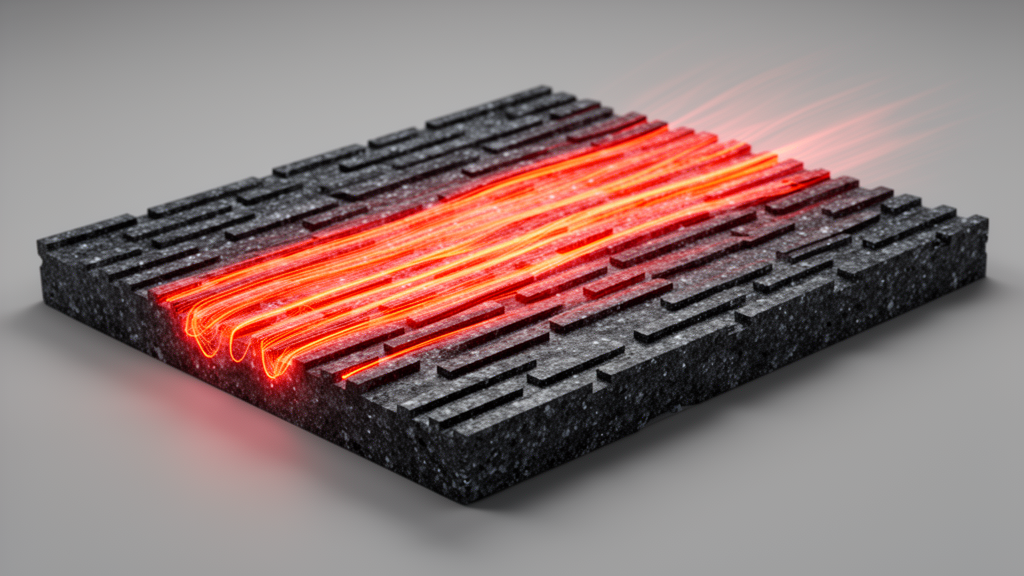
Physicists have found a way to flatten the energy landscape of light inside a chip-scale optical device simply by choosing the right material and carving it into the right shape. The work demonstrates, in experiment rather than only in simulation, a route to controlling the topology of light–matter coupling through material anisotropy alone.
The central object in the study is a quasi-bound state in the continuum, or qBIC: a resonant mode of an array of subwavelength nanoresonators that is nearly non-radiative and can exhibit ultrasharp spectral features. In a metasurface made of square nanoresonators arranged in a C4-symmetric lattice on a silicon dioxide substrate, an isotropic constituent material would support a non-radiative, doubly degenerate mode at the centre of the momentum-space Brillouin zone, the Γ point. The team’s design introduces a controlled asymmetry parameter α that reshapes the square resonators into prisms with two different side lengths while keeping the in-plane footprint constant. This perturbation, combined with a unit-cell enlargement by a factor of √2 that folds the Brillouin zone, transforms the dark degenerate modes into two radiative qBICs with orthogonal polarizations and identical field profiles rotated by 90 degrees.
The decisive ingredient is the intrinsic optical anisotropy of ReS2 itself. The crystal’s in-plane permittivity tensor has two unequal components, εxx and εyy, aligned with the crystallographic axes. By deterministically aligning the metasurface coordinate system with the crystal b axis—identified from the elongated edges of exfoliated flakes, which cleave along that direction because of robust Re–Re bonds—the researchers ensured that each qBIC couples to a distinct component of the anisotropic permittivity. In a simplified non-dispersive model with ε = 18, Δε = εxx − εyy ≈ 1.7 (equivalent to a birefringence Δn ≈ 0.2) and an out-of-plane component εzz = 7.25, the doubly degenerate qBIC splits when Δε is non-zero: mode 1 redshifts while mode 2 blueshifts. The resulting spectral splitting scales linearly with Δε and closely matches full numerical simulations.
The most striking consequence of this splitting is topological. In the isotropic case, the far-field polarization vector fields of both modes carry integer winding numbers of −1 centred at the Γ point—polarization vortices with an integer topological charge. When a small anisotropy matching the value for ReS2 is introduced, that single integer charge splits into a pair of half-integer charges of −1/2, symmetrically displaced along the kx axis. These fractional singularities coincide with points at which the two orthogonally polarized modes touch, forming photonic Dirac cones whose dispersion mirrors the graphene-like meeting of two conical bands at a single point. The same anisotropy simultaneously reshapes the band curvatures: in the ky = 0 plane the x-polarized mode develops a flatband while the y-polarized mode becomes strongly curved, and the roles are reversed in the kx = 0 plane.
Turning theory into measurement, the team fabricated the ReS2 metasurface—flakes exfoliated from commercial bulk crystals, patterned by electron-beam lithography with a gold hardmask, etched with SF6-based reactive ion etching, and roughly 90 nanometres thick to optimize overlap between the photonic modes and the excitonic medium—and performed angle-resolved Fourier-space transmittance spectroscopy at room temperature. The measured dispersions confirmed the predictions. For excitation polarization parallel to the crystal b axis, the dispersion is parabolic along one in-plane direction and strongly flattened along the orthogonal direction; for perpendicular excitation, the flat and parabolic directions interchange. Quantitative fits accounting for hybridization between the intrinsic qBIC and a substrate-induced grating mode showed that the flat branch has a curvature more than two orders of magnitude lower than the parabolic branch, with curvature ratios of 102.6 ± 7.0 for mode 1 and 108.1 ± 8.9 for mode 2, and correspondingly suppressed group velocities near the Γ point.
The authors are careful to note that these are directional, not two-dimensional, flatbands: the dispersion is quenched along a single momentum direction only, and because hybridization with the grating channel introduces residual curvature, the experimentally extracted flat branches show a finite but strongly suppressed curvature rather than vanishing exactly. Even so, the flatbands are remarkably broad, extending across 93.7 percent of the accessible k-space region for mode 1 and 91.5 percent for mode 2, limited only by the onset of diffraction. This breadth distinguishes the approach from photonic-crystal slab schemes, in which group-velocity suppression is confined to narrow band-edge regions.
The polarization topology around the Dirac points was also verified experimentally. Using hyperspectral Stokes-parameter measurements in momentum space, the team resolved two branches intersecting in a Dirac-like crossing at kx/k0 ≈ ±0.35. By extracting the polarization angle φ = arctan(S2/S1)/2 and fitting the analytical RSE band structure to the data, they obtained momentum-resolved polarization-angle maps in which the polarization evolves continuously along each branch and exhibits singular points coinciding with the Dirac points. The far-field polarization vectors display a half-integer winding around the singularity, corresponding to a topological charge of −1/2, in direct agreement with the simulations. The researchers point out that at these Dirac points only the eigenfrequencies coalesce, unlike at exceptional points, where both eigenvectors and eigenfrequencies coalesce. They also note that the orientation of the in-plane anisotropy axis provides an additional tuning parameter that revolves the Dirac points through momentum space without any further geometrical perturbation.
The final step transferred this engineered dispersion landscape into the polaritonic regime. Bulk ReS2 crystals possess two energetically separated excitonic transitions, linearly polarized along nearly orthogonal in-plane directions, and ReS2 is notable for strong in-plane anisotropy and thickness-independent direct-bandgap excitons. By scaling the metasurface so that the qBIC eigenfrequencies were tuned into resonance with these excitonic transitions, the researchers coupled each orthogonally polarized qBIC to its corresponding exciton. Experimental transmittance spectra at normal incidence revealed clear splitting from the hybridization, with coupled-mode fits yielding Rabi splittings of ℏΩR1 = 110 meV and ℏΩR2 = 108 meV, and a quantitative analysis of coupling strengths and linewidths confirmed operation in the strong-coupling regime. The lower polariton bands comprise 43 percent exciton 1 and 57 percent mode 1, and 51 percent exciton 2 and 49 percent mode 2, according to the Hopfield coefficients, with the ratios reversed for the upper bands; along the flatband direction these coefficients remain nearly constant over the accessible momentum range, indicating a genuinely mixed, momentum-independent light–matter composition.
Compared with earlier flatband schemes that rely on frustrated lattices such as kagome or Lieb geometries, strained honeycomb polariton lattices, or superlattice and BIC-merging approaches—all of which depend on finely tuned structural interference or auxiliary ingredients and are therefore sensitive to fabrication disorder—the anisotropy-based mechanism uses a single resonance with no auxiliary quasiparticles, and the flatbands are directly accessible in the far field. The approach is also distinct from hyperbolic-media studies of surface phonon polaritons, which probe direction-dependent near-field propagation; here the researchers realize bulk exciton–polaritons whose anisotropy originates from the excitonic transitions themselves and extends into the far field. The authors suggest the mechanism could generalize to other anisotropic media such as black phosphorus and two-dimensional magnets, or be mimicked in isotropic materials through engineered asymmetry.
Because flatband polaritons combine quenched kinetic energy, qBIC-enhanced photon lifetimes and room-temperature excitons in a single monolithic material, the researchers highlight two target functionalities: polarization-selective, low-threshold polariton lasing, and slow-light-enhanced nonlinear processes over a wide angular range enabled by group-velocity suppression across more than 90 percent of the far-field accessible momentum range, which, combined with exciton-driven nonlinearities of the self-hybridized polaritons, could open a route towards polarization-selective, low-power nonlinear emission. These remain proposed directions rather than demonstrated applications of the present device. What the study establishes is the experimental demonstration itself: that material anisotropy alone, harnessed in a C4-symmetric metasurface carved from bulk ReS2, can split an integer polarization vortex into two half-integer charges, create Dirac points and directional flatbands, and carry that topologically textured dispersion into strongly coupled exciton–polaritons measured at room temperature under ambient conditions.
Subject of Research: Topological control of directional photonic and polaritonic flatbands in anisotropic ReS2 metasurfaces
Article Title: Topological control of polaritonic flatbands in anisotropic van der Waals metasurfaces
Article References: Heimig, C., Weber, T., Cruciano, C., Genco, A., Possmayer, T., Sortino, L., Valentini, G., Manzoni, C., Gorkunov, M. V., Cerullo, G., Antonov, A. A., & Tittl, A. (2026). Topological control of polaritonic flatbands in anisotropic van der Waals metasurfaces. Nature Materials. https://doi.org/10.1038/s41563-026-02776-3
Image Credits: AI Generated
DOI: 10.1038/s41563-026-02776-3
Keywords: ReS2, metasurfaces, flatbands, exciton-polaritons, quasi-bound states in the continuum, topological charges, Dirac points, van der Waals materials, photonics, strong coupling, group velocity, nanophotonics
Cite Scienmag News
Denise Maddox. (October 29, 2026). Anisotropic ReS2 Metasurfaces Steer Polaritons into Directional Flatbands. Scienmag. https://scienmag.com/anisotropic-res2-metasurfaces-steer-polaritons-into-directional-flatbands/
Denise Maddox. "Anisotropic ReS2 Metasurfaces Steer Polaritons into Directional Flatbands." Scienmag, 29 October 2026, https://scienmag.com/anisotropic-res2-metasurfaces-steer-polaritons-into-directional-flatbands/. Accessed 4 November 2026.
Denise Maddox. "Anisotropic ReS2 Metasurfaces Steer Polaritons into Directional Flatbands." Scienmag. October 29, 2026. https://scienmag.com/anisotropic-res2-metasurfaces-steer-polaritons-into-directional-flatbands/