


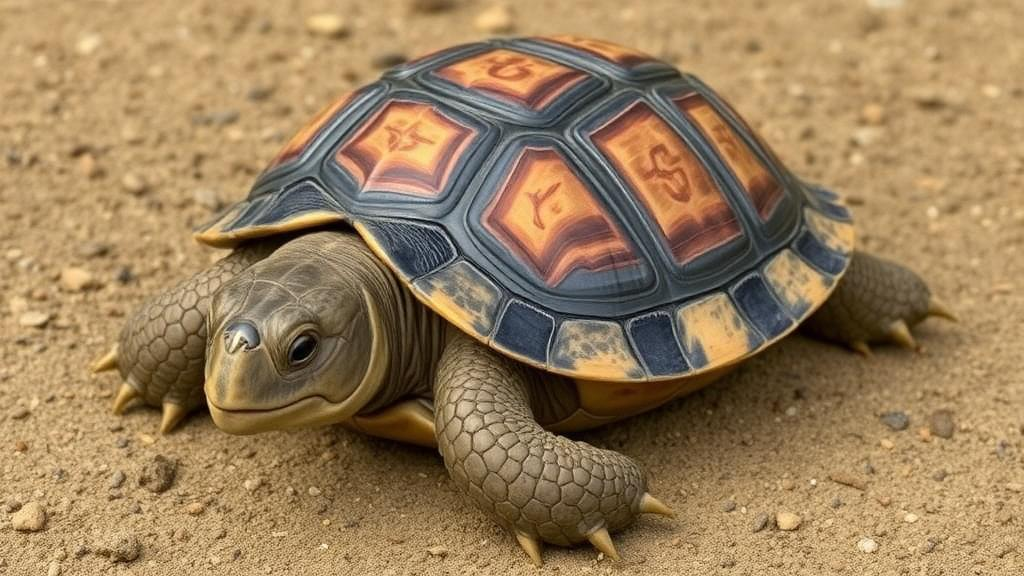
One of the world’s richest turtle fossil records has finally given up its secrets. In a new study published in the journal Fossil Record, researchers used micro-computed laminography and tomography to reconstruct, bone by bone, the anatomy of Allaeochelys crassesculpta, a carettochelyid turtle that lived about 47 million years ago in and around the volcanic maar lake of Messel, Germany. The species is known from more than a hundred specimens, most of them nearly complete articulated skeletons, yet its anatomy had never been described in detail since its original naming more than a century ago. The new work provides high-resolution three-dimensional reconstructions of the cranium, mandible, and fore- and hindlimbs, and reveals a striking mosaic of primitive and advanced traits that reshapes how scientists view the evolution of this unusual family of turtles.
Carettochelyids are an enigmatic lineage of aquatic turtles whose only living representative is the pig-nosed turtle Carettochelys insculpta, a relict species surviving in southern New Guinea and the Northern Territory of Australia. The group first appears in the fossil record in the late Early Cretaceous of Asia, with early species known from South Korea, Thailand, and Uzbekistan, and is thought to have originated in Asia, plausibly during the Late Jurassic. Diversity peaked during the Eocene, when roughly half of all known extinct species lived, including Allaeochelys crassesculpta at Messel. Today, 21 valid species of carettochelyids are recognized, spanning from the late Early Cretaceous to the middle Miocene, but most are known only from fragmentary shells or isolated bones, which has long hampered efforts to reconstruct the family’s evolutionary history.
The Messel material stands apart. In addition to dozens of complete skeletons, pairs of individuals found together were shown in earlier work to represent the first record of copulating fossil vertebrates, preserving turtles that died while mating and sank into deeper, gas-poisoned layers of the ancient lake. The original description by Harrassowitz in 1922 established two species, Anosteira crassesculpta and Anosteira gracilis, later recognized as a single taxon, but subsequent additions to knowledge of the species’ anatomy were minor. The new study draws on more than 50 specimens held in major German and international collections, focusing on the extensive holdings of the Hessisches Landesmuseum Darmstadt and the Senckenberg Naturmuseum Frankfurt.
Scanning posed considerable technical challenges. Most Messel fossils are preserved as flattened skeletons embedded in epoxy plates, and even skulls that look superficially well preserved turned out to be heavily crushed internally. The team, working at the Institute for Photon Science and Synchrotron Radiation of the Karlsruhe Institute of Technology, scanned several skulls and limbs, and fully segmented only the best-preserved cranium, a specimen catalogued as SMF Me3004. That cranium, flattened during burial, consisted of 151 bony elements that the researchers digitally reassembled in the software Blender, comparing the result with cranial reconstructions of other carettochelyids to guide the reconstruction. The resulting models document a skull bearing the family’s signature ornamentation of thick ridges separated by equally sized grooves, a deeply emarginated temporal region, and a suite of novel anatomical details, including previously unreported canals and foramina associated with the internal carotid artery system, the vidian nerve, and the abducens nerve.
The anatomy revealed a fascinating mix of characteristics. Allaeochelys crassesculpta shares with earlier-branching carettochelyids such as Kizylkumemys and Anosteira a straight labial margin of the maxilla, a large and deep antrum postoticum, an absence of an enfolded ridge covering the pterygoid fossa, and a foramen for the internal carotid canal positioned relatively far forward. At the same time, it displays hallmark features of more advanced carettochelyids, including a contact between the maxilla and quadratojugal below the jugal, loss of any contact between the quadratojugal and squamosal, an equilateral triangular entoplastron, a wide posterior plastral lobe, and the complete loss of both carapace and plastral scutes. This blending of old and new traits places the species near the base of the lineage that ultimately produced the living pig-nosed turtle.
Perhaps the most eye-catching result concerns how this 47-million-year-old turtle swam. The living pig-nosed turtle is the only freshwater turtle whose limbs are modified into flippers, and it moves through water using ‘synchronous rowing,’ in which both forelimbs beat in unison in a style intermediate between the rowing of ordinary freshwater turtles and the flapping of sea turtles. Earlier work had suggested, based on the humerus of the Early Cretaceous carettochelyid Byeoljubuchelys yeosuensis, that this locomotor style arose later in the group’s history. But the new three-dimensional reconstruction of a complete forelimb of Allaeochelys crassesculpta tells a different story. The manus accounts for more than half of the total forelimb length, a proportion comparable to the pig-nosed turtle and to sea turtles, and the humerus is straight, flattened, and equipped with a greatly enlarged medial process and a distally displaced lateral process, exactly the features that anchor the hypertrophied swimming muscles in both modern flippers-bearing turtles. Together with limb-proportion analysis using established paleoecological methods, these features indicate that Allaeochelys crassesculpta was as well adapted to open-water swimming as its modern relative, implying that synchronous rowing likely evolved sometime between the Late Cretaceous and the Paleocene.
The scans also exposed an unexpected physiological adaptation. Micro-computed tomography revealed that the cranial bones of Allaeochelys crassesculpta are highly porous, particularly in the frontal, parietal, opisthotic, pterygoid, squamosal, and the fused basioccipital-exoccipital complex. Similar extreme porosity is known in the bones of sea turtles and is generally interpreted as lightening of the skeleton in strongly aquatic animals. Combined with the flipper-like limbs, this suggests the species was a proficient swimmer that patrolled the surface waters of the Messel lake, foraging for food near the surface. It was there, the researchers suggest, that mates encountered one another, occasionally with fatal results when pairs sank into anoxic depths, and the presence of juveniles of varying sizes indicates the lake supported a viable resident population rather than acting as a systematic death trap for mating turtles alone.
The aquatic specialization of Allaeochelys crassesculpta likely explains why it dominates the Messel turtle fauna. It far outnumbers the aquatic geoemydid Palaeoemys messeliana, the trionychid turtle known as “Trionyx” messeliana, and the podocnemidid Neochelys franzeni. Strikingly, the species is completely absent from the roughly contemporaneous site of Geiseltal, whose turtle fauna is dominated by terrestrial forms, suggesting that Geiseltal lacked permanent bodies of water. Juvenile specimens of Allaeochelys crassesculpta, five of which the study identifies for the first time, mirror the adults in miniature, already showing the flipper-like forelimbs, the characteristic shell ornamentation, and the complete absence of scutes, with carapace lengths ranging from four to 7.5 centimeters compared to an adult average of about 18.7 centimeters.
To test how the new anatomical findings reshuffle the family tree, the team assembled a new morphological matrix of 24 taxa and 66 characters, incorporating previously excluded species and 29 newly formulated characters. Analyses under both parsimony and Bayesian tip-dating confirmed the broad outline of carettochelyid evolution, retrieving the Korean Byeoljubuchelys yeosuensis as the earliest branching member and uniting Allaeochelys and Carettochelys in a single advanced lineage. Allaeochelys crassesculpta emerged as an early-branching member of that lineage, and the French species Allaeochelys rouzilhacensis proved so similar that the authors suggest it may be a junior synonym, urging further scanning of its holotype to settle the question. Yet the trees remained poorly resolved, largely because more than 70 percent of character data is missing for 15 of the 22 fossil carettochelyids, nearly 90 percent for nine of them. The researchers conclude that better fossils remain essential, but their detailed documentation of dozens of previously unreported cranial and mandibular features now provides a far richer anatomical toolkit for interpreting every new carettochelyid discovery to come.
Subject of Research: Osteology, paleoecology, and phylogenetic relationships of the Eocene carettochelyid turtle Allaeochelys crassesculpta from Messel
Article Title: Osteology, paleoecology, and phylogenetic relationships of the carettochelyid turtle Allaeochelys crassesculpta from the middle Eocene Konservat-Lagerstätte of Messel, Germany
Article References: Rollot, Y., Zuber, M., Hamann, E., & Joyce, W. G. (2026). Osteology, paleoecology, and phylogenetic relationships of the carettochelyid turtle Allaeochelys crassesculpta from the middle Eocene Konservat-Lagerstätte of Messel, Germany. Fossil Record, 29(2), 611-674. https://doi.org/10.3897/fr.29.195537
Image Credits: AI Generated
DOI: 10.3897/fr.29.195537
Keywords: Allaeochelys crassesculpta, Carettochelyidae, Messel Pit, Eocene turtles, micro-computed tomography, synchronous rowing, pig-nosed turtle, paleoecology, phylogenetics, turtle evolution, flippers, Konservat-Lagerstätte
Cite Scienmag News
Gavin Prescott. (October 15, 2026). Ancient Turtle From Messel Fossil Site Swam Like Today’s Pig-Nosed Turtle, 3D Scans Reveal. Scienmag. https://scienmag.com/ancient-turtle-from-messel-fossil-site-swam-like-todays-pig-nosed-turtle-3d-scans-reveal/
Gavin Prescott. "Ancient Turtle From Messel Fossil Site Swam Like Today’s Pig-Nosed Turtle, 3D Scans Reveal." Scienmag, 15 October 2026, https://scienmag.com/ancient-turtle-from-messel-fossil-site-swam-like-todays-pig-nosed-turtle-3d-scans-reveal/. Accessed 15 October 2026.
Gavin Prescott. "Ancient Turtle From Messel Fossil Site Swam Like Today’s Pig-Nosed Turtle, 3D Scans Reveal." Scienmag. October 15, 2026. https://scienmag.com/ancient-turtle-from-messel-fossil-site-swam-like-todays-pig-nosed-turtle-3d-scans-reveal/


