


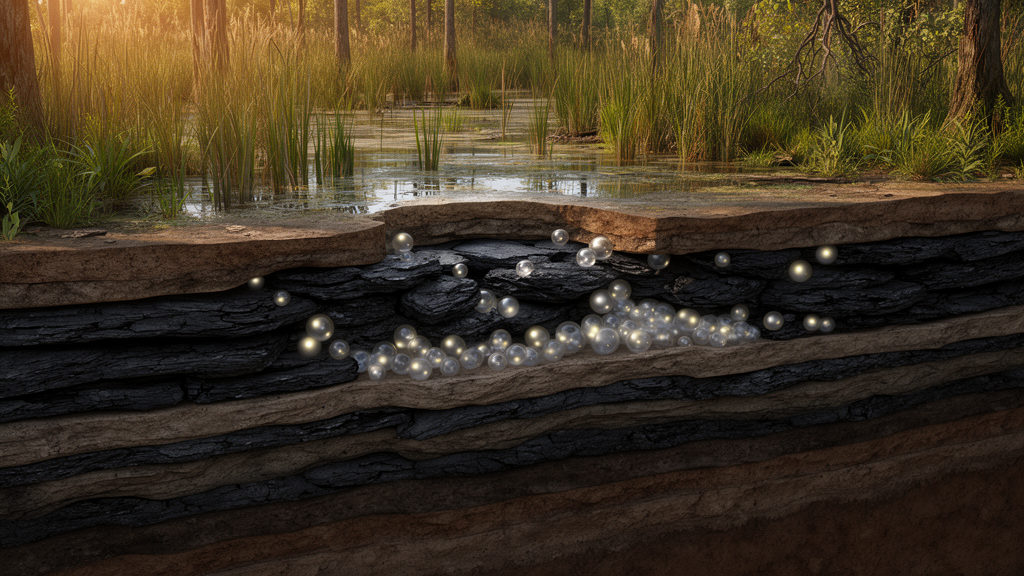
Coalbed methane does not distribute itself evenly through a coal deposit. A study of the Baode Block in China’s Ordos Basin, published in Natural Resources Research, shows that the ancient marsh environments in which the coal formed, recorded today as distinct coal facies, exert a strong control over how much methane the rock can adsorb and how readily that methane can be released. The researchers analyzed 58 coal samples from two coal seams, traced vertical variations in facies through each seam, and connected those variations directly to pore structure and adsorption–desorption behavior, identifying the most favorable intervals for coalbed methane development.
The team characterized each sample using maceral and mineral analysis, proximate analysis, mercury intrusion porosimetry, low-temperature nitrogen and carbon dioxide adsorption, and methane isothermal adsorption experiments. Using the GI–TPI diagram, which combines the gelification index with the textural preservation index to reconstruct paleo-marsh conditions, the researchers identified four coal facies: wet forest swamp (A), water-covered swamp (B), wet herbaceous swamp (C), and dry forest swamp (D). The wetter, tree-dominated facies A and B contained higher vitrinite and fixed carbon contents and lower inertinite and ash yields than facies C and D. Vertically, the pattern was consistent in both seams: facies A and B dominantly occur in the middle sections, while facies C and D develop in the upper and lower sections.
These compositional differences translate into pronounced contrasts in pore architecture. Coals from facies A and B are dominated by micropores, with average micropore pore volume and specific surface area percentages of 82.3 percent and 99.3 percent, respectively. In contrast, facies C and D coals contain a larger share of transitional pores, mesopores, and macropores, which together contribute an average of 41.6 percent of total pore volume, compared with 17.7 percent in facies A and B. Statistical analysis reinforced the link between environment and pore structure: micropore volume correlated positively with the gelification index and negatively with the textural preservation index and the tissue index, while macropore volume showed no clear linear correlation with these indices. The wetter, better-preserved peat-forming settings produced the fine micropore networks that dominate gas storage capacity.
The consequences for methane behavior followed the same pattern. Langmuir volume, a measure of maximum adsorption capacity, decreased from facies A to facies D, indicating higher adsorption capacity for the wet forest swamp and water-covered swamp coals. These same facies also yielded higher critical desorption pressures, meaning the methane they store begins to release at more favorable pressure conditions during production. Taken together, the results show that facies A and B coals combine high adsorption capacity with superior desorption performance within this dataset.
Applying these findings at the seam scale, the researchers identified the middle sections of the No. 4 + 5 and No. 8 + 9 seams, designated S-2 and T-2, as the sweet-spot intervals for coalbed methane development in the Baode Block. These intervals are dominated by brighter lithotypes formed under facies A and B conditions, concentrating the favorable micropore systems and desorption characteristics in discrete zones within each seam. The study addresses the previously poorly understood link between coal facies and coalbed methane adsorption–desorption behavior, and shows how a facies-based workflow can translate that understanding into concrete exploration targets in the Baode Block.
Subject of Research: Coal facies vertical heterogeneity and its effect on coalbed methane adsorption–desorption behavior in the Baode Block, Ordos Basin
Article Title: Coal Facies Vertical Heterogeneity and Its Effect on CBM Adsorption–Desorption Behavior in Baode Block: Implications for Sweet-Spot Intervals Selection
Article References: Meng, Y., Liu, J., Wang, X., Fu, H., Hou, W., Li, Z., Li, Y., & Liu, Y. (2026). Coal Facies Vertical Heterogeneity and Its Effect on CBM Adsorption–Desorption Behavior in Baode Block: Implications for Sweet-Spot Intervals Selection. Natural Resources Research. https://doi.org/10.1007/s11053-026-10792-y
Image Credits: AI Generated
DOI: 10.1007/s11053-026-10792-y
Keywords: coalbed methane, coal facies, Ordos Basin, Baode Block, pore structure, adsorption–desorption, sweet-spot intervals, vitrinite, micropores, Langmuir volume, paleo-marsh environment, Coal
Cite Scienmag News
Violet Maxwell. (October 26, 2026). Ancient Swamp Environments Dictate Methane Storage in Ordos Basin Coal Seams. Scienmag. https://scienmag.com/ancient-swamp-environments-dictate-methane-storage-in-ordos-basin-coal-seams/
Violet Maxwell. "Ancient Swamp Environments Dictate Methane Storage in Ordos Basin Coal Seams." Scienmag, 26 October 2026, https://scienmag.com/ancient-swamp-environments-dictate-methane-storage-in-ordos-basin-coal-seams/. Accessed 26 October 2026.
Violet Maxwell. "Ancient Swamp Environments Dictate Methane Storage in Ordos Basin Coal Seams." Scienmag. October 26, 2026. https://scienmag.com/ancient-swamp-environments-dictate-methane-storage-in-ordos-basin-coal-seams/


