

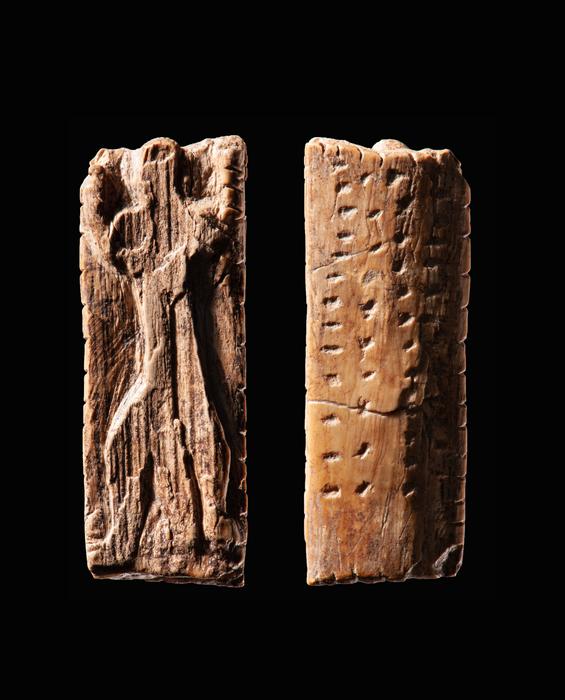
Over 40,000 years ago, long before the advent of formal writing systems, our early ancestors were already etching signs and symbols onto tools and sculptures. This radical insight comes from a groundbreaking study undertaken by linguist Christian Bentz of Saarland University and archaeologist Ewa Dutkiewicz from the Museum für Vor- und Frühgeschichte in Berlin. Their pioneering research employs advanced computational methods to analyze thousands of prehistoric signs, revealing an astonishing complexity in these ancient markings—a complexity that rivals the earliest known proto-cuneiform scripts from Mesopotamia, which appeared some 40,000 years later.
The archaeological artifacts central to this study date from the Palaeolithic era, spanning approximately 34,000 to 45,000 years ago. Many of these relics were uncovered in the Swabian Jura region of southwestern Germany, a notable hotspot for early symbolic expression. Among the most remarkable objects analyzed is the so-called “Adorant” figurine from the Geißenklösterle Cave—an ivory plate carved with an anthropomorphic figure blending human and lion features, interspersed with carefully crafted rows of dots and notches. Similar symbolic motifs are found on other artifacts such as a small mammoth carving from Vogelherd Cave, inscribed with rows of crosses and dots, and the famous Lion Human from Hohlenstein-Stadel Cave, where evenly spaced notches adorn the figure’s arm. These symbols suggest deliberate, structured systems of notation.
Unlike sporadic or purely decorative marks, the distinctive sequences and repetitions of notches, lines, dots, and crosses appear to form intentional sign systems. Bentz and Dutkiewicz’s team argues that these signs were designed to convey information, encoding thoughts or messages in a systematic fashion. Utilizing computational analysis of over 3,000 individual signs cataloged from approximately 260 distinct objects, the researchers applied quantitative linguistic frameworks to assess the statistical structure of these ancient symbol sequences. This approach diverges from traditional archaeological methods by focusing not on deciphering direct meanings but on measuring information density and the probabilistic characteristics intrinsic to these notations.
Their results demonstrate that these Palaeolithic sign systems exhibit a level of information encoding complexity remarkably comparable to that found in the earliest proto-cuneiform writing of ancient Mesopotamia. Proto-cuneiform tablets—emerging around 3,000 BCE and recognized as among the first formal writing systems—also rely heavily on repeated symbols exhibiting similar statistical properties. Notably, both these ancient sign sequences and early proto-cuneiform scripts emphasize repetitive elements, a trait absent from modern alphabets and spoken languages, indicating a unique mode of symbolic communication among Palaeolithic humans.
Professor Bentz explains that while modern writing systems reflect spoken language and carry high informational density, the prehistoric signs instead occupy a distinct category. Their repetition and regularity suggest systems encoding structured but non-linguistic information. Such systems likely served as early frameworks for recording knowledge or coordinating social activities, predating the direct transcription of speech by thousands of years. This new understanding challenges prior assumptions that writing emerged suddenly and completely with the earliest cuneiform, revealing instead an evolutionary continuum beginning deep in human prehistory.
Archaeologist Dr. Ewa Dutkiewicz expands on the cultural significance of these findings, emphasizing that the remarkably portable nature of many of these objects—small enough to be held in a hand—mirrors the physical attributes of proto-cuneiform tablets. The artefacts were clearly cherished and transported, implying their role not simply as utilitarian tools or decorative objects but as carriers of important encoded information. The sophisticated craftsmanship and symbolic complexity reflect highly developed cognitive abilities and social structures among early Homo sapiens living alongside Neanderthals in Europe during the Late Pleistocene.
The research team’s method involved digitalizing the sign sequences into an extensive database, followed by advanced statistical and machine learning analyses. Metrics such as entropy, which quantify the unpredictability and information content in symbol sequences, revealed these ancient notations possessed comparable entropy values to proto-cuneiform texts. This quantifiable measure underscores a surprising consistency across tens of millennia in how humans organize visual information, despite vast cultural and technological differences.
The findings also deepen our understanding of the gradual development of information encoding, highlighting a long lineage of symbolic expression that predates writing but laid its groundwork. Bentz concurs that writing, as a system explicitly designed to transcribe spoken language, is just one stage in a diverse evolutionary trajectory of visual communication systems. This continuum ranges from incised patterns on ancient tools and figurines through proto-writing to fully developed scripts and symbol systems underlying modern digital communication.
One especially thought-provoking implication is the comparison to modern artificial intelligence systems, such as large language models. These AI models interpret and generate language sequences by leveraging statistical predictability much like the prehistoric sign systems reveal patterns of repetition and information encoding. This analogy opens new avenues for exploring the cognitive and technological roots of symbolic communication as a fundamental human capacity.
While the precise meanings conveyed by the Palaeolithic signs remain elusive, the research provides an empirical framework from which future interpretations can proceed more systematically. It highlights the cognitive sophistication of Stone Age humans who, anatomically modern yet lacking access to accumulated millennia of literacy traditions, nevertheless developed complex sign systems to enhance group coordination, knowledge transmission, and survival in challenging environments.
This study forms part of the European Research Council-funded Evolution of Visual Information Encoding (EVINE) project, directed by Professor Bentz. The project investigates the full arc of symbolic communication’s evolution, from the earliest known signs to contemporary writing and beyond. Bentz and Dutkiewicz continue to traverse Europe, cataloging Palaeolithic signs from museum collections and archaeological sites, promising further revelations regarding humanity’s deep-rooted legacy of information encoding.
The research was recently published in the journal Proceedings of the National Academy of Sciences (PNAS), consolidating a new understanding of how early humans harnessed visual symbols to communicate meaningfully. This discovery not only enriches our knowledge of prehistoric cognition and culture but also underscores how foundational symbolism and encoding are to human development—past, present, and future.
Subject of Research: Origins and complexity of Palaeolithic sign systems as precursors to writing
Article Title: (Not provided in the source material)
News Publication Date: February 23, 2026
Web References:
https://www.erc-evine.de/
https://www.youtube.com/@StoneAgeSigns
http://dx.doi.org/10.1073/pnas.2520385123
References:
Proceedings of the National Academy of Sciences, DOI: 10.1073/pnas.2520385123
Image Credits:
Landesmuseum Württemberg / Hendrik Zwietasch, CC BY 4.0
Keywords:
Palaeolithic signs, early symbolic systems, proto-cuneiform, information density, computational linguistics, Stone Age, visual encoding, archaeological notation, prehistoric art, cognitive evolution


