

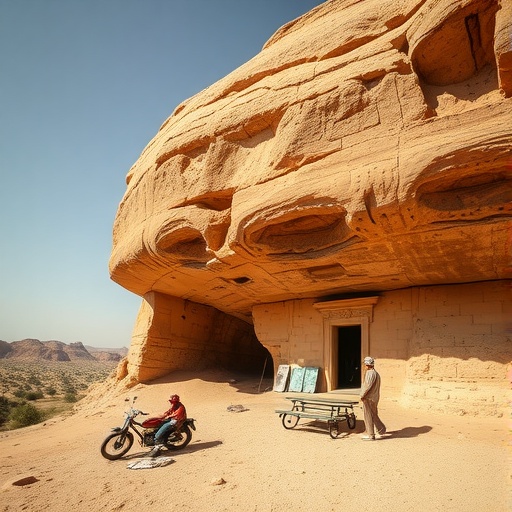
In a groundbreaking study recently published in Nature Communications, an international team of researchers has unveiled compelling evidence that humans inhabited the Arabian Peninsula between 60,000 and 16,000 years ago. This discovery, centered on excavations at the Buhais Rockshelter in the United Arab Emirates, challenges previous assumptions about the timing and extent of early human migration into the Arabian Peninsula, painting a richer picture of human prehistory outside Africa. The research, led by Bretzke, Kim, Jasim, and colleagues, highlights the intricate interplay between climatic shifts, environment, and human adaptation in one of the world’s most arid regions during the Late Pleistocene epoch.
The Buhais Rockshelter excavation site has become a pivotal location for understanding human dispersal routes out of Africa and across Asia. Situated in the Hajar Mountains, Buhais offers a rare stratigraphic record revealing continuous and repeated human occupation. Archaeologists employed advanced dating techniques, including optically stimulated luminescence (OSL) and uranium-thorium dating, to establish a robust chronological framework. These analyses demonstrated the presence of Homo sapiens in the region far earlier than many had predicted, pushing back the timeline of human settlement in Arabia by tens of thousands of years.
One of the most significant revelations of this study is the indication that Arabian habitats supported human life through multiple glacial-interglacial cycles. The researchers uncovered sedimentary layers and archaeological materials that denote fluctuating environmental conditions—ranging from wetter, more hospitable periods to severe aridity. This adaptability elucidates the resilience of early modern humans, who not only traveled through but also settled in challenging environments, refashioning their subsistence strategies according to climatic pressures.
The lithic assemblages found within Buhais further emphasize the technological capacities and cultural complexity of its ancient inhabitants. Stone tools discovered at the site exhibit variability that suggests a nuanced response to changing resource availability and hunting practices. The analysis of these artifacts also aligns Buhais with contemporaneous archaeological traditions spanning Northeast Africa and Southwestern Asia, supporting theories of interconnected prehistoric populations.
Intriguingly, the study underscores the role of Arabia as a crucial corridor for dispersal, rather than merely a transient passage. The long-term occupation revealed at Buhais challenges prior models that viewed the region as mostly inhospitable during the Late Pleistocene. Instead, fluctuating paleohydrological conditions, including the presence of freshwater springs and rivers during wetter phases, may have provided refugia and stepping stones facilitating sustained human occupation and migration.
The team’s multidisciplinary approach—combining paleoenvironmental reconstruction, archaeological surveys, and chronometric dating—paints a vivid portrait of life in the Arabian Peninsula across millennia. Analysis of fossilized pollen and faunal remains helped reconstruct past vegetation and climate, affirming that water availability was a critical factor in human settlement. These environmental proxies corroborate periods of increased humidity coinciding with intensified human activity, highlighting a dynamic relationship between humans and their ecosystem.
Moreover, the genetic implications of this find are profound. The presence of humans in Arabia at such an early date supports emerging genomic evidence suggesting multiple waves of human migrations out of Africa. This may indicate that the Arabian Peninsula was not a simple gateway, but an essential habitat influencing genetic diversity and population dynamics in this broader region.
The excavation’s stratigraphy revealed repeated occupation layers with minimal disturbance, indicating that human groups returned or persisted in the area over extended periods. This continuity suggests complex social behaviors, possibly including knowledge transmission and cultural traditions maintained across generations. Such behaviors are typically inferred from sites with more developed social structures and contribute to evolving narratives about prehistoric human societies.
The study also brings new focus to the impact and timing of climatic events such as the Last Glacial Maximum on human populations in Arabia. The evidence shows human habitation persisted through the colder, drier phases up until around 16,000 years ago, indicating a remarkable capacity for adaptation. This challenges simplified models presuming humans could only survive in Arabia during brief, favorable climatic windows.
Critically, this research has profound implications for the understanding of early human interaction with megafauna and other fauna during this time. The analysis of animal bones from the Buhais site demonstrates a sophisticated exploitation of localized species, suggesting strategic hunting and foraging practices that contributed to human survival. This ecological knowledge would have been crucial for enduring the fluctuating conditions of the Late Pleistocene.
By situating the Arabian Peninsula as a more significant node in human prehistory, this study encourages a reevaluation of archaeological efforts in the region. It calls for expanded research into other sites that may harbor traces of early human life, urging collaboration among disciplines to refine models of human dispersal and adaptation.
Furthermore, this discovery at Buhais resonates beyond archaeology, offering insights into human resilience, adaptability, and migration that remain relevant amid modern discussions about climate change and environmental challenges. The documented ability of early humans to modify their behavior and survive drastic environmental shifts underscores resilience strategies that could inform contemporary ecological and sociocultural understanding.
This research, underpinned by state-of-the-art methods and international cooperation, sets a new benchmark for archaeological inquiry into human origins within arid environments. The results not only deepen scientific comprehension but also captivate a public fascinated by the roots of human journey and survival.
As future work unfolds, scientists anticipate that ongoing excavations and refined dating methods will further illuminate the complexity of human life in Arabia, potentially revealing even older layers of occupation or more nuanced behavioral data. The Buhais Rockshelter thus emerges as a cornerstone site, helping to redefine the narrative of humanity’s ancient migration pathways and the profound resilience of our ancestors.
In sum, the study by Bretzke and colleagues represents a major advance in paleoanthropology, providing concrete data that extends the timeline and refines the map of human dispersal. It challenges conventional paradigms and enriches the story of how early modern humans navigated and thrived in seemingly inhospitable landscapes, thus reshaping our understanding of human prehistory in the Arabian Peninsula.
Subject of Research:
Human settlement in the Arabian Peninsula during the Late Pleistocene through archaeological and paleoenvironmental evidence at Buhais Rockshelter.
Article Title:
Evidence from Buhais Rockshelter for human settlement in Arabia between 60,000 and 16,000 years ago.
Article References:
Bretzke, K., Kim, S., Jasim, S.A. et al. Evidence from Buhais Rockshelter for human settlement in Arabia between 60,000 and 16,000 years ago. Nat Commun 17, 2502 (2026). https://doi.org/10.1038/s41467-026-70681-z
Image Credits: AI Generated
DOI: https://doi.org/10.1038/s41467-026-70681-z


