

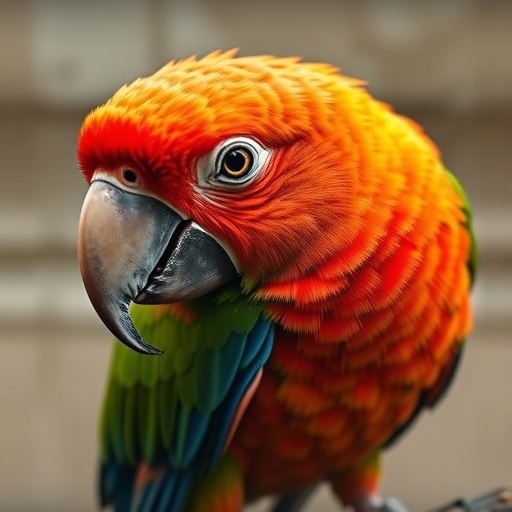
In a groundbreaking exploration into ancient trade networks and cultural interactions in South America, a new study published in Nature Communications unveils compelling evidence of a pre-Inca trans-Andean parrot trade. This research leverages cutting-edge ancient DNA analysis alongside sophisticated spatial modeling techniques, offering unprecedented insights into the complexity and extent of early Andean societies’ commerce and ecological exchanges long before the rise of the Inca Empire. The findings challenge previous notions of pre-Columbian connectivity across formidable geographic barriers, illustrating a nuanced picture of socio-economic interactions facilitated by bird trade routes.
The Andes Mountains, a natural and imposing divide, have long been considered a significant barrier to cultural and biological interchange between the coastal and highland regions of South America. This study, led by Olah, Bover, Llamas, and their colleagues, dismantles that assumption by uncovering molecular signatures of parrot species that were transported across this rugged terrain. By extracting and sequencing ancient DNA from archaeological parrot remains discovered at multiple sites on both sides of the Andes, the researchers identified not only the species involved but also traced their origins to distant ecological zones. This comprehensive genetic approach provided a biological record of trade routes, documenting the movement of exotic avian species that were highly valued by pre-Inca communities.
Integrating genetic data with spatial modeling, the team reconstructed probable trade pathways, highlighting how parrots transported from lower elevations thrived in diverse cultural contexts situated on the Andean plateau. This synergy between molecular biology and geospatial analytics is a pioneering step in archaeology, allowing scientists to move beyond mere typological affiliations of artifacts or remains toward dynamic reconstructions of ancient human behaviors and interactions. By statistically simulating factors such as geographic obstacles, ecological boundaries, and cultural preferences, the spatial models underscored the feasibility and frequency of trans-Andean exchange long before the establishment of the famous Inca road system.
Parrots, prized for their vibrant plumage and symbolic importance, were more than mere exotic pets; they formed integral components of ritualistic, social, and possibly economic systems. The study elucidates how these birds represented status, spiritual power, and connection to distant lands, serving as living trophies that signified alliances and trade partnerships. The ability to track their movements genetically thus opens a window into understanding ancient Andean social networks, revealing a sophisticated dimension of pre-Columbian life that encompassed long-distance exchange of high-value goods across challenging environments.
This research sits at the crossroads of several disciplines: archaeogenetics, paleoecology, anthropology, and spatial science. The methodology involved extracting mitochondrial DNA sequences from avian remains that date back several hundred to a few thousand years. By comparing these sequences with modern reference databases of South American parrot species, the team succeeded in identifying species that were not native to the archaeological sites where the remains were found. Such molecular evidence was critical in confirming that certain parrots were indeed imported, rather than being local fauna, thereby substantiating the hypothesis of deliberate trade and transport.
Furthermore, the computational spatial models, incorporating environmental variables and known archaeological site locations, provided a probabilistic framework within which to infer the most likely routes and exchange mechanisms. This approach took into account topographical features such as mountain passes, river valleys, and ecological niches that would either facilitate or hinder such trade. Through this lens, the researchers could map corridors of interaction, shedding light on how ancient populations navigated and overcame natural obstacles to maintain and develop complex economic networks.
The implications of this study extend far beyond the specifics of parrot trade. It fundamentally challenges the long-held view that pre-Inca societies were isolated or only engaged in short-distance interaction. Instead, it reveals a vibrant mosaic of interconnected communities with the capability and willingness to exchange goods across the intimidating Andean landscape. The cultural ramifications of this network illuminate shared practices, beliefs, and social structures that were continuously shaped by these interactions, providing a richer understanding of the pre-Columbian Andes as a region of dynamic cultural synthesis.
In addition to its anthropological significance, the research offers critical insights into historical biodiversity and conservation biology. By documenting the presence and movement of various parrot species in the past, the study helps reconstruct ecological baselines and patterns of species distribution that have been altered or diminished due to modern-day habitat loss and anthropogenic impacts. This paleogenetic archive serves as an important resource for contemporary conservation efforts aiming to preserve the unique and fragile biodiversity of the Andean region.
One of the most fascinating revelations concerns the strategic value of parrots within the trade system. Unlike staple commodities such as textiles or ceramics, parrots represent a living good that required ongoing care and specialized knowledge in transport and maintenance. Their survival during transit across harsh and varied environments speaks volumes about the logistical sophistication and dedicated trade infrastructure utilized by ancient Andean peoples. This aspect adds complexity to the narrative of pre-Columbian commerce, emphasizing not just the movement of inanimate goods, but also the exchange and management of living organisms.
Moreover, the study provides nuanced evidence that social differentiation and political organization in the Andes were intricately tied to control over exotic and symbolic resources like parrots. The elites’ possession of these birds likely conferred prestige and legitimized social status, reinforcing hierarchical structures and possibly facilitating intergroup diplomacy. Such cultural dynamics underscore the multifaceted role that trade and exchange played in shaping social and political landscapes during formative periods in Andean history.
Importantly, this research demonstrates the power of integrating interdisciplinary tools, especially by combining ancient DNA analytics with spatial science, to disentangle complex archaeological questions. The precision in identifying the biological provenance of parrots and linking them to specific ecological zones across the Andes could not be achieved through traditional archaeological techniques alone. This novel framework opens pathways for future studies investigating other traded biotic elements, ranging from plants to domesticated animals, enriching our understanding of ancient human-environment interactions.
The investigation also poses intriguing questions for future research, such as the extent to which these trade networks included other valuable fauna, or how the routes evolved over time in response to climatic, political, or social changes. Continued exploration of ancient DNA datasets from a wider range of archaeological contexts could clarify temporal patterns and fluctuations, providing a more detailed chronology of interregional exchanges and fostering broader syntheses of Andean history.
Ultimately, this study invites a reimagining of the pre-Inca Andes as a region characterized by active, long-distance human engagement with diverse ecologies, supported by sophisticated cultural practices and technologies. The trade of parrots stands as a compelling symbol of these complex interregional connections, shedding light on an aspect of ancient life that intricately wove together environment, economy, and society. Through their vibrant feathers and genetic signatures, these birds speak across millennia, narrating a story of resilience, ingenuity, and cross-mountain connectivity.
The authors’ multidisciplinary approach not only enriches our understanding of past human societies but also exemplifies how modern scientific techniques can uncover hidden dimensions of history. As archaeogenetics and spatial modeling continue to advance, they promise to revolutionize the landscape of archaeological interpretation, unearthing new stories from the depths of time. This seminal study marks a significant milestone in such scientific progress, offering a vivid testament to the enduring interdependence of culture and nature in shaping human civilizations.
In conclusion, Olah and colleagues’ research on pre-Inca parrot trade across the Andes stands as a transformative contribution to the study of ancient South America. Through the innovative fusion of ancient DNA evidence and spatial analytics, they reveal a thriving network of cross-Andean exchange predicated upon ecological expertise, social complexity, and cultural symbolism. This narrative reshapes the way we perceive the pre-Columbian Andes, highlighting the ingenuity of its peoples and the intricate ties that bound them across formidable landscapes.
Subject of Research: Ancient DNA analysis and spatial modeling of pre-Inca parrot trade networks across the Andes.
Article Title: Ancient DNA and spatial modeling reveal a pre-Inca trans-Andean parrot trade.
Article References:
Olah, G., Bover, P., Llamas, B. et al. Ancient DNA and spatial modeling reveal a pre-Inca trans-Andean parrot trade. Nat Commun 17, 2117 (2026). https://doi.org/10.1038/s41467-026-69167-9
Image Credits: AI Generated


