


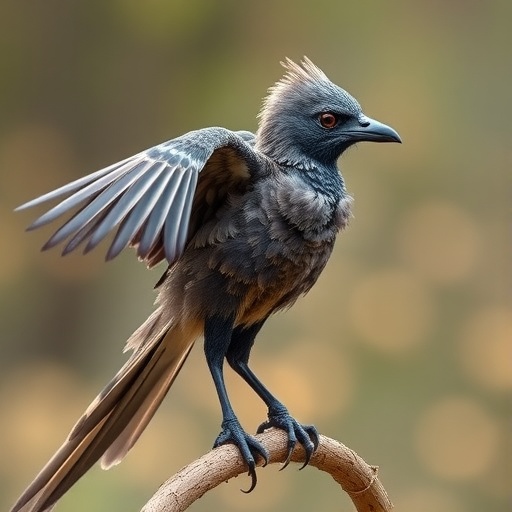
In a remarkable breakthrough that pushes the boundaries of our understanding of early avian evolution, scientists have unveiled a newly identified species of ancient bird—Plumadraco bankoorum—that boasts the longest and best-preserved rachis-dominated tail feathers (RDFs) ever documented. These feathers are unlike anything observed in modern birds, revealing a fascinating chapter of evolutionary biology dating back approximately 121 million years to the Early Cretaceous period. This discovery not only enriches our knowledge of feather morphology in extinct species but also sheds significant light on the role of ornamental feathers in sexual selection far earlier than previously known.
Plumadraco bankoorum, discovered in the fossil-rich beds of Liaoning Province, China, presents an intriguing specimen measuring merely 15 centimeters from beak to tail. Despite its diminutive overall size, the twin tail feathers extend nearly 30 centimeters each, a startling hyperelongation that would have dramatically altered the bird’s silhouette and appearance. These tail feathers are dominantly formed by a widened central shaft known as the rachis, a feature starkly different from the plume-like feathers visible in contemporary avifauna, indicating a unique evolutionary pathway in feather development.
The morphological structure of RDFs observed in Plumadraco is particularly notable for its unusually broad and stiff central rachis, which diminishes progressively along the length of each feather. This tapering allows for remarkable flexibility at the distal segments, particularly the terminal ‘rackets’—expanded tips of the feathers—which were likely capable of flickering or waving motions. Such dynamic movement could parallel modern avian display behaviors, as seen in species like birds-of-paradise and peacocks, where elongated feathers serve as visual signals to attract mates or assert dominance.
Notably, the aerodynamic utility of these feathers appears minimal; their form and size suggest that instead of aiding flight, these ornamental features functioned predominantly in social or reproductive signaling. This aligns with behaviors in extant bird species where sexually dimorphic plumage enhances visual appeal at the cost of flight efficiency. The evolutionary implication is clear: sexual selection pressures have long been instrumental in shaping avian morphology, influencing even the development of extravagant feather types during the Early Cretaceous.
Researchers propose that the specimen likely represents a male individual based on this extreme ornamental trait, consistent with sexual dimorphism patterns widely documented in extant birds. Typically, males display vivid and elaborate plumage for courtship displays, while females adopt more cryptic coloration to enhance camouflage during nesting. However, confirming this hypothesis for Plumadraco necessitates further evidence analyzing the musculature associated with tail feather movement and nesting behaviors preserved in fossil records.
Analytical methods applied in studying this fossil specimen involved detailed microscopic examination and comparative morphology with modern bird feathers. The preservation of soft tissues and feather structures in this fossil is exceptional, providing a rare window into the integumentary biology of enantiornithines—a group of prehistoric birds that thrived during the Mesozoic era and are considered important for understanding avian evolutionary history. Such preservation is invaluable for reconstructing feather anatomy, shedding light on the mechanical properties and functions of these ancient ornaments.
The presence of hyperelongated ornamental feathers in Plumadraco bankoorum pushes back the documented emergence of sexually selected ornamental traits in birds to at least 121 million years ago. This revelation suggests that complex reproductive behaviors reliant on visual cues were deeply rooted in early bird evolution and could have played a role in speciation and ecological interactions. It provides a robust framework for investigating how sexual selection has driven the diversification of feather types through deep time.
Intriguingly, the structural weakening or “enfeeblement” observed along the rachis of these feathers—manifested as a progressively narrowing central stalk—may have been an adaptive feature enabling flexible motion. Such mechanical properties would allow the feathers to flutter or flick in specific display behaviors, enhancing their visual impact. This finely tuned balance between structural integrity and flexibility exemplifies how evolutionary forces forge intricate adaptations for mating rituals.
The discovery of these extraordinary RDFs in an enantiornithine bird also enriches the broader dialogue concerning the evolution of feathers—from simple filaments to complex, functional structures serving diverse purposes including thermoregulation, flight, and signaling. Plumadraco’s feathers serve as a tangible link connecting primitive feather morphology with the complex ornamentation seen in many modern bird species.
Alexander D. Clark, one of the principal investigators, reflects on the wonder this specimen evokes. He emphasizes how such fossil finds highlight a complexity in ancient life forms that far exceeds previous assumptions. To imagine Plumadraco flying over a primordial landscape, its elongated tail feathers undulating through dawn light, brings a striking immediacy to the prehistoric world and invites new appreciation for the evolutionary processes shaping biodiversity over millions of years.
Future research promises to delve deeper into the biomechanical analyses of these feathers, as well as the ecological context in which Plumadraco lived. Understanding muscle attachment sites and the bird’s nesting habits will be essential to corroborate hypotheses about sexual selection and display function. Moreover, uncovering similar fossil specimens can help delineate whether such ornamental feathers were widespread or confined to select lineages, thus elucidating evolution’s broader patterns in avian ornamentation.
The discovery of Plumadraco bankoorum not only introduces a captivating new player into the story of feather evolution but also ensures that the field of paleornithology remains vibrant and dynamic. This work underscores the critical importance of exceptional fossil preservation and interdisciplinary research unlocking secrets preserved in the stony archives of Earth’s deep past.
Cite Scienmag News
Gavin Prescott. (May 27, 2026). Ancient Bird Flaunts Long Tail Feathers to Woo Mates, Study Reveals. Scienmag. https://scienmag.com/ancient-bird-flaunts-long-tail-feathers-to-woo-mates-study-reveals/
Gavin Prescott. "Ancient Bird Flaunts Long Tail Feathers to Woo Mates, Study Reveals." Scienmag, 27 May 2026, https://scienmag.com/ancient-bird-flaunts-long-tail-feathers-to-woo-mates-study-reveals/. Accessed 4 September 2026.
Gavin Prescott. "Ancient Bird Flaunts Long Tail Feathers to Woo Mates, Study Reveals." Scienmag. May 27, 2026. https://scienmag.com/ancient-bird-flaunts-long-tail-feathers-to-woo-mates-study-reveals/


