

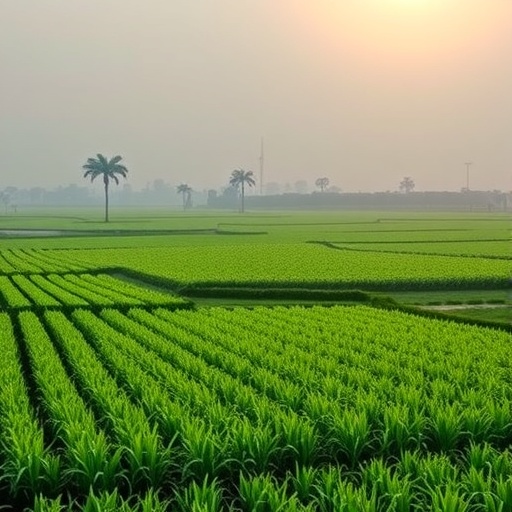
In a pioneering study led by researchers Dharavath and Goroshi, significant insights have emerged regarding vegetation resilience in Indian agriculture through the examination of the Normalized Difference Vegetation Index (NDVI) trends. The relationship between climate impacts and agricultural productivity is a complex interplay that is garnering increased attention against the backdrop of climate change. This research specifically investigates the NDVI, a widely recognized vegetation index that uses satellite data to provide critical information about plant health, distribution, and biomass density across the Indian landscape.
The findings suggest that changes in NDVI values over time offer a reliable indicator of how agroecosystems are responding to climatic variations. By decoding these trends, the researchers have not only illuminated areas of enhanced resilience but also highlighted regions vulnerable to climatic stressors, which is critical for policy-making and strategic agricultural planning. The work emphasizes that understanding NDVI trends is crucial for predicting food security and agricultural productivity, particularly in a nation like India, where agriculture is a vital economic sector.
Throughout their analysis, Dharavath and Goroshi meticulously examined temporal NDVI data correlating it to climate parameters such as temperature, precipitation, and prevailing weather patterns. They utilized a robust dataset derived from remote sensing technologies, which allowed for granular observations at the regional level. This methodological strength lends credibility to their assertions regarding the significant fluctuations observed in vegetation health corresponding with varying climatic conditions. The detailed assessment of NDVI trends over multiple cropping seasons showcases how microclimatic factors can have profound effects on macro-level agricultural outputs.
Moreover, the researchers delved deeply into the implications of these NDVI variations for different crop types, establishing a nuanced understanding of resilience among various agricultural practices in India. For instance, specific crops exhibited stronger resilience to climatic variability, prompting recommendations for farmers to consider these findings when planning their sowing strategies. By identifying crops that are more adaptable to shifting climatic conditions, the study also serves as a pragmatic approach to ameliorating potential adverse effects on food production.
It is essential to underscore the broader environmental implications highlighted in the research. The decline in NDVI values in certain regions signals not just agricultural challenges but also raises alarms regarding ecological stability. The interplay between agricultural practices and ecosystem health is critical, with NDVI acting as a barometer for the sustainability of agricultural landscapes. This interconnected understanding between agriculture and ecology provides a holistic framework for enhancing environmental stewardship practices in India.
In addition, the researchers advocate for the integration of NDVI trends into national agricultural policies to bolster climate resilience. By aligning agricultural practices with the insights generated from NDVI data, policymakers can make informed decisions aimed at mitigating the impacts of climate change on food production systems. The call for data-driven decisions resonates strongly with the ongoing global discourse on sustainable agriculture, urging farmers, scientists, and policymakers alike to collaborate on adaptive strategies.
Through their research, Dharavath and Goroshi have also addressed the potential ramifications of climate variability on rural livelihoods. As agriculture supports a substantial portion of the Indian population, understanding NDVI dynamics becomes imperative not just for economic factors but also for social stability. The researchers draw attention to the risk posed to rural communities who rely heavily on agriculture for their sustenance and income, underscoring the need for proactive measures to ensure agricultural viability amidst changing climates.
Furthermore, the study opens avenues for future research exploring the integration of advanced technologies such as artificial intelligence and machine learning algorithms in analyzing NDVI trends. Such technological advancements could refine predictive capabilities, enabling better planning and response mechanisms both at local and national levels. The amalgamation of technology with traditional agricultural practices might foster innovative approaches aimed at tackling the challenges posed by climate change.
As agriculture faces increasing pressures from climate change, the role of resilience becomes paramount. The insights from this research not only inform immediate agricultural practices but also contribute to broader discussions about climate adaptation strategies. By spotlighting the interconnections between climate, vegetation health, and agricultural output, the work of Dharavath and Goroshi signifies a crucial step towards promoting sustainable farming practices in India and beyond.
In conclusion, the intricate tapestry of climate, vegetation, and agriculture as knitted together by NDVI trends paints a stark picture of the challenges ahead. The collaborative efforts of scientists, farmers, and policymakers hold the key to navigating these challenges while ensuring food security and ecological balance. Thus, as this research continues to resonate within the scientific community, it paves the way for more impactful studies aimed at deciphering the relationship between our planet’s changing climate and the agricultural systems that sustain human life.
Through diligent investigation and analysis, the importance of NDVI as a tool for understanding vegetation resilience cannot be overstated. The findings shared by Dharavath and Goroshi provide a beacon of hope, emphasizing that with the right knowledge and adaptation strategies, there remains potential to harness the challenges posed by climate change into opportunities for sustainable agricultural growth.
By engaging with these critical findings, stakeholders across the agricultural spectrum can work collectively towards a future where Indian agriculture not only endures but flourishes amidst climatic unpredictability.
Subject of Research: NDVI trends and climate impacts on Indian agriculture
Article Title: Decoding vegetation resilience: NDVI trends and climate impacts in Indian agriculture
Article References:
Dharavath, N., Goroshi, S. Decoding vegetation resilience: NDVI trends and climate impacts in Indian agriculture.
Environ Monit Assess 198, 37 (2026). https://doi.org/10.1007/s10661-025-14794-w
Image Credits: AI Generated
DOI: https://doi.org/10.1007/s10661-025-14794-w
Keywords: NDVI, vegetation resilience, climate change, agriculture, India, food security, sustainability


