

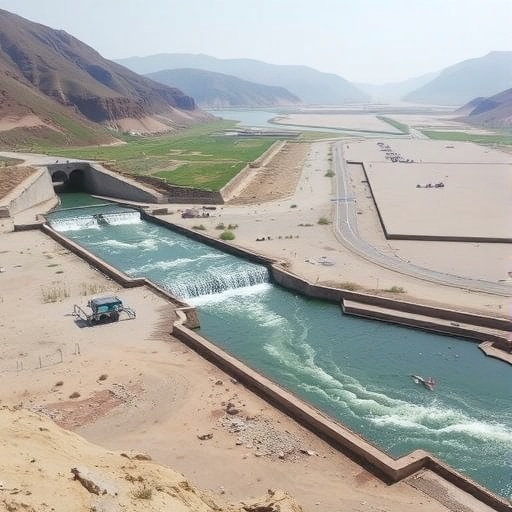
In recent years, the importance of understanding hydrological cycles has surged, fueled by increasing concerns over water scarcity and drought conditions worldwide. A team of researchers led by Behroozi, Fattahi, and Sayadi embarked on an in-depth analysis of the factors influencing river discharge as it pertains to hydrological droughts, focusing on the Atrak River in a study titled “Deciphering hydrological drought controls on Atrak River discharge predictability: a multiscale dynamic assessment.” Their groundbreaking work initiates a multi-faceted examination using dynamic modeling approaches to provide insight into the complex interactions shaping river flow variability in times of drought.
The study importantly highlights the profound implications of climate change on hydrological patterns, with the Atrak River serving as a critical case study area. The fluctuations in discharge within this river system are symptomatic of wider global trends that affect numerous ecosystems, agriculture, and human livelihoods. Therefore, understanding the intricate controls over river discharge not only benefits local management strategies but also contributes to global models that estimate water availability under different climatic scenarios.
To unravel the enigma surrounding the Atrak River’s discharge predictability, the researchers employed a multiscale dynamic assessment framework that integrates meteorological data with hydrological models. This methodological approach allows them to dissect the various temporal and spatial scales that dictate river behavior, thereby revealing essential control mechanisms that can influence discharge variability. Such a comprehensive analytic strategy provides a robust platform for predicting future hydrological trends in the context of anticipated climate variability.
Significantly, the research draws attention to the concept of hydrological drought, defined as an extended period of below-average water availability in a river system. This phenomenon is crucial for assessing the predictability of river discharge, as it can lead to severe consequences for water supply, agriculture, and ecosystems. By delving into how hydrological drought manifests within the Atrak River basin, the researchers set the foundation for devising effective strategies to mitigate the adverse effects of such events.
Key among the findings is the observation that rainfall patterns and temperature anomalies are significant indicators of river discharge unpredictability. The researchers utilized historical data across various climatological stations to examine these interdependencies and noted how shifts in precipitation intensity can exacerbate or alleviate hydrological drought conditions. This careful examination emphasizes the necessity for integrating climate data into water resource management systems to enhance resilience against drought impacts.
Another critical consideration outlined in the study is the role of land use and watershed management practices in shaping river discharge outcomes. The researchers meticulously analyzed how agricultural practices, urban development, and deforestation can alter natural water flow and absorption patterns within the Atrak River basin. Such anthropogenic factors not only contribute to adverse hydrological changes but also challenge existing water resource management frameworks, necessitating a shift toward more sustainable practices.
Moreover, the research underscores the importance of localized studies in the context of global climate models. While general climate models provide insights into anticipated trends, localized studies such as the one conducted on the Atrak River offer granular data that can refine predictions and assist regional planners. By focusing on specific hydrological responses to climate variability, the research aids in tailoring adaptive management strategies that resonate with local conditions and societal needs.
In synthesizing their findings, the researchers advocate for a collaborative approach between scientists, policymakers, and local communities. Engaging stakeholders in the discussion around water resource management is indispensable for ensuring that strategies can be effectively implemented and adhered to. Furthermore, fostering public awareness around hydrological issues enhances community resilience and promotes sustainable water use practices essential for mitigating the impacts of future hydrological droughts.
The implications of this research extend beyond the immediate context of the Atrak River, serving as a vital case for similar river systems experiencing the harrowing effects of climate change and anthropogenic influences. The multi-scale dynamic assessment technique showcased by Behroozi and his team provides a methodological blueprint that can be replicated in other regions facing similar hydrological challenges. Additionally, the findings serve as a stark reminder of the intricate interdependencies that constitute our water systems and the global implications of local river management.
As climate change continues to develop, this research provides a critical lens through which to interpret shifting hydrological landscapes globally. Developing water management strategies that adequately respond to climate-induced changes will be crucial in the years to come. The authors advocate for immediate action rooted in scientific research to foster adaptive strategies that ensure long-term water security not just for the Atrak River but for communities worldwide threatened by the looming specter of hydrological drought.
Conclusively, the research led by Behroozi, Fattahi, and Sayadi sheds new light on understanding river discharge predictability amidst hydrological droughts. Their rigorous methodologies and findings mark a significant contribution to the field of environmental science, aiming to enhance our preparedness and resilience against the increasingly unpredictable nature of our water resources. The integration of scientific understanding with effective management practices stands as a pivotal step towards ensuring sustainable water use in a rapidly changing climate.
Subject of Research: Hydrological drought controls and river discharge predictability
Article Title: Deciphering hydrological drought controls on Atrak River discharge predictability: a multiscale dynamic assessment
Article References:
Behroozi, M., Fattahi, M.H. & Sayadi, A. Deciphering hydrological drought controls on atrak river discharge predictability: a multiscale dynamic assessment. Environ Sci Pollut Res (2026). https://doi.org/10.1007/s11356-025-37387-z
Image Credits: AI Generated
DOI: https://doi.org/10.1007/s11356-025-37387-z
Keywords: Hydrological drought, Atrak River, river discharge, climate change, water resource management, sustainable practices, climate variability, predictive modeling, watershed management.


