

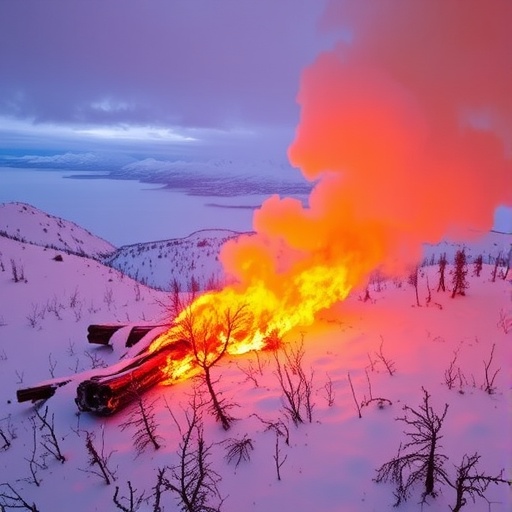
The Arctic–boreal region, a vast expanse characterized by its frigid landscapes and extensive permafrost layers, is undergoing profound transformation. Recent research illuminates a disturbing and complex dynamic whereby the thawing of permafrost is not only reshaping the region’s physical environment but also intensifying wildfire regimes in unprecedented ways. This emerging feedback loop threatens to accelerate ecological disruption, carbon release, and climate warming, raising alarm about the stability of these crucial northern ecosystems.
Permafrost, which underpins much of the Arctic–boreal zone, refers to soil and sediment that remains frozen for at least two consecutive years. Its thawing leads to a thickening of the active layer—the uppermost soil stratum that freezes and thaws seasonally. As global temperatures rise, this active layer has been observed to deepen significantly over the past two decades, inducing cascading consequences for several biophysical processes, including heat and water transfer within the soil, vegetation dynamics, and atmospheric interactions.
A comprehensive study led by Li and colleagues integrates 21 years of soil active layer thickness data (1997 to 2018) across the Arctic–boreal region with sophisticated causal inference models and a space-for-time substitution method. This multidisciplinary approach enables researchers to unravel the complex chains of cause and effect linking permafrost thaw to changes in wildfire behavior, thereby advancing our understanding of how these processes coevolve under a warming climate.
What emerges from this analysis is a powerful narrative of feedback amplification. Thaw-induced changes in surface conditions reduce the albedo—the reflectivity of the Earth’s surface—leading to greater solar absorption and warmer soil temperatures during summer months. Simultaneously, reductions in soil moisture due to enhanced evaporation and drainage amplify atmospheric dryness, creating ideal conditions for fire ignition and spread. These thermal and hydrological shifts thus set the stage for more frequent, larger, and more severe wildfires across this boreal expanse.
The thickened active layer also promotes increased vegetation growth, paradoxically providing enhanced fuel loads for wildfires. This increased biomass coupled with drying soil organic matter results in an ecosystem more prone to combustion and fire propagation. These fires, in turn, release vast quantities of carbon stored in both live vegetation and frozen soils, contributing significantly to greenhouse gas emissions and further accelerating global warming—a quintessential example of a positive feedback loop.
Intriguingly, the study notes that these changes are not isolated but interconnected in a compound feedback system wherein permafrost thaw, fire regimes, and climate trends reinforce each other with growing intensity. This interaction amplifies fire risk beyond what would be expected from climate warming alone, signaling a paradigm shift in how boreal environments respond to anthropogenic and natural pressures.
From a climatological perspective, these findings underscore a critical challenge: the permafrost–fire feedback could erode the carbon sink functions traditionally attributed to boreal forests, transforming them into substantial carbon sources. This shift threatens to undermine international climate mitigation efforts and complicates projections of future global temperature trajectories.
The hydrological effects are equally troubling. As fires consume protective organic layers and litter, changes in soil structure can alter water retention and runoff patterns, potentially disrupting local and regional water cycles. These disruptions can exacerbate drought conditions, increase fire susceptibility, and degrade habitat quality for endemic species, further destabilizing the Arctic–boreal biome.
Ecologically, the consequences of intensified wildfire activity driven by permafrost thaw extend beyond carbon dynamics. The altered fire regimes may accelerate the loss of biodiversity by transforming forest composition, opening new niches for invasive species, or triggering shifts toward shrubland or grassland dominance in some areas. Such changes could significantly impact traditional subsistence activities and indigenous livelihoods that depend on these ecosystems.
Moreover, smoke emissions from increasingly frequent and intense fires pose health risks locally and even globally as particulates and aerosols influence atmospheric chemistry and can travel vast distances. These fires also release black carbon, which, when deposited on snow and ice, accelerates melting by reducing surface albedo, further exacerbating warming in a dangerous feedback cascade.
These findings emerge at a critical juncture when efforts to limit global warming to safe thresholds are underway. The study’s authors stress the urgency of immediate and ambitious climate action to curtail greenhouse gas emissions and slow the rate of permafrost degradation. Without intervention, the intertwined processes of thaw and fire could spiral into scenarios that profoundly alter Arctic–boreal landscapes, carbon cycling, and global climate regulation.
The research utilizes robust datasets and cutting-edge modeling techniques that strengthen confidence in the observed patterns and projections. By employing causal inference analysis alongside a space-for-time substitution framework, the study rigorously disentangles the complex interactions between soil thermal dynamics, vegetation response, atmospheric conditions, and fire activity, overcoming challenges posed by the long temporal scales and vast spatial heterogeneity of the Arctic–boreal region.
Crucially, this work calls attention to the need for enhanced monitoring and integrated management strategies that consider the expanding role of permafrost-related feedbacks in wildfire risk predictions. It also highlights the importance of preserving intact permafrost and minimizing disturbances that could exacerbate soil warming and drying trends.
As the Arctic–boreal region continues to warm at approximately twice the global average rate, the repercussions of these amplified fire regimes will likely intensify and become more widespread. Understanding and mitigating these feedbacks represent a formidable scientific and policy challenge but one that is vital to preserving the integrity of some of Earth’s most climate-sensitive and ecologically valuable landscapes.
By revealing the mechanistic links and consequences of permafrost thaw-induced fire amplification, this research marks a significant advance in global change science. It not only deepens our understanding of these critical feedback loops but also underscores the gravity of permafrost thaw as a catalyst for ecosystem-level transformations with profound global ramifications.
In summary, the thawing of Arctic–boreal permafrost triggers a cascade of biophysical and ecological changes that intensify wildfire regimes, disrupt carbon cycling, and exacerbate climate warming. These findings charge the scientific community and policymakers with the urgent task of addressing these evolving risks through concerted mitigation efforts to safeguard the future of northern ecosystems and the climate system at large.
Subject of Research: Amplification of Arctic–boreal fire regimes driven by permafrost thaw and associated biophysical and ecological feedbacks.
Article Title: Amplified Arctic–boreal fire regimes from permafrost thaw feedbacks.
Article References:
Li, J., Lai, G., Meng, L. et al. Amplified Arctic–boreal fire regimes from permafrost thaw feedbacks. Nat. Geosci. (2026). https://doi.org/10.1038/s41561-025-01894-y
DOI: https://doi.org/10.1038/s41561-025-01894-y


