

Sunday, August 16, 2026
Science
No Result
View All Result
  • Login
  • HOME
  • SCIENCE NEWS
  • CONTACT US
  • HOME
  • SCIENCE NEWS
  • CONTACT US
No Result
View All Result
Scienmag
No Result
View All Result
Home Science News Technology and Engineering

Algorithms Generate Foundry-Ready Photonic Circuits Beyond Human Intuition

July 28, 2026
in Technology and Engineering
Reading Time: 2 mins read
0
Algorithms Generate Foundry-Ready Photonic Circuits Beyond Human Intuition

Algorithms Generate Foundry-Ready Photonic Circuits Beyond Human Intuition

65
SHARES
587
VIEWS
Share on FacebookShare on Twitter
ADVERTISEMENT

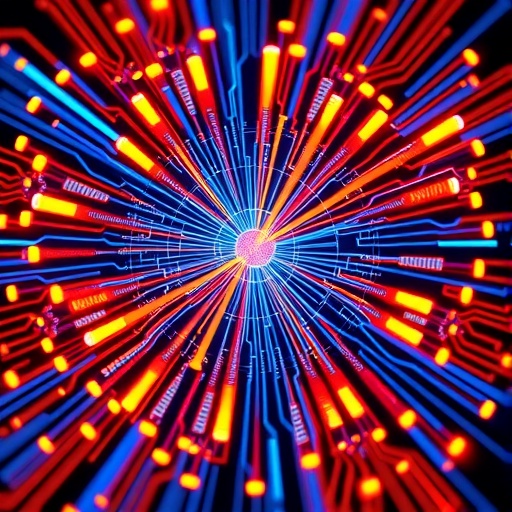
Photonic microchips promise dramatically faster information processing by steering and manipulating light on chip-scale platforms. Unlike conventional electronic routing, these devices guide light through micrometer-wide waveguides laid out over only a few millimeters, enabling applications that span telecommunications, precision sensing, large-scale AI data centers, and quantum technologies.

A major bottleneck in integrated photonics has been design time. Engineers typically “handcraft” component geometries—tuning parameters until grating couplers, ring resonators, and other building blocks achieve the desired performance. This iterative process can be slow, especially when the goal is simultaneously high efficiency and extreme miniaturization.

Researchers from the Max Planck Institute for the Science of Light (MPL) and Harvard University report a different strategy: inverse design. Instead of starting from a familiar blueprint, the team specifies the optical function—such as how light should be split by wavelength, separated by spatial mode, or reflected—and then uses a computer algorithm to search for nanostructures that satisfy those requirements.

The resulting layouts often resemble irregular patterns of holes and ridges, yet they can control light with high precision. Working on thick silicon nitride—a platform valued for low optical loss and compatibility with multi-color photonics—the approach yields three functional component classes that can occupy areas up to 500 times smaller than conventional designs.

To make the method fabrication-ready, the optimization explicitly accounts for manufacturing constraints such as minimum feature sizes and robustness to realistic variations. This bridges the gap between computational idealizations and what can be built in a commercial foundry process.

The team designed and tested inverse-designed wavelength splitters, spatial mode sorters, and compact mirrors that underpin on-chip optical cavities. One example mirror reflects as much as 98.5% of incoming light while rejecting other spatial modes, allowing light to bounce more than a hundred times within a cavity formed by paired mirrors.

Looking ahead, the researchers plan to integrate these compact components with nonlinear photonic circuits. High circulating intensities could then generate optical frequency combs—precise sets of evenly spaced wavelengths—supporting improved telecommunications, metrology, and emerging quantum technologies.

In short, the work demonstrates a unified inverse-design framework for multiple optical “jobs” on the same silicon nitride chip, pushing integrated photonics toward denser, faster, and more scalable architectures.


Subject of Research: Not applicable
Article Title: Inverse-designed silicon nitride nanophotonics
News Publication Date: 28-May-2026
Web References: http://dx.doi.org/10.1038/s41467-026-73390-9
References: Nature Communications; DOI: 10.1038/s41467-026-73390-9
Image Credits: MPL, Toby Bi

Keywords

inverse design, silicon nitride, nanophotonics, integrated photonics, wavelength splitters, mode sorters, optical cavities, photonic microchips, frequency combs, on-chip mirrors

Tags: AI-driven photonic device designapplications of photonic microchips in telecommunications and AIcomputer-aided photonic component layouthigh-efficiency photonic componentsinverse design in integrated photonicsnanostructure optimization for light manipulationphotonic circuit miniaturizationphotonic device fabrication automationphotonic microchip designquantum photonic circuit developmentsilicon nitride photonics platformswaveguide routing and light control
Share26Tweet16
Previous Post

Xi’an Jiaotong Achieves Low-Cost Roll-to-Roll 3D Nanobowl Light-Trapping Films

Next Post

Review Finds Stable Circular RNAs as Noninvasive Biomarkers for Cancer Detection

Related Posts

KAIST develops semiconductor neuron that harnesses noise to selectively process signals
Technology and Engineering

KAIST develops semiconductor neuron that harnesses noise to selectively process signals

August 16, 2026
Imagining natural and extra robotic thumbs together strengthens kinesthetic sensorimotor networks
Technology and Engineering

Imagining natural and extra robotic thumbs together strengthens kinesthetic sensorimotor networks

August 15, 2026
Epoxy-Engineered PZT Nanocomposite Sensor Array Enables Noise-Resistant Health and Swallowing Monitoring
Technology and Engineering

Epoxy-Engineered PZT Nanocomposite Sensor Array Enables Noise-Resistant Health and Swallowing Monitoring

August 15, 2026
Scientists Increasingly Rely on Black-Box Tools They Neither Control Nor Understand
Technology and Engineering

Scientists Increasingly Rely on Black-Box Tools They Neither Control Nor Understand

August 15, 2026
NIH Pediatric Research Funding Trends and Structural Patterns, 2015–2024
Technology and Engineering

NIH Pediatric Research Funding Trends and Structural Patterns, 2015–2024

August 15, 2026
Anxiety and Mood Disorders Across Lifespan in Very Preterm and Term-Born Individuals
Technology and Engineering

Anxiety and Mood Disorders Across Lifespan in Very Preterm and Term-Born Individuals

August 15, 2026
Next Post
Review Finds Stable Circular RNAs as Noninvasive Biomarkers for Cancer Detection

Review Finds Stable Circular RNAs as Noninvasive Biomarkers for Cancer Detection

  • Mothers who receive childcare support from maternal grandparents show more

    Mothers who receive childcare support from maternal grandparents show more parental warmth, finds NTU Singapore study

    27656 shares
    Share 11059 Tweet 6912
  • University of Seville Breaks 120-Year-Old Mystery, Revises a Key Einstein Concept

    1061 shares
    Share 424 Tweet 265
  • Bee body mass, pathogens and local climate influence heat tolerance

    682 shares
    Share 273 Tweet 171
  • Researchers record first-ever images and data of a shark experiencing a boat strike

    546 shares
    Share 218 Tweet 137
  • Groundbreaking Clinical Trial Reveals Lubiprostone Enhances Kidney Function

    531 shares
    Share 212 Tweet 133
Science

Embark on a thrilling journey of discovery with Scienmag.com—your ultimate source for cutting-edge breakthroughs. Immerse yourself in a world where curiosity knows no limits and tomorrow’s possibilities become today’s reality!

RECENT NEWS

  • Tropical Forest Biomass Responds to Diverse Climate Controls
  • Survey-Based Model Reveals How Preparedness Constraints Shape Cholera Transmission in Sudan
  • Waste-Based Retrofits Improve Thermal Performance in North Sinai Social Housing
  • KAIST develops semiconductor neuron that harnesses noise to selectively process signals

Categories

  • Agriculture
  • Anthropology
  • Archaeology
  • Athmospheric
  • Biology
  • Biotechnology
  • Blog
  • Bussines
  • Cancer
  • Chemistry
  • Climate
  • Earth Science
  • Editorial Policy
  • Marine
  • Mathematics
  • Medicine
  • Pediatry
  • Policy
  • Psychology & Psychiatry
  • Science Education
  • Social Science
  • Space
  • Technology and Engineering

Subscribe to Blog via Email

Success! An email was just sent to confirm your subscription. Please find the email now and click 'Confirm Follow' to start subscribing.

Join 5,149 other subscribers

© 2025 Scienmag - Science Magazine

Welcome Back!

Login to your account below

Forgotten Password?

Retrieve your password

Please enter your username or email address to reset your password.

Log In
No Result
View All Result
  • HOME
  • SCIENCE NEWS
  • CONTACT US

© 2025 Scienmag - Science Magazine
