


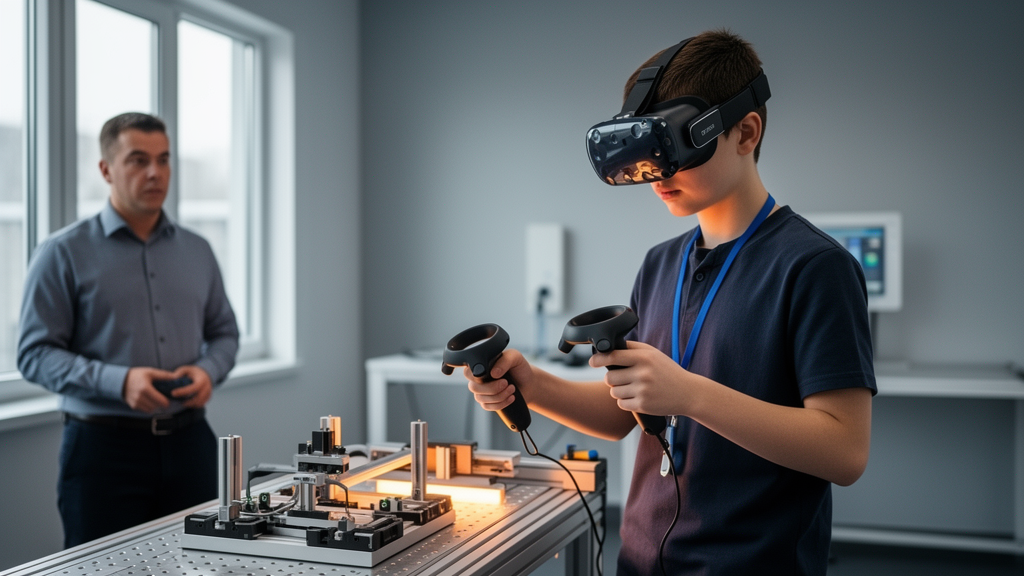
When it comes to mastering complex operational skills, the training world has long assumed that highly motivated learners are best left to chart their own course. A new study challenges that assumption with striking evidence: an adaptive-difficulty algorithm, quietly adjusting the challenge of a virtual reality task in real time, outperformed self-directed training even among elite, highly driven trainees. The findings, published in Frontiers in Virtual Reality, carry implications that stretch from commercial pilot training to the first human mission to Mars.
The research, conducted by teams at the University of Colorado Boulder, the United States Air Force Academy, and Embry-Riddle Aeronautical University, enrolled 45 cadets with specialized aviation education and randomly assigned them to one of three training conditions. All participants trained in immersive virtual reality using an Oculus Quest 2 headset to perform a simulated Mars entry, descent, and landing (EDL) task, a mission-relevant operational skill that demands the integration of multiple subtasks under time pressure. The cadets completed 30 consecutive training trials, followed by 5 evaluation trials at a difficulty level none of them had experienced before.
The EDL task itself was deliberately complex. Each trial required three consecutive subtasks: landing site selection, where trainees assessed a topographic map under an 8-second time constraint to pick a site that balanced proximity to scientific points of interest against avoidance of steep, hazardous terrain; manual control piloting, where they executed roll and pitch maneuvers with a joystick to align their vehicle’s flight path with a guidance cue while actively nulling against wind disturbances; and terminal descent, where they used a hand thruster with limited fuel to minimize vertical speed at the moment of touchdown. Each subtask had 24 possible difficulty levels, and a crash in any single subtask scored the entire trial as a failure.
The three training groups experienced fundamentally different facilitation styles. The algorithm-facilitated group trained under a 2-up, 1-down (2U1D) adaptive algorithm that modulated each subtask’s difficulty independently based on performance: two consecutive “Excellent” ratings stepped the difficulty up by one level, a single “Poor” rating stepped it down, and an “Adequate” rating held it steady. The self-led group, by contrast, saw their performance feedback after each trial and then used a slider to select their own difficulty level for the next trial, applied uniformly across all three subtasks. The static control group trained at a fixed difficulty level of 12 out of 24 for all 30 trials, regardless of performance.
The results upended the researchers’ first hypothesis. Participants in the self-led condition voluntarily trained at significantly higher average difficulty levels than the algorithm group, averaging 16.3 on the difficulty scale compared to 11.3 for the algorithm-facilitated trainees, a difference that was highly statistically significant (p = 0.0006). Yet this greater challenge did not translate into greater mastery. The self-led group experienced significantly more crashes during training than the algorithm group, a relationship driven primarily by the manual control piloting subtask, where the difficulty of wind disturbances proved particularly unforgiving when trainees pushed themselves beyond their stable performance envelope.
During the evaluation phase, when all groups faced a static difficulty level of 18, a level deliberately skipped during both algorithm-facilitated and self-led training, the algorithm group demonstrated the highest integrated task skill. Their five-trial average performance was significantly better than the static group’s (p = 0.004) and approached significance compared to the self-led group (p = 0.097). The static group fared worst by a wide margin: 69 percent of static-trained subjects experienced at least one crash trial out of the five evaluation attempts, and one static subject crashed in four out of five trials, a behavior not seen in any other training condition. The crash rate difference across groups during evaluation was statistically significant (p = 0.033).
The subjective measures reinforced the performance data. On the modified Reduced Instructional Materials Motivation Survey (RIMMS), the algorithm group tended to report the highest motivation across all four sub-metrics of attention, relevance, confidence, and satisfaction, though only the confidence sub-metric reached statistical significance (p = 0.048). The self-led group reported the lowest average confidence, suggesting that when learners are left to facilitate their own training without guidance, they may push themselves into difficulty ranges that undermine their belief in their own abilities rather than building it.
Flow, the psychological state of deep engagement described by Csikszentmihalyi, told a similar story over time. Using the Flow Short Scale at three timepoints during training, the researchers found that algorithm-trained and static-trained subjects showed positive trends in flow, while self-led subjects showed declining trends. By the final training timepoint, the self-led group’s flow was significantly lower than the algorithm group’s (adjusted p = 0.02). Notably, the researchers ruled out motivational tendency differences as an explanation: no significant differences existed between groups in responses to questions about whether they prioritized feeling challenged versus scoring highly, meaning the self-led group’s choices were not driven by a different motivational profile.
The study’s authors connect these findings to a broader training landscape. Prior work on CPR instruction has shown that instructor facilitation improves skill acquisition, even when self-instruction produces equivalent retention. Intelligent tutoring systems research has demonstrated that facilitated learning narrows the gap with human tutors, though these systems have typically been applied to classroom settings rather than complex operational simulations. The current study makes a novel contribution by providing and evaluating an automated tool for effective facilitation without a human operator for complex, operationally relevant tasks, using difficulty level as the mechanism to focus a learner’s development onto the subtask where skill growth is most needed.
The implications for training design in high-consequence industries are substantial. As aviation and spaceflight sectors grow, the demand for larger training cohorts will require either massive investment in instructor personnel or a fundamental shift toward automated facilitation. During long-duration exploration missions, such as a transit to Mars, communication delays of up to 40 minutes round trip will prohibit real-time training facilitation from mission control, making in-flight automated training a critical capability for mitigating expected skill decay. The study’s evidence that algorithmic facilitation outperforms self-regulated learning, even among highly motivated individuals, suggests that structured adaptability, ensuring difficulty aligns with an individual’s actual learning trajectory rather than their perceived challenge threshold, should be a priority for future training systems. The researchers caution that their findings may generalize best to highly screened, competitively placed cohorts with strong intrinsic and extrinsic motivation, and that long-term retention, skill durability, and transfer to novel tasks remain unexplored. Future work will investigate richer feedback mechanisms, potentially powered by more complex learning algorithms that can recognize and respond to specific behavioral weaknesses, such as the overly cautious terminal descent behavior observed in some subjects who repeatedly ran out of fuel before touchdown.
Subject of Research: Algorithmic facilitation versus self-led learning in complex skill development for operational training
Article Title: Investigation of algorithmic facilitation vs. self-led learning in complex skill development for operational training
Article References: Putman, E., Haynie, K., Harvey, J., Tossell, C. C., Clark, T. K., & Hayman, A. P. A. (2026). Investigation of algorithmic facilitation vs. self-led learning in complex skill development for operational training. Frontiers in Virtual Reality, 7, Article 1892103. https://doi.org/10.3389/frvir.2026.1892103
Image Credits: AI Generated
DOI: 10.3389/frvir.2026.1892103
Keywords: adaptive difficulty, virtual reality training, dynamic difficulty adjustment, self-regulated learning, flow, motivation, entry descent and landing, Mars landing, operational training, intelligent tutoring systems, skill acquisition, aviation training
Cite Scienmag News
Courtney Benton. (October 16, 2026). Algorithm-Led VR Training Beats Self-Directed Practice for Mastering Complex Skills. Scienmag. https://scienmag.com/algorithm-led-vr-training-beats-self-directed-practice-for-mastering-complex-skills/
Courtney Benton. "Algorithm-Led VR Training Beats Self-Directed Practice for Mastering Complex Skills." Scienmag, 16 October 2026, https://scienmag.com/algorithm-led-vr-training-beats-self-directed-practice-for-mastering-complex-skills/. Accessed 16 October 2026.
Courtney Benton. "Algorithm-Led VR Training Beats Self-Directed Practice for Mastering Complex Skills." Scienmag. October 16, 2026. https://scienmag.com/algorithm-led-vr-training-beats-self-directed-practice-for-mastering-complex-skills/


