


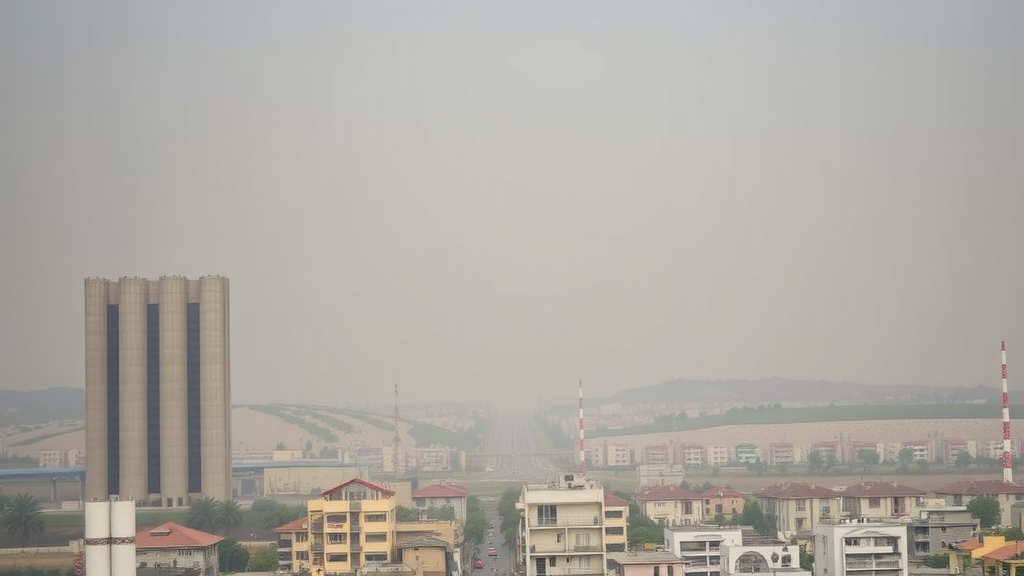
A decade of daily air quality and mortality records from one of Iran’s most heavily industrialized cities has delivered one of the clearest pictures yet of what chronic, multi-pollutant exposure is doing to human health in the Middle East. Researchers at Arak University of Medical Sciences analyzed ten years of data, from January 2015 to November 2025, for the city of Arak, a major center of petrochemical, metal, and manufacturing industries in central Iran. Their conclusion, published in the journal Air Quality, Atmosphere & Health, is stark: an estimated 527 excess deaths occur in the city every year, roughly five percent of all mortality, that can be attributed to the ambient air its residents breathe. The study is among the most comprehensive multi-pollutant time-series analyses ever conducted for an industrial urban setting in the region, and it carries implications that extend far beyond one city.
The research team, led by Behrooz Karimi with colleagues Mohsen Farzin and Seyed Hamed Mirhoseini, assembled an unusually complete environmental record. Daily concentrations were tracked for seven major pollutants simultaneously: fine particulate matter known as PM2.5, coarse particulate matter or PM10, sulfur dioxide, nitrogen dioxide, nitric oxide, ground-level ozone, and carbon monoxide. These were matched against daily counts of deaths from all causes, from cardiovascular diseases, and from respiratory diseases across the city. Arak makes an ideal natural laboratory for this kind of work because its air carries a signature blend of industrial emissions, traffic exhaust, and residential fuel combustion, producing chronically elevated pollutant levels that rarely fall to levels considered safe by international standards.
Methodologically, the study relied on generalized linear models with a negative binomial distribution, a statistical framework well suited to count data such as daily death totals, which are overdispersed relative to a simple Poisson process. The models were adjusted for meteorological variables including temperature and humidity, for long-term seasonal trends, and for temporal confounders such as day of the week. Crucially, the team ran the analysis twice: once in a single-pollutant framework, where each pollutant’s association with mortality is estimated in isolation, and once in a multi-pollutant framework, where all pollutants compete for explanatory power. This dual approach matters because pollutants in real urban air are correlated with one another, sharing the same emission sources and atmospheric conditions, and single-pollutant estimates can therefore conflate the effects of a toxicant with those of the mixture it travels in.
The headline findings center on two pollutants. In the single-pollutant models, an increase in PM2.5 concentration equal to the interquartile range of its daily distribution was associated with a relative risk of 1.112 for total mortality, with a 95 percent confidence interval of 1.082 to 1.142. Sulfur dioxide performed almost identically, with a relative risk of 1.102 per interquartile range increase and a confidence interval of 1.074 to 1.131. In practical terms, a modest, routinely observed rise in either pollutant was followed within days by a measurable increase in the city’s death toll. The largest effects appeared for respiratory mortality, confirming that the lungs are the frontline of harm, although cardiovascular deaths also rose significantly with exposure.
Timing emerged as a consistent theme. The strongest mortality associations were concentrated in a lag window of zero to three days, meaning deaths rose not weeks after a pollution episode but almost immediately. This pattern is characteristic of short-term, acute effects: fine particles and acidic gases triggering arrhythmias, heart attacks, strokes, and exacerbations of asthma and chronic obstructive pulmonary disease in vulnerable people, particularly the elderly and those with pre-existing disease. Distributed lag modeling allowed the researchers to spread the effect across the days following exposure and identify precisely where the risk signal was strongest, an important refinement over simpler same-day analyses that can miss or misattribute delayed effects.
The multi-pollutant models told a subtler and arguably more policy-relevant story. When all pollutants were entered together, the associations for PM2.5 and sulfur dioxide remained statistically robust, with relative risks of 1.086 and 1.092 respectively, indicating that each exerts an independent toxic effect on mortality. Nitrogen dioxide, by contrast, saw its association attenuate substantially once co-pollutants were accounted for. The authors interpret this as evidence that nitrogen dioxide in Arak functions primarily as a marker of the traffic-related pollution mixture rather than as an independent killer. This distinction is consequential for regulators: it suggests that controlling the particulate and sulfur-containing components of the city’s air, largely tied to industrial and combustion sources, should take priority over interventions focused narrowly on the traffic-derived nitrogen oxide marker.
Seasonal stratification added another layer of insight. The mortality risk associated with PM2.5 was stronger during the summer months, a counterintuitive finding given that particulate levels in many Iranian cities peak in winter, when temperature inversions trap pollutants near the ground and residential heating burns more fuel. The researchers propose that enhanced photochemical activity in summer transforms and reactivates particle-bound components, generating secondary pollutants and more chemically aggressive aerosols. Sunlight-driven atmospheric chemistry can oxidize sulfur and nitrogen compounds into sulfates and nitrates, alter the oxidative potential of particles, and interact with elevated ozone, all of which may amplify the biological toxicity of a given mass concentration of particulate matter. For health impact assessments, this implies that mass-based metrics alone may understate summer risk.
Translating the statistical associations into a burden estimate, the team calculated that 527 deaths per year in Arak, or 5.0 percent of total mortality, are attributable to ambient air pollution exposure. Respiratory mortality showed the highest vulnerability, a pattern consistent with the toxicology of inhaled particles and sulfur gases, which deposit in the airways and provoke inflammation, oxidative stress, and impaired host defense. The biological plausibility is well supported by the broader literature: fine particles have been shown to cause endothelial injury and systemic inflammation, and sulfur dioxide exposure has repeatedly been linked to cardiovascular hospitalizations in European multi-city studies. What the Arak study adds is a quantified, locally grounded estimate for a rapidly industrializing Middle Eastern city, a category of urban environment that global burden-of-disease calculations have historically struggled to represent.
The findings also fit into a widening body of evidence on air pollution in Iran. Previous systematic reviews and meta-analyses had already established associations between air pollution and cardiovascular and respiratory mortality and hospitalizations across Iranian cities, and land-use regression modeling in Arak itself had documented pronounced spatial variation in particulate concentrations tied to industrial activity. Earlier work in Isfahan had quantified the health and economic costs of fine particulate matter there. Yet the new study is notable for its duration, its breadth of pollutants, and its explicit comparison of single- and multi-pollutant frameworks, which together allow the authors to make a prioritization argument that single-pollutant studies cannot: emission control strategies should target particulate matter and sulfur-containing pollutants first, because these are the components whose independent toxicity survives rigorous statistical scrutiny.
For a city of Arak’s size, 527 excess deaths a year is not an abstraction. It is a continuous, largely invisible toll, equivalent to a preventable public health emergency unfolding one day at a time, with risk peaking within seventy-two hours of each pollution episode. The study’s authors frame the burden as substantial and, critically, preventable, pointing to emission control as the decisive lever. In low- and middle-income countries, where industrial growth often outpaces environmental regulation, the Arak experience offers both a warning and a template. Ten years of routine monitoring data, rigorously analyzed, can identify which pollutants kill, on what timescale, and in which seasons, giving policymakers the evidence needed to justify interventions, from industrial scrubbers and fuel sulfur limits to traffic management, that could remove a five percent surcharge from the city’s annual death count. Whether that happens, the authors suggest, is now less a scientific question than a political one.
Subject of Research: Short-term effects of ambient air pollution on cause-specific mortality in an Iranian industrial city over ten years
Article Title: Mortality burden of air pollution in an Iranian industrial city: a 10-year multi-pollutant time-series study
Article References: Karimi, B., Farzin, M., & Mirhoseini, S. H. (2026). Mortality burden of air pollution in an Iranian industrial city: a 10-year multi-pollutant time-series study. Air Quality, Atmosphere & Health, 19(9), Article 207. https://doi.org/10.1007/s11869-026-02098-y
Image Credits: AI Generated
DOI: 10.1007/s11869-026-02098-y
Keywords: air pollution, PM2.5, sulfur dioxide, mortality, time-series analysis, Iran, industrial city, cardiovascular mortality, respiratory mortality, multi-pollutant models, public health, attributable risk
Cite Scienmag News
Russell Cooper. (September 21, 2026). Air Pollution Linked to More Than 500 Preventable Deaths Each Year in Iranian Industrial City. Scienmag. https://scienmag.com/air-pollution-linked-to-more-than-500-preventable-deaths-each-year-in-iranian-industrial-city/
Russell Cooper. "Air Pollution Linked to More Than 500 Preventable Deaths Each Year in Iranian Industrial City." Scienmag, 21 September 2026, https://scienmag.com/air-pollution-linked-to-more-than-500-preventable-deaths-each-year-in-iranian-industrial-city/. Accessed 4 October 2026.
Russell Cooper. "Air Pollution Linked to More Than 500 Preventable Deaths Each Year in Iranian Industrial City." Scienmag. September 21, 2026. https://scienmag.com/air-pollution-linked-to-more-than-500-preventable-deaths-each-year-in-iranian-industrial-city/


