

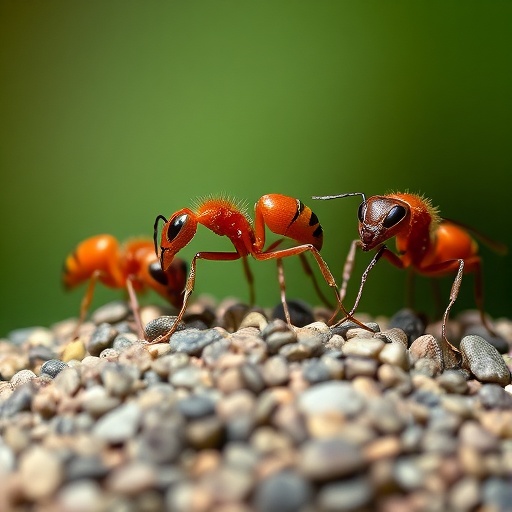
In the intricate world of social insects, chemical communication forms the very backbone of their societal structure. A groundbreaking study from Markus Knaden’s research group at the Max Planck Institute for Chemical Ecology has cast new light on the vulnerability of these essential communications—specifically focusing on how modern atmospheric pollutants, particularly ozone, disrupt nestmate recognition in ants. These findings herald significant ecological implications, underscoring how anthropogenic air pollution imperils not only individual insects but entire colonies, thereby threatening critical ecological balances.
Ant colonies rely predominantly on complex, species-specific hydrocarbon blends found on their cuticles to identify friend from foe. These blends are dominated by alkanes—stable molecules resilient to most environmental changes—and alkenes, which, although present in minuscule quantities, contain carbon-carbon double bonds that render them highly susceptible to oxidative damage by ozone. Early adult ants imprint on this chemical signature soon after hatching, enabling them to distinguish colony members through contact chemoreception. This “molecular handshake” prevents aggression among nest mates and safeguards colony cohesion.
The team’s previous work revealed how ozone exposure degrades double bonds in sex pheromones of fruit flies, impairing mate recognition and even dissolving species barriers, producing sterile hybrids. Building on these insights, the latest research probed whether similar oxidative degradation impacts the hydrocarbon blends ants depend on for social recognition. Exposing multiple ant species to ozone concentrations of 100 parts per billion—levels frequently recorded in urban and industrial hotspots during the summer—offered an experimental window into potential disruptions of their chemical communications.
The results were striking: five out of six studied ant species displayed aggression toward ozone-exposed nest mates identical to that typically directed at foreign intruders. Behavioral assays showed increased threat displays and physical attacks, signaling breakdowns in the ants’ ability to recognize familiar colony members. These social fractures emerged rapidly following only 20 minutes of ozone exposure, spotlighting the potent and immediate functional damage caused by oxidizing pollutants.
Chemical analyses employing cutting-edge thermodesorptive gas chromatography confirmed the biochemical basis of this behavior. While alkanes remained stable, the ozone effectively oxidized and diminished the critical alkenes on the ants’ cuticle hydrocarbons. These seemingly minor components, which constitute only a minor fraction of the total chemical profile, are pivotal for conveying the fine-tuned specificity of a colony’s odor. Their oxidative degradation scrambles the “colony scent signature,” making ozone-experienced ants chemically unrecognizable to their brethren.
One species diverged from this pattern: the clonal raider ant Ooceraea biroi exhibited no heightened aggression following ozone exposure. This anomaly likely stems from its unique biology—an entirely clonal, queenless species with inherently low inter-colony aggression—for which chemical differentiation is less critical. The absence of threat facilitated further behavioral experimentation integrating the Lise Meitner Research Group Social Behavior team’s expertise, revealing that ozone exposure reduces brood care behaviors in adult ants, leading to larval neglect and increased mortality.
Notably, the larvae’s deaths were not directly attributed to ozone toxicity but were presumed secondary to disrupted chemical communication between larvae and adult workers. This impaired interaction underscores how even subtle oxidations in chemical signals cascade into catastrophic colony-level dysfunction and failure, revealing a hitherto underappreciated dimension of how air pollutants threaten insect sociality.
These findings serve as a stark reminder that the insect decline crisis—often attributed to habitat destruction and pesticide use—may have its roots partly in atmospheric chemistry changes wrought by humans. Considering ants contribute an estimated biomass rivaling all birds and mammals combined, and fulfill indispensable ecological roles—from seed dispersal to pest control—the insidious effects of pollutants like ozone could precipitate far-reaching ecosystem destabilizations.
Moreover, extrapolating these results to other social insects such as bees raises worrying prospects for agriculture and global food security. Bees’ pollination services underpin much of the world’s crop production, and their chemical communication systems might be similarly vulnerable to oxidative pollutants, aggravating their already declining populations. This research thus expands the dialogue on air pollution’s ecological consequences, urging more integrated approaches addressing environmental health, biodiversity conservation, and human wellbeing.
Beyond underscoring the specific molecular degradation pathways, this study highlights the importance of preserving chemical integrity in natural communication networks. It exemplifies how anthropogenic environmental stressors disrupt biosemiotic systems fundamental to species survival and ecosystem functionality. The exact mechanisms by which ozone interacts with hydrocarbon signatures open new avenues for research into ecological toxicology and pollution mitigation strategies tailored to protect insect chemical signaling.
Fundamentally, these discoveries challenge us to rethink pollution not merely as an isolated human health risk but as a pervasive disruptor of ecological communication. Airborne oxidants like ozone and nitrogen oxides must be considered environmental toxins with multifaceted impacts extending deep into the fabric of intricate social behaviors that sustain ecosystems. The research teams involved call for heightened awareness and interdisciplinary efforts to address the ecological cascade triggered by rising pollution.
As humanity confronts the twin crises of climate change and biodiversity loss, findings like these emphasize the tightly woven interdependencies in nature and the fragility of ecosystem resilience in the face of chemical perturbations. Protecting chemical communication channels essential for social insect survival may be a crucial step toward safeguarding biodiversity and maintaining ecological stability on an increasingly polluted planet.
This pioneering investigation stands as a testament to the power of experimental ecology combined with advanced analytical chemistry, unfolding new dimensions in environmental science. The detailed characterization of ozone’s impact on ants’ cuticular chemistry not only advances fundamental knowledge but also provides a critical warning about the unseen chemical battles waged in polluted air—battles that imperil the harmonious social worlds of some of nature’s most essential and industrious creatures.
Subject of Research: Animals
Article Title: Oxidizing pollutants can disrupt nestmate recognition in ants
News Publication Date: 2-Feb-2026
Web References:
http://dx.doi.org/10.1073/pnas.2520139123
Image Credits: Markus Knaden, Max Planck Institute for Chemical Ecology
Keywords: Ozone pollution, chemical communication, social insects, ants, nestmate recognition, hydrocarbons, alkenes, oxidation, ecological disruption, insect behavior, environmental toxins, biodiversity


