


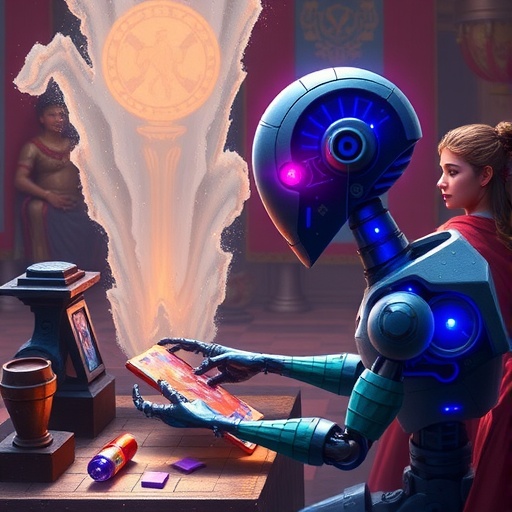
For the first time, researchers have combined the power of artificial intelligence with archaeological investigation to unlock the enigmatic rules of an ancient Roman board game. This pioneering study, a collaborative effort among European institutions including Maastricht University, Leiden University, and Flinders University, employs AI-driven simulations to decode the gameplay encoded on a centuries-old limestone artifact unearthed in the territory of the former Roman Netherlands. By methodically analyzing patterns of wear etched into the stone, the team has reconstructed probable rules and gameplay scenarios, providing unprecedented insight into an ancient cultural pastime.
The object at the center of this research is a finely carved limestone slab discovered near Heerlen, a historical region now within modern-day Netherlands. Unlike most Roman-era games traced through ephemeral media like dust or wood—materials that rarely survive time—this durable stone bears a detailed geometric pattern with intersecting lines and visible surface wear consistent with repeated use as a gaming board. The artifact’s preservation not only presents a rare glimpse into ancient leisure but also poses an intricate puzzle: what were the rules and objectives of the game played upon it?
Addressing this mystery demanded cutting-edge computational techniques. Archaeologists collaborated with computer scientists to deploy an AI system known as Ludii, developed within the Digital Ludeme Project, a European research initiative dedicated to mathematically and historically plausible reconstructions of traditional games. This AI platform was tasked with simulating hundreds of distinct rule sets to assess which game mechanics could feasibly generate the wear patterns observed on the limestone surface. By allowing AI agents to play countless iterations, the system aimed to identify a set of coherent rules that matched the real-world evidence.
The methodology fundamentally revolves around a form of computational archaeology, where AI acts as an impartial experimentalist capable of exhaustively exploring vast rule spaces and gameplay possibilities that human researchers could not feasibly test. The simulations incorporated rule elements from a variety of known ancient European games, including the Scandinavian haretavl and Italy’s gioco dell’orso, thereby anchoring the analysis in historical context while allowing for novel rule inferences. The results consistently indicated a strategic category known as blocking games, wherein the objective is to immobilize the opponent’s pieces rather than directly capture them.
Central to this outcome was the AI’s ability to replicate the friction-induced wear patterns concentrated along certain carved lines. By iteratively adjusting rule parameters—such as piece movement constraints and win conditions—the AI sought configurations that not only led to plausible game dynamics but also created spatial usage patterns identical to those physically preserved on the artifact. This dual validation bridges the gap between theoretical gameplay modeling and tangible archaeological evidence, establishing a new paradigm for interpreting ancient material culture.
The implications of unveiling a blocking game dating from the Roman period are profound. Traditionally, such games are scarcely documented prior to medieval Europe, implying that strategic gameplay of this nature may have a far deeper historical lineage than previously acknowledged. This discovery challenges prevailing narratives about the evolution of game mechanics and social pastimes over millennia. Furthermore, it opens avenues for reassessing other archaeological finds that to date have resisted conventional interpretation, suggesting that AI could be instrumental in decoding many ancient mysteries encoded in wear patterns or geometric designs.
Dr. Matthew Stephenson, a lead computer scientist from Flinders University, emphasized the transformative potential of integrating modern machine learning with archaeological inquiry. “Our approach demonstrates how computational simulations can bridge interdisciplinary boundaries, providing a quantitative and replicable framework for understanding cultural artifacts that otherwise would remain enigmatic,” he stated. Such AI-driven models not only corroborate historical hypotheses but also generate new perspectives that can guide future excavation and conservation strategies.
The research is exemplary of the collaborative synergy between archaeology, digital modeling, and cultural history. By leveraging the Digital Ludeme Project’s extensive repository of ancient games and employing open-source AI tools, the team crafted a nuanced reconstruction far richer than could be achieved by either discipline alone. The strategy underscores how emerging technologies redefine scholarly capabilities, enabling researchers to pose novel questions and derive answers from complex datasets intrinsic to cultural heritage.
Importantly, this study also suggests a scalable methodological framework for similar inquiries. AI simulations can be tailored to investigate an array of artifacts featuring geometric patterns or signs of use wear, from board-like objects to engraved stones and ceramics. As computational models grow more sophisticated, incorporating broader historical datasets and player behavior algorithms, their applicability to archaeological problem-solving will expand, offering a new dimension to the social sciences.
The article detailing these findings, “Ludus Coriovalli: using artificial intelligence-driven simulations to identify rules for an ancient board game,” was published in the esteemed journal Antiquity. The research involved an interdisciplinary team spanning several European universities and institutions, supported by the European Research Council’s Consolidator Grant for the Digital Ludeme Project. High-performance computing infrastructure facilitated the extensive simulations, while open-access publication ensures the methodology’s accessibility for future scholars.
The success of this integrative approach offers compelling evidence that the intersection of AI and archaeology can revolutionize our understanding of historical artefacts. By reproducing ancient gameplay through AI agents, researchers can validate hypotheses regarding cultural behaviors previously obscured by millennia of time. This breakthrough not only enriches our comprehension of ancient social practices but also heralds a broader shift towards computational techniques as standard tools in archaeological sciences.
Looking forward, the study’s authors envision applying these methods to other enigmatic artifacts globally, including those lacking textual or iconographic documentation. Artificial intelligence may soon become indispensable in unraveling the hidden stories embedded within the material remnants of human history. As Dr. Crist, the lead archaeologist of the study, poignantly remarked, “AI offers archaeologists a promising new tool for understanding ancient games that don’t resemble those known from surviving texts or artworks.”
This landmark research exemplifies how entwining computational innovation with classical scholarship can uncover long-lost cultural narratives embedded in objects once deemed inscrutable. It marks a seminal step toward unlocking the playful past of ancient civilizations, revealing not merely the objects they left behind, but also the rules that governed their social interaction and leisure.
News Publication Date:
11-Feb-2026
Web References:
https://www.cambridge.org/core/journals/antiquity/article/ludus-coriovalli-using-artificial-intelligencedriven-simulations-to-identify-rules-for-an-ancient-board-game/E5644BD43F8A5DC86DD1183A3E645ED9
http://dx.doi.org/10.15184/aqy.2025.10264
http://ludeme.eu/
References:
Walter Crist, Éric Piette, Karen Jeneson, Dennis J.N.J. Soemers, Matthew Stephenson, Luk van Goor, Cameron Browne. “Ludus Coriovalli: using artificial intelligence-driven simulations to identify rules for an ancient board game.” Antiquity. DOI: 10.15184/aqy.2025.10264
Keywords
Artificial Intelligence, Archaeology, Ancient Games, Roman Board Game, Ludus Coriovalli, Computational Simulation, Digital Ludeme Project, Cultural Heritage, Game Reconstruction, Blocking Games, Machine Learning, Historical Recreation
Cite Scienmag News
Denise Maddox. (March 19, 2026). AI Uncovers Secrets Behind Ancient Gaming Enigma. Scienmag. https://scienmag.com/ai-uncovers-secrets-behind-ancient-gaming-enigma/
Denise Maddox. "AI Uncovers Secrets Behind Ancient Gaming Enigma." Scienmag, 19 March 2026, https://scienmag.com/ai-uncovers-secrets-behind-ancient-gaming-enigma/. Accessed 4 September 2026.
Denise Maddox. "AI Uncovers Secrets Behind Ancient Gaming Enigma." Scienmag. March 19, 2026. https://scienmag.com/ai-uncovers-secrets-behind-ancient-gaming-enigma/


