


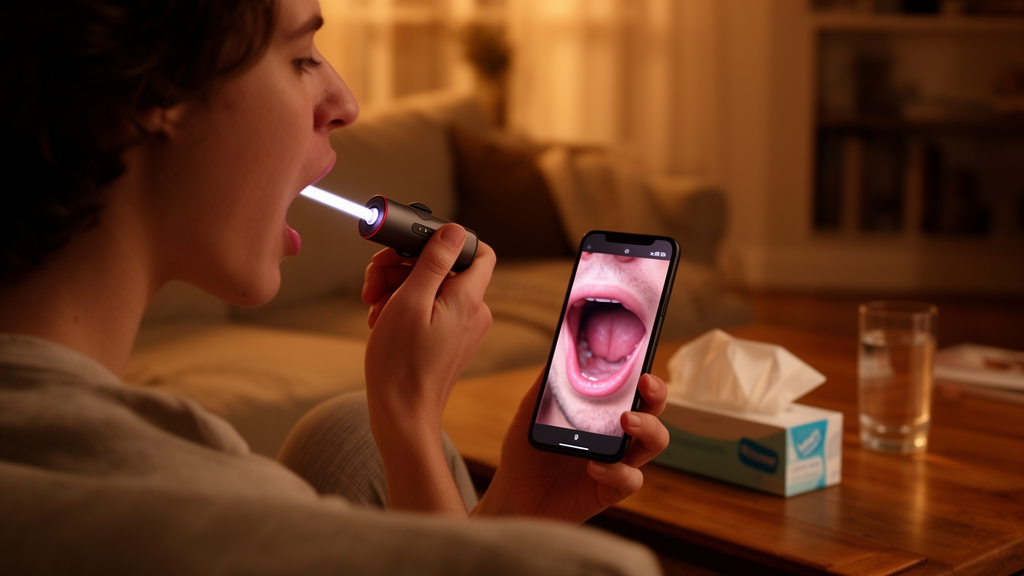
For more than a century, telemedicine has promised to dissolve the distance between patients and physicians, yet one stubborn obstacle has kept that promise only partially fulfilled: the diagnostic test that requires a biological sample. Blood draws, urine analyses, and nasopharyngeal swabs all demand either a trip to a clinic or, at best, an uncomfortable act of self-collection at home. A new feasibility study from the University of Tokyo, published in Frontiers in Medical Engineering, argues that this bottleneck may finally be breakable. The researchers examined bio-sampling alternative diagnostic imaging, or BADI, an artificial intelligence–based approach that diagnoses influenza from a simple photograph of the throat, and mapped out what it would take to move such technology from the examination room into the living room.
The study, led by Masayoshi Nageishi and Shingo Kano of the Graduate School of Frontier Sciences, centers on a concrete case rather than a hypothetical one. The researchers selected nodoca, an AI-based influenza imaging diagnostic device launched in Japan by Aillis, Inc. in 2022. Since December 1, 2022, influenza diagnosis using nodoca has been covered by Japan’s national insurance system, marking the first reimbursement in the country under the C2 category for novel functions and technologies employing AI-based medical devices. The device works by integrating patient information with pharyngeal images captured during examination, which are then analyzed through deep learning–based pattern recognition algorithms that detect influenza-specific findings and symptoms, producing a result that indicates the presence or absence of influenza virus infection.
The technical contrast with conventional testing is striking. In a standard antigen test, exemplified in the study by QuickNavi-Flu, a product with the largest domestic market share in Japan, a physician or nurse inserts a sterile swab into the nasal or pharyngeal cavity to collect mucosal fluid. The specimen is mixed with reagents and dropped onto a test kit, where an antigen–antibody reaction produces a visible detection line after a waiting period of roughly 10 to 15 minutes. The reported sensitivity is 86.7 percent, and the test can distinguish between influenza A and B. Nodoca, by comparison, requires only a few seconds of image capture with a dedicated camera, after which the pre-trained deep learning system completes its analysis within a few seconds to several tens of seconds, entirely without direct involvement of medical personnel in the interpretation step.
Perhaps the most consequential technical advantage lies in the timing window. Conventional antigen tests are recommended 12 to 48 hours after the onset of fever, because viral loads in the earliest hours of infection are often too low for reliable detection, creating a real risk of false negatives. Nodoca inverts this constraint: a high detection rate is expected even within the very early phase, within roughly six hours of symptom onset. The biological basis is the appearance of distinct pharyngeal changes known as influenza follicles at an early stage of infection. These changes are not readily discernible to the human eye, but the deep learning model, trained on accumulated datasets, can identify them from the captured images. The device’s reported sensitivity exceeds 80 percent, though it cannot distinguish between influenza A and B strains, a limitation the authors flag explicitly.
The patient experience differs just as sharply. Swab-based collection can cause pain or discomfort, particularly in pediatric populations, and imposes a waiting period between sample collection and result. Nodoca achieves diagnosis without physical discomfort and delivers results almost instantaneously, allowing diagnosis at times previously unsuitable because of clinic hours, test turnaround, or waiting constraints. In clinical trials, 90.6 percent of participants reported a preference for undergoing nodoca testing in the future. The economic picture is nearly a wash: reimbursement per test is 301 points, roughly 903 yen, for the antigen test versus 305 points, about 915 yen, for the imaging approach, with both covered by insurance and a 30 percent patient copayment. The cost structure differs, however, with the imaging device requiring acquisition costs, disposable camera covers, and system usage fees rather than a per-kit consumable.
Yet the study is careful about what the technology currently is and is not. Nodoca functions as a screening tool, and diagnoses are not made solely on the basis of its output. Physicians make comprehensive judgments by integrating the AI result with clinical symptoms and other examination findings, and only patients deemed positive or high risk by the imaging assessment proceed to confirmatory antigen testing. Published research has reported concordance rates of only approximately 75 percent with antigen testing, which the authors identify as a pressing argument for algorithmic enhancement and expansion of training datasets. Under present conditions, they note, remote screening with such a device would not reduce the need for confirmatory testing and would offer only limited incremental benefit; full replacement of antigen testing would demand substantial improvements in accuracy, potentially through optimized image quality, multiview or multimodal inputs, and stronger disease-specific training data.
To assess remote feasibility, the researchers built a two-part analytical framework, comparing in-clinic testing, home-based biological testing, and BADI-based diagnostics. A procedure-dependent analysis examined diagnostic steps, the involvement of physicians or nurses, and required time, while a procedure-independent analysis covered clinical significance, cost, and feasibility of remote application. They anchored the comparison in the American Test-to-Treat model, where at-home antigen testing, teleconsultation, and medication delivery have already been integrated into a single continuum of care, and in the United Kingdom’s NHS-led COVID Oximetry @home program. Home-use influenza and COVID-19 antigen kits are already commercially distributed in the United States and Europe; their sensitivity is considered moderate, around 60 percent compared with PCR, though performance improves markedly when testing occurs within 72 hours of symptom onset.
From this comparison, the study distilled four essential conditions for transitioning BADI-type diagnostics to remote healthcare delivery. First, sufficient availability and accessibility for patients, meaning the device must be affordable, obtainable through pharmacies, drugstores, or online platforms, and potentially supported by subscription models combining device rental with AI analysis fees or inclusion in public reimbursement schemes. Second, assurance of diagnostic accuracy and clinical reliability, which requires large-scale comparative studies against antigen and PCR testing, subgroup analyses across age groups and disease phases, and training datasets that encompass pediatric and elderly populations, comorbidities, and vaccination histories. Third, high usability and interpretive clarity, calling for intuitive operation aided by voice guidance, auto-focus, and framing guides, plus standardized result displays such as positive, negative, or indeterminate, so that non-experts can act on the output without ambiguity. Fourth, seamless integration into medical systems with immediate linkage to appropriate treatment, including automated transmission of results into electronic health records, in-app video consultations, electronic prescriptions, and delivery of antiviral medications, all built on interoperability and security standards such as HL7 FHIR and ISO/IEC 27001.
The authors are candid about the study’s limitations. The comparison was conducted within the Japanese healthcare system, whose universal insurance structure shapes every cost evaluation, and the positioning of BADI devices could vary considerably under other regulatory and reimbursement regimes. The analysis generalizes from a single nascent case, and the framework’s robustness must be tested against additional products, generations of technology, and cross-national comparisons. There are also AI-specific hurdles: generalizability across diverse patient attributes, transparency of diagnostic reasoning through visualization features that highlight the anatomical regions flagged as abnormal, and the current inability to perform strain typing or multiplex screening of pathogens such as SARS-CoV-2. Applicability is presently restricted to patients aged six and older who can open their mouths sufficiently wide, since younger children were excluded from clinical trials.
Even so, the trajectory the study sketches is broad. The authors define BADI devices generically as diagnostic tools that replace biological sampling through imaging of external or superficially accessible sites such as the throat, oral cavity, tongue, or iris, and they anticipate extensions to COVID-19 and other respiratory infections, pharyngitis and streptococcal screening, otitis media via tympanic membrane imaging, and dermatological disease. The U.S. Food and Drug Administration has already highlighted patient-performed digital photography in dermatology as a relevant evaluative technology for remote clinical trials. If the four conditions the researchers identify can be satisfied, the era in which a camera, a deep learning model, and a video call replace the swab, the waiting room, and the clinic visit may be closer than the century-long history of telemedicine would suggest.
Subject of Research: Feasibility of AI-based throat imaging as a non-invasive alternative to biological sampling for remote influenza diagnosis in telemedicine
Article Title: Bio-sampling alternative diagnostic imaging for telemedicine: a feasibility study of an AI-based throat camera for influenza
Article References: Nageishi, M., & Kano, S. (2026). Bio-sampling alternative diagnostic imaging for telemedicine: a feasibility study of an AI-based throat camera for influenza. Frontiers in Medical Engineering, 3, Article 1476892. https://doi.org/10.3389/fmede.2025.1476892
Image Credits: AI Generated
DOI: 10.3389/fmede.2025.1476892
Keywords: telemedicine, artificial intelligence, diagnostic imaging, influenza, deep learning, point-of-care testing, remote diagnostics, pharyngeal imaging, rapid antigen test, digital health, clinical engineering, non-invasive diagnostics
Cite Scienmag News
Ophelia Keating. (October 16, 2026). AI Throat Camera Could Replace Swabs and Bring Flu Diagnosis Into the Home. Scienmag. https://scienmag.com/ai-throat-camera-could-replace-swabs-and-bring-flu-diagnosis-into-the-home/
Ophelia Keating. "AI Throat Camera Could Replace Swabs and Bring Flu Diagnosis Into the Home." Scienmag, 16 October 2026, https://scienmag.com/ai-throat-camera-could-replace-swabs-and-bring-flu-diagnosis-into-the-home/. Accessed 16 October 2026.
Ophelia Keating. "AI Throat Camera Could Replace Swabs and Bring Flu Diagnosis Into the Home." Scienmag. October 16, 2026. https://scienmag.com/ai-throat-camera-could-replace-swabs-and-bring-flu-diagnosis-into-the-home/


