


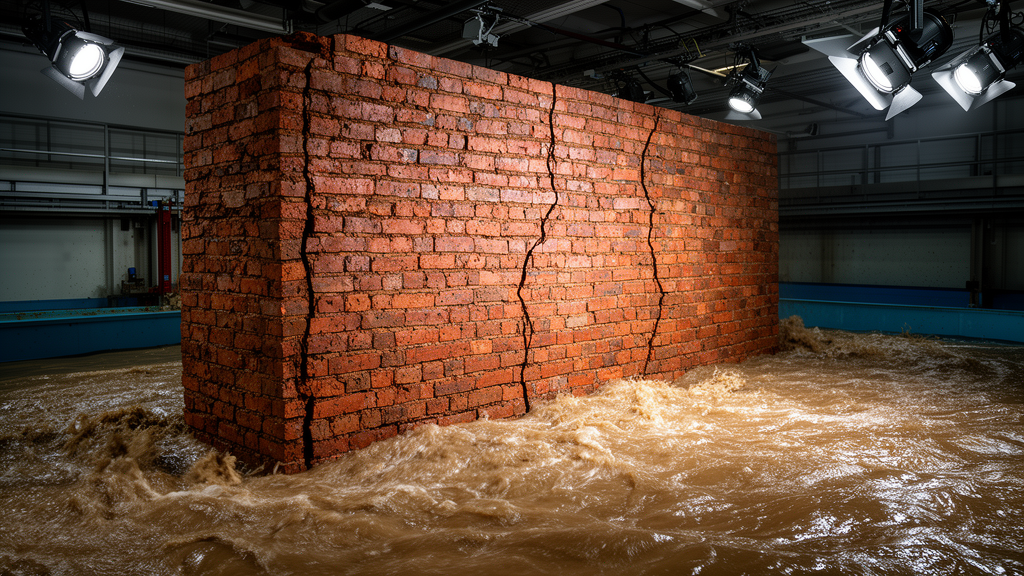
Researchers have developed a machine learning framework that predicts the flood vulnerability of masonry walls with accuracy comparable to detailed structural simulations, while significantly reducing computational costs. Published in the journal AI in Civil Engineering, the study introduces a mechanics-informed surrogate modelling approach designed to bridge the gap between fast but opaque empirical models and slow but transparent mechanics-based analyses. The framework enables the efficient prediction of fragility parameters for unreinforced masonry walls, which are particularly susceptible to out-of-plane collapse during flood events. By training artificial intelligence models on data generated from a mechanics-based simulator, the team created a tool that retains a direct link to the governing structural mechanisms of wall failure.
The primary challenge in assessing flood-induced structural damage lies in the trade-off between computational efficiency and physical interpretability. Simplified fragility models offer speed but often lack transparency regarding the specific failure mechanisms at play. Conversely, mechanics-based analyses provide clear insights into collapse dynamics but are computationally expensive when applied to large-scale regional assessments. The study addresses this limitation by using machine learning surrogates to emulate the outputs of a limit-analysis simulator. This approach allows for rapid evaluation of nonlinear structural behavior without sacrificing the physical consistency inherent in the reference analytical model.
The mechanics-based simulator adopted in the study is based on a simplified limit-analysis model originally proposed by Milanesi and colleagues in 2018. In this framework, a masonry wall is idealized as an assembly of rigid blocks separated by planar cracks. Collapse is identified through the principle of virtual work, assuming unlimited compressive strength and stiffness, no tensile resistance, and no relative slip between adjacent blocks. The model balances the destabilizing work caused by hydrostatic pressure against the stabilizing work provided by the wall’s self-weight and vertical loads from upper floors. This balance determines the critical flood depth at which the wall overturns.
To generate the training data, the researchers created a synthetic dataset comprising 10,000 nominal wall configurations. These configurations were sampled within constrained ranges representing typical low-rise masonry walls in European and Mediterranean contexts. The input variables included wall thickness, floor height, number of upper floors, masonry density, opening ratio, wall length, and boundary condition. Four idealized boundary restraint configurations, denoted P1 through P4, were considered, representing increasing levels of edge support. For each configuration, the simulator calculated the distribution of collapse depths, from which the fragility parameters—the median collapse depth and the logarithmic standard deviation—were derived.
The machine learning surrogates were trained to predict these two fragility parameters using a variety of algorithms, including linear sparse regressions, kernel-based methods, and ensemble models. The models were evaluated using stratified five-fold cross-validation to ensure consistent representation of the different boundary conditions. For the prediction of the fragility median, the Support Vector Regression model with mechanics-based features achieved a coefficient of determination of 0.998 and a mean absolute error of 0.023 meters. This performance indicates an almost exact reproduction of the mechanics-based simulator, demonstrating that the surrogate can accurately emulate the reference model’s outputs within the constrained sampling domain.
In contrast, the prediction of the fragility dispersion parameter proved more challenging. The dispersion parameter describes the spread of collapse depths resulting from material and geometric uncertainties. Linear models achieved a coefficient of determination of approximately 0.70, while ensemble methods improved this to between 0.92 and 0.95. The lower accuracy for dispersion reflects the fact that this parameter is influenced by uncertainty propagation mechanisms that are not fully captured by the nominal wall geometry and material properties used as inputs. The study notes that future extensions could improve dispersion prediction by incorporating explicit uncertainty descriptors, such as coefficients of variation and correlation structures, into the input space.
A central contribution of the work is the integration of explainable artificial intelligence techniques to interpret the surrogate predictions. The researchers applied sensitivity analysis and partial dependence diagnostics to quantify the role of various geometric and material variables. The results revealed that the number of upper floors, wall thickness, and boundary condition form the dominant sensitivity group for the fragility median. The influence of the number of upper floors is positive and concave, indicating diminishing marginal gains from additional vertical load. Wall thickness exhibits a clear monotonic positive effect, with the influence becoming more pronounced under stronger boundary restraint.
The boundary condition plays a critical role in modulating collapse capacity. The study found a consistent ordering of collapse capacity across the four restraint configurations, with P1 being the most vulnerable and P4 the most resistant. Configurations with top restraint, such as P2 and P4, form a higher-capacity group compared to those without top restraint, such as P1 and P3. This highlights the stabilizing role of upper restraint and vertical load contribution in the adopted model. The risk heatmap generated by the surrogate models visually confirms that increasing boundary restraint shifts the median collapse depth toward larger flood values for all representative wall cases.
The computational efficiency of the proposed framework is a significant advantage for large-scale flood risk assessment. The mechanics-based simulator requires incremental flood-depth analysis and stability checks, which can be time-consuming, especially for restrained configurations that involve internal optimization. In contrast, the trained surrogate models predict fragility parameters through algebraic feature transformations and regression evaluations. For 10,000 wall configurations, the surrogate models completed the predictions in 1.35 seconds, compared to an estimated 3.76 hours for the corresponding mechanics-based evaluations. This represents a speedup of approximately 10,000 times, enabling rapid scenario screening and uncertainty propagation in regional vulnerability assessments.
Despite its high accuracy, the framework has specific limitations related to the assumptions of the reference simulator. The limit-analysis model assumes rigid-block mechanisms, no sliding, and no scour, which may lead to overestimation of collapse capacity in real-world scenarios where these mechanisms govern the response. The study acknowledges that the surrogate predictions are valid within the idealized hydrostatic, non-sliding, and no-scour assumptions of the adopted analytical model. Detailed assessment remains necessary for dynamic flood environments, debris-impact scenarios, or cases where sliding, local damage, or foundation degradation may control the structural response.
The proposed framework is intended for rapid screening and preliminary engineering evaluation of masonry wall fragility under flood loading. It provides a mechanics-informed complement to empirical depth-damage models, offering a transparent and computationally efficient alternative for assessing structural vulnerability. By combining the accuracy of mechanics-based simulations with the speed of machine learning, the study offers a practical route for integrating detailed structural insights into large-scale flood risk management. The methodology is transferable to analogous problems in structural and hazard risk modelling, where the balance between computational cost and physical interpretability is a central concern.
Future research directions include enriching the mechanics-based data-generation stage with higher-fidelity numerical models that account for joint sliding, cohesive-frictional interface behavior, and foundation degradation. The hydraulic input space could also be expanded to include flow velocity and hydrodynamic pressure coefficients, allowing the surrogate to move beyond hydrostatic loading assumptions. Coupling wall-level fragility predictions with system-level building models will enable a more comprehensive assessment of structural redundancy and progressive collapse. These extensions aim to broaden the applicability of the surrogate approach to more realistic and complex flood-damage scenarios.
The study was conducted by a team of researchers including Stefanos Georgiadis, Marco Nale, Marco Faggioli, Željana Nikolić, and Elena Benvenuti. Their work addresses a specific gap in flood-risk assessment where empirical depth-damage relationships, often derived from post-event observations or insurance records, lack sensitivity to structural configuration and failure mechanisms. While these empirical models offer simplicity and scalability, they are region-specific and provide limited insight into the physical processes governing structural failure. The proposed surrogate framework aims to retain the accuracy of mechanics-based simulations while allowing for efficient prediction and physically meaningful interpretation of flood-induced wall collapse.
To ensure the surrogate predictions remain consistent with structural mechanics, the researchers employed a generalized sensitivity analysis framework. This included permutation-based global importance, which measures the degradation in predictive performance when feature values are randomly permuted, and partial dependence functions that characterize nonlinear marginal effects. These tools allowed the team to visualize how geometric, material, and boundary-condition variables influence the fragility parameters. The analysis confirmed that the learned trends align with the underlying mechanics of wall overturning, providing a transparent link between the machine learning outputs and the physical behavior of the masonry walls.
The computational efficiency of the framework was quantified by comparing boundary-weighted mechanics-based runtimes with measured post-training surrogate inference times. The mean simulator times varied significantly by boundary condition, ranging from 0.0086 seconds for the one-edge restraint configuration to 3.3795 seconds for the four-edge restraint configuration. These timings were measured on a Windows 10 workstation with eight logical CPUs. The substantial reduction in computational cost after training is particularly relevant for regional risk assessments and parametric studies, where thousands of wall configurations may need to be evaluated repeatedly for uncertainty propagation and rapid scenario screening.
The framework is primarily intended for rapid screening and preliminary engineering evaluation of masonry wall fragility under flood loading. The outputs are wall-level fragility parameters for individual exposed masonry wall units under specified boundary conditions. For building-level applications, these wall-level predictions can be embedded within a broader system-level assessment that accounts for diaphragm action, wall-to-floor connections, cross-wall interaction, and structural redundancy. This distinction is important because ignoring system-level interaction may either overestimate risk by neglecting redundancy or underestimate risk by neglecting progressive collapse triggered by the failure of a critical wall.
The applicability of the framework is bounded by the hydrostatic loading assumption of the reference simulator. The present formulation is most appropriate for quasi-static or hydrostatic-equivalent flood actions, where the peak demand can be represented by a pressure distribution associated with flood depth or maximum run-up. The analysis does not consider high-velocity floods, debris-impact scenarios, or rapidly varying hydraulic conditions, where hydrodynamic demand and impulsive loading may control the response. Future extensions could involve coupling wall-level surrogates with simplified building-scale models to enable a more comprehensive assessment of system-level collapse and damage propagation.
Subject of Research: Machine learning surrogates for predicting and interpreting flood fragility parameters of masonry walls
Article Title: Machine learning surrogates for predicting and interpreting flood fragility parameters of masonry walls
Article References: Georgiadis, S., Nale, M., Faggioli, M., Nikolić, Ž., & Benvenuti, E. (2026). Machine learning surrogates for predicting and interpreting flood fragility parameters of masonry walls. AI in Civil Engineering, 5(1), Article 29. https://doi.org/10.1007/s43503-026-00112-x
Image Credits: AI Generated
DOI: 10.1007/s43503-026-00112-x
Keywords: Machine, learning, surrogates, predicting, interpreting, flood, fragility, parameters, masonry, walls, scientific research
Cite Scienmag News
Violet Maxwell. (November 9, 2026). AI Surrogates Predict Masonry Wall Flood Collapse. Scienmag. https://scienmag.com/ai-surrogates-predict-masonry-wall-flood-collapse/
Violet Maxwell. "AI Surrogates Predict Masonry Wall Flood Collapse." Scienmag, 9 November 2026, https://scienmag.com/ai-surrogates-predict-masonry-wall-flood-collapse/. Accessed 9 November 2026.
Violet Maxwell. "AI Surrogates Predict Masonry Wall Flood Collapse." Scienmag. November 9, 2026. https://scienmag.com/ai-surrogates-predict-masonry-wall-flood-collapse/




