


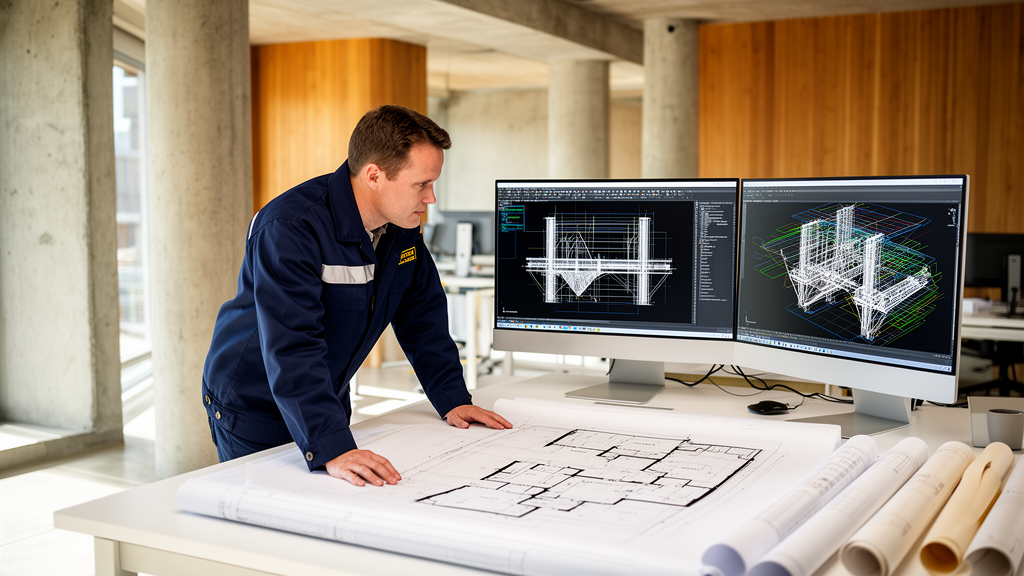
A research team led by Associate Professor Jaewook Jeong from the Department of Safety Engineering at Seoul National University of Science and Technology has developed an artificial intelligence-assisted automated pipeline capable of identifying human errors across structural design documents. Evaluated in a case study of a residential construction project in South Korea, the system achieved information extraction accuracies exceeding 90 percent and identified 253 discrepancies between design records, including 29 critical errors, providing a systematic approach to reducing manual verification workloads.
Effective communication and coordination among diverse project stakeholders represent a foundational requirement within project-based sectors such as construction. Throughout any building initiative, teams rely on an extensive assortment of technical documents to guide execution. When inconsistencies arise across these disparate materials, the resulting miscommunications frequently precipitate schedule delays and escalating project expenditures, establishing an acute need for reliable mechanisms that detect discrepancies during early project phases.
To address coordination breakdowns, the construction industry has increasingly explored digital collaboration solutions such as building information modeling, commonly known as BIM. Digital modeling platforms permit multiple engineers and designers to share, inspect, and update engineering drawings and technical records within a unified environment, facilitating the early identification of conflicting specifications. Nevertheless, substantial initial capital requirements, an industry-wide shortage of trained personnel, and persistent technical barriers have curtailed widespread BIM adoption, leaving numerous building ventures reliant on traditional document-based exchanges.
In conventional document-driven environments, project contributors routinely employ disparate software packages and varying document formats, creating conditions where critical data can be easily misinterpreted or inconsistently recorded. This vulnerability is especially pronounced between structural calculation documents and structural drawings. When discrepancies emerge between calculation records and graphical blueprints, they introduce human errors that, in severe instances, possess the potential to jeopardize structural integrity and building safety, demanding rigorous management oversight.
To mitigate the risks and labor intensity associated with manual auditing, the researchers engineered an automated framework that directly inspects conventional design files without requiring the deployment of BIM infrastructure. As explained by Prof. Jeong, the AI-assisted pipeline extracts, organizes, and evaluates data across structural calculation documents and engineering drawings to uncover human errors. The underlying study, detailing the architecture and empirical validation, appeared online in October 2026 and was published in Volume 185 of Engineering Applications of Artificial Intelligence on December 1, 2026.
The processing architecture begins with project data acquisition and systematic preprocessing, wherein project records are gathered and low-quality data elements are filtered out. To standardize and extract structural metrics from calculation documents, the workflow applies DocLayNet-YOLO, a generalized document layout analysis model, to pinpoint regions containing target structural data. Once these regions are established, the Surya-OCR model extracts the structural member properties in text format, after which the gathered data are consolidated and standardized into a single structured file.
Extracting data from structural drawings involves distinct computational challenges, as structural schedules present multiple building members within tabular grids characterized by varying row and column widths. To process these layouts, the framework first identifies individual member codes. The pipeline pairs optical character recognition with classical computer vision algorithms—specifically Canny edge detection, the Hough transform, and morphological operations—to locate tabular zones containing member identifiers, subsequently filtering, refining, and standardizing the recovered schedule data.
Once extraction across both document streams is finalized, the system validates the information and performs automated comparative analyses. By using member codes and directional indicators as primary keys, the framework establishes direct correspondence between calculation entries and corresponding drawing schedules. The pipeline flags discrepancies, identifies and records duplicate entries, organizes the output into a standardized dataset, and categorizes every detected anomaly. To facilitate practical deployment, the investigators packaged the pipeline into a user-friendly, web-based software application.
In an empirical case study centered on a residential construction project in South Korea, the automated system demonstrated robust extraction performance, recording an accuracy of 95.56 percent on structural calculation documents and 90.47 percent on structural drawings. The comparative verification phase uncovered 253 total discrepancies across the project records. These detected errors comprised 224 missing entries, 15 main reinforcement mismatches, eight dimensional discrepancies, three stirrup mismatches, and three duplicate entries, confirming the system’s capacity to systematically uncover hidden drafting and calculation divergences.
Prof. Jeong highlighted that the AI-assisted pipeline provides practical utility for structural engineers, design consultants, general contractors, and construction supervision teams, enabling them to resolve discrepancies before on-site structural defects occur. The approach offers notable utility for small- and medium-sized construction enterprises that lack the resources to implement BIM platforms. By lessening the burden of manual error checking and strengthening documentation consistency, such automated pipelines represent a step toward integrating accessible artificial intelligence safeguards directly into everyday civil engineering practice.
In the residential construction project case study in South Korea, the verification process systematically categorized the 253 identified discrepancies to evaluate how inconsistencies manifest across engineering records. Missing entries constituted the vast majority of detected discrepancies, accounting for 224 instances where structural data appeared inconsistently between documents. In addition to these missing records, the pipeline identified 15 main reinforcement mismatches, eight dimensional discrepancies, three stirrup mismatches, and three duplicate entries across the design documentation. Crucially, experimental evaluation revealed that 29 of the detected human errors represented critical errors, illustrating the serious nature of discrepancies arising during manual drafting. By flagging minor inconsistencies alongside critical reinforcement and dimensional divergences, the system confirmed its capacity to systematically uncover hidden errors that could compromise building safety during on-site execution.
For structural calculation documents, the automated workflow initiates processing by acquiring necessary project files and pruning low-quality information during a preliminary preprocessing phase. To extract and standardize numerical and textual structural specifications, the framework employs the DocLayNet-YOLO model, a generalized document layout analysis architecture. The model first identifies regions containing target information, after which the Surya-OCR model extracts key structural member information in text form. In the final step of calculation processing, this extracted information is merged and standardized into a single file. This structured extraction achieved an accuracy of 95.56 percent on structural calculation documents during the case study, demonstrating that data compiled across different tools or document formats can be reliably converted into a standardized representation.
For structural drawings, where multiple members are listed in schedules with varying row and column widths, member codes are identified first. Locating the table regions containing these member codes requires a specialized approach combining optical character recognition with classical computer vision operations. Specifically, the framework utilizes OCR together with Canny edge detection, the Hough transform, and morphological operations to locate table regions containing the member codes. Once the boundaries of these tabular regions are detected, the extracted information within the member code regions is filtered and refined to eliminate irregularities. The refined data are then standardized, enabling the system to achieve an extraction accuracy of 90.47 percent on structural drawings. This specialized visual extraction ensures that tabular schedule information can be directly compared against corresponding calculation records.
Following the separate extraction and standardization of both document streams, the pipeline validates the extracted information and conducts comparative analysis across the two document types. To establish reliable correspondence between calculation documents and structural drawings, the system relies on member codes and direction as key identifiers. By linking data points through these common identifiers, the automated framework detects discrepancies, identifies duplicate entries, and reports conflicting information across the paired documents. The framework organizes these findings into a consistent dataset, categorizing each identified error to facilitate structured review. Beyond its core analytical algorithms, the research team developed a user-friendly, web-based application to deploy the automated pipeline. This web interface provides an accessible platform where project teams can apply the framework to practical workflows without requiring specialized programming expertise.
Collaboration between different stakeholders is a key part of project-based industries like construction, where a variety of documents are required for effective communication. When project contributors use different software tools and document formats, technical information can be misinterpreted or inconsistently represented. Inconsistencies between structural calculation documents and structural drawings are particularly concerning because such discrepancies can introduce human errors that, in severe cases, could compromise building safety. While digital collaboration tools like building information modeling allow multiple designers to share and revise engineering drawings and documents for early error detection, BIM adoption is restricted by high initial costs, a lack of skilled personnel, and technical barriers. Consequently, many construction projects remain reliant on traditional, document-based collaboration, creating a persistent need for automated checking tools that operate independently of BIM systems.
By operating directly on conventional design documents without requiring BIM infrastructure, the AI-assisted pipeline offers practical utility for diverse industry practitioners. Associate Professor Jaewook Jeong pointed out that the automated pipeline could help structural engineers, design consultants, contractors, and construction supervision teams identify discrepancies before they lead to construction errors, improving the overall reliability of buildings and infrastructure. The framework could be particularly valuable for small- and medium-sized construction projects that cannot implement BIM due to resource constraints. Overall, the automated system demonstrates significant potential for reducing the burden of manual error checking while improving documentation consistency across conventional building initiatives. In the future, integrating this automated pipeline into routine engineering workflows could make advanced safety technologies more accessible throughout the construction sector.
Subject of Research: Automated AI detection of human errors in structural construction design documents
Article Title: Seoul National University of Science and Technology researchers develop new AI-assisted pipeline to identify errors in construction design documents
Article References: Seoul National University of Science and Technology researchers develop new AI-assisted pipeline to identify errors in construction design documents. Original publication (Bibliographic details unavailable.)
Image Credits: AI Generated
DOI: Not provided
Keywords: structural design documents, construction safety, error detection, structural calculation documents, structural drawings, building information modeling, DocLayNet-YOLO, Surya-OCR, Canny edge detection, Hough transform, morphological operations, Seoul National University of Science and Technology, Jaewook Jeong, residential construction, reinforcement mismatches, document layout analysis
Cite Scienmag News
Courtney Benton. (November 12, 2026). AI Pipeline Detects Structural Design Errors in Construction Documents Without BIM. Scienmag. https://scienmag.com/ai-pipeline-detects-structural-design-errors-in-construction-documents-without-bim/
Courtney Benton. "AI Pipeline Detects Structural Design Errors in Construction Documents Without BIM." Scienmag, 12 November 2026, https://scienmag.com/ai-pipeline-detects-structural-design-errors-in-construction-documents-without-bim/. Accessed 12 November 2026.
Courtney Benton. "AI Pipeline Detects Structural Design Errors in Construction Documents Without BIM." Scienmag. November 12, 2026. https://scienmag.com/ai-pipeline-detects-structural-design-errors-in-construction-documents-without-bim/




