

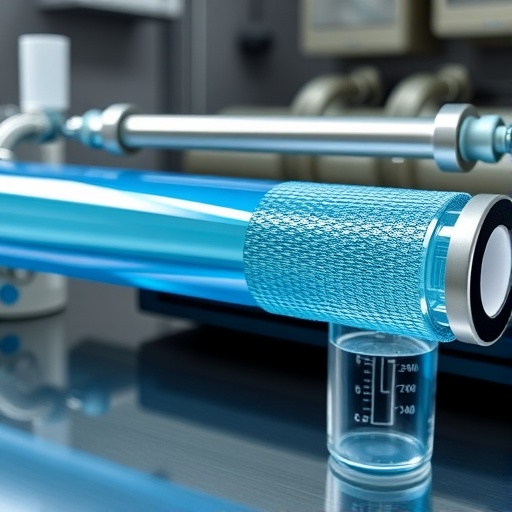
In recent advancements within the field of water treatment, research led by Cheng, Z., Yu, Y., and Meng, X. has unveiled innovative methods utilizing automated machine learning to enhance reverse osmosis (RO) membrane performance. The study, published in Environmental Engineering, emphasizes a pioneering approach focused on predicting membrane flux and dynamically adjusting chemical dosages, thereby heralding a new era in efficient water purification technologies. This is particularly relevant given the growing global water crisis, which necessitates the development of more effective and sustainable methods for water management and treatment.
Traditional methods of water treatment have often faced limitations, where manual intervention is necessary to maintain optimal operating conditions for reverse osmosis systems. These systems are critical for several applications, including seawater desalination, industrial wastewater treatment, and even municipal drinking water production. The efficiency of RO membranes can be adversely affected by factors such as fouling, scaling, and variations in feed water quality. Consequently, there is an inherent need for innovative strategies that can automate and optimize these complex processes.
The research presented by Cheng et al. introduces a cutting-edge machine learning framework that enables the prediction of membrane flux based on historical operational data. By employing advanced algorithms, the researchers can analyze vast datasets, extracting patterns and correlations that would be nearly impossible to discern through conventional methods. This automated predictive capability not only aids in forecasting potential performance issues but also plays a crucial role in enhancing the sustainability of RO operations.
Key to the researchers’ approach is the dynamic adjustment of chemical dosages, which has proven to be essential in mitigating issues such as membrane fouling and scaling. Chemical treatments are commonly used in reverse osmosis systems to prevent these challenges, yet determining the optimal dosage often relies on trial and error methods. The innovative system designed by Cheng and his team, however, utilizes real-time data analytics to adjust these dosages automatically, ensuring that the RO system operates at peak efficiency while minimizing chemical waste and environmental impact.
As part of the research, the efficacy of the automated system was validated through extensive testing on actual RO setups, demonstrating significant improvements in membrane flux reliability. In traditional setups, fluctuations in water quality and system pressure can lead to inconsistent performance. With the implementation of machine learning-driven automation, these fluctuations can be anticipated and managed proactively, resulting in enhanced operational stability.
Water scarcity is an escalating concern across the globe, with populations increasingly reliant on advanced technologies for a steady supply of clean water. The contributions of Cheng et al. offer a potential solution that not only addresses current water quality challenges but also sets a precedent for future innovations. As water treatment facilities adopt more intelligent systems, the integration of automated solutions could see a significant reduction in operational costs while improving the scalability of water treatment processes.
Moreover, this research aligns with broader sustainability goals, including reducing the ecological footprint of industrial processes. Efficient chemical usage directly correlates with lower environmental impacts, as reduced chemical runoff lessens the risk of harming aquatic ecosystems. The ability to autonomously and effectively manage chemical dosages through machine learning positions this research as a front-runner in sustainable water treatment technologies.
The implications of these advancements extend beyond industrial applications. As municipalities strive to improve their water systems, the insights gained from this research can facilitate the scaling of these automated solutions to fit varied contexts, from urban treatment plants to rural water systems. By harnessing the power of automation and machine learning, public health can be better safeguarded through a more reliable and consistent supply of drinking water.
Furthermore, these technological advances could pave the way for enhanced regulatory compliance, as water treatment facilities will be better equipped to respond to real-time data indicating potential violations of water quality standards. Automated adjustments could ensure that systems remain compliant without the need for constant human oversight, streamlining operations and reducing the potential for human error.
The study also sheds light on how data-driven approaches can revolutionize research and development in water treatment technologies. By utilizing a machine learning-based predictive model, researchers can gain invaluable insights into the interactions between various operational parameters, leading to further innovations in membrane design and material development that could enhance overall efficiency.
Ultimately, the findings from Cheng, Z., Yu, Y., and Meng, X. serve as a compelling case for the integration of automated machine learning technologies into conventional water treatment operations. This research underscores the potential for these systems to transform the landscape of water purification, making it not only more efficient but also more adaptable to the inevitable challenges posed by climate change and population growth.
As the demand for clean, potable water continues to rise, the lessons learned from this pivotal study can act as a catalyst for further innovation within the field. The future of reverse osmosis technology holds great promise, and with ongoing research and development in automated systems, the dream of universally accessible clean water could soon be within reach.
The advancements represented in this work resonate with the urgent needs of society today, emphasizing a strategic shift toward integrating intelligent systems within existing water treatment infrastructure. The ability to predict and respond to challenges actively transforms how we think about and manage one of our most precious resources. As we look ahead, the collaborative efforts of scientists, engineers, and policymakers will be vital in realizing the full potential of these technologies for the sustainable future of global water management.
This study and its findings not only illuminate the path for improving water treatment processes but also inspire hope for enhanced global health through better resource management. Moving forward, the implications of this research will undoubtedly influence a multitude of fields, from environmental engineering and policy-making to public health and business operations geared towards sustainable practices.
As scientists continue to explore the vast potential of machine learning in various domains, the intersection between artificial intelligence and environmental stewardship is likely to yield innovative solutions that can turn the tide on challenges facing our planet. By reinforcing the partnership between technology and sustainability, we can aspire to foster a future where clean water is not a privilege but a right for all.
Subject of Research: Automated machine learning-based reverse osmosis membrane flux prediction and chemical dosage dynamic adjustment.
Article Title: Automated machine learning-based reverse osmosis membrane flux prediction and chemical dosage dynamic adjustment.
Article References:
Cheng, Z., Yu, Y., Meng, X. et al. Automated machine learning-based reverse osmosis membrane flux prediction and chemical dosage dynamic adjustment. ENG. Environ. 20, 3 (2026). https://doi.org/10.1007/s11783-026-2103-2
Image Credits: AI Generated
DOI: 10.1007/s11783-026-2103-2
Keywords: Reverse osmosis, machine learning, membrane flux prediction, chemical dosage, water treatment, automation, sustainability, environmental engineering.


