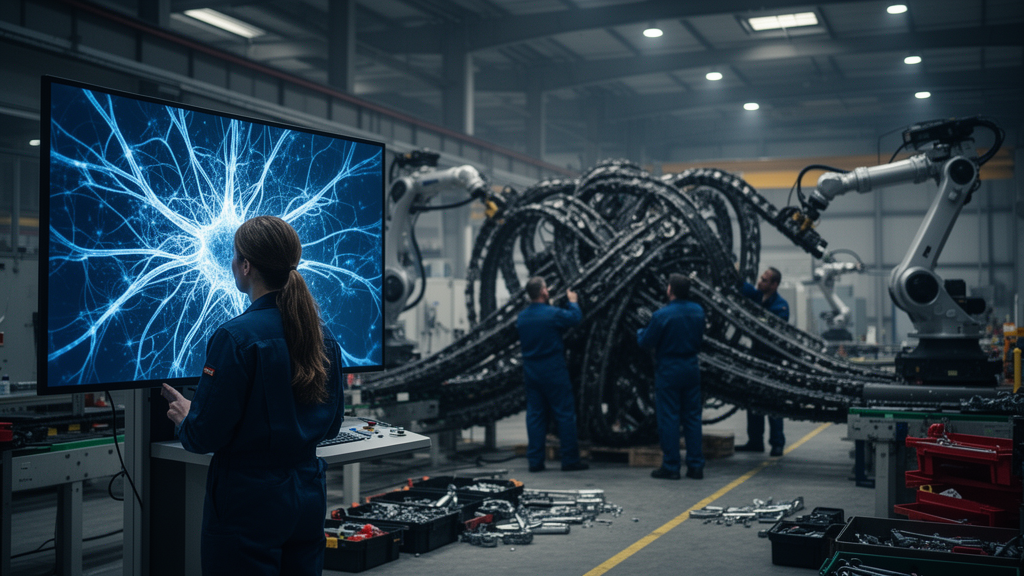
High-end equipment manufacturers face a nasty class of failures that researchers call compound disruptions: a natural disaster may physically fragment an operations and maintenance network while, at the same moment, trade sanctions choke off critical resource flows. Each risk type alone is hard enough, but together they create a recovery problem in which fixing the network’s structure and rescheduling scarce resources constantly interfere with each other. A new study published in Scientific Reports tackles this coupled challenge with a hierarchical artificial intelligence approach that learns to reconfigure networks and allocate resources as one integrated decision.
The research team, led by Chen Wei, Ping-feng Liu and Wan-ying Rao, built a dual-layer model that separates a manufacturing system into a business network and a resource network. Recovery therefore requires two coordinated moves: reconfiguring the damaged network topology, and scheduling heterogeneous, category-specific resources across multiple projects that compete for them under contractually binding delivery deadlines. Because reconfiguration changes which scheduling decisions are even feasible, while scheduling outcomes feed back into how well a reconfiguration performs, the two layers cannot be optimized in isolation.
To handle this coupling, the authors developed a dual-agent algorithm based on hierarchical multi-agent proximal policy optimization, abbreviated HMA-PPO. Its defining architectural feature is a hierarchical conditional coordination mechanism. The reconfigured network is passed forward to construct the state and feasible decision conditions for downstream resource scheduling, while both agents’ decisions are jointly evaluated as a single recovery solution.
The resulting system-level evaluation is then shared by both agents when they update their policies, so each learns in the context of the other. The method was benchmarked against established alternatives, including Multi-Agent Proximal Policy Optimization (MAPPO) and Adaptive Large Neighborhood Search (ALNS), using numerical experiments on three small instances and one large network. The results were striking: HMA-PPO achieved the lowest mean objective value among all tested baselines, and on the three small instances it reached the exact optimum every time.
Once trained, the system needed only about 0.24 seconds to make an online decision, a speed that matters when disruptions demand rapid response. The advantage grew with problem size. On the large network, HMA-PPO’s mean objective value was 12.84 percent lower than MAPPO’s and 7.21 percent lower than ALNS’s, and the authors report that this relative solution-quality advantage becomes more evident as the tested decision space expands.
Beyond algorithmic performance, the scenario analyses delivered a sobering message about compound risk itself. When both natural disasters and trade sanctions were modeled together, total operations and maintenance cost rose by 25.17 percent on average compared with a single natural-disaster scenario.
The study also found that backup-supplier configuration and operating margins materially affect recovery resilience, meaning that how a firm structures its supplier base before a crisis shapes how badly a compound disruption hurts afterward. These findings carry practical weight for resilience management in advanced manufacturing and for operations research more broadly, offering what the authors describe as a unified perspective on coupled structural recovery and constrained resource allocation. Rather than treating network repair and resource scheduling as separate problems handled by separate departments, the framework evaluates them together, reflecting how disruptions propagate through the modeled factory system.
The study translates its results into concrete guidance. Enterprises should diversify their backup-supplier portfolios, but the authors caution against relying on supplier count alone; quality, usable capacity, transportation conditions and delivery reliability should be assessed jointly. They also recommend stress testing to identify scenario-specific operating buffers, and prioritizing scarce resources according to project urgency, resource criticality and contractual delivery requirements.
As a numerical modeling study, the work tests its algorithm on simulated instances rather than live factory data, so its performance figures describe the tested scenarios. Even so, a learning system that can weigh network structure and resource allocation simultaneously, and respond in a fraction of a second once trained, offers one route toward recovery strategies that hold up when risks compound rather than arrive one at a time.
Subject of Research: Hierarchical multi-agent reinforcement learning for operations and maintenance disruption recovery under compound risks in high-end equipment manufacturing
Article Title: Hierarchical multi-agent reinforcement learning for operations and maintenance disruption recovery in high-end equipment manufacturing under compound risks
Article References: Wei, C., Liu, P.-F., & Rao, W.-Y. (2026). Hierarchical multi-agent reinforcement learning for operations and maintenance disruption recovery in high-end equipment manufacturing under compound risks. Scientific Reports. https://doi.org/10.1038/s41598-026-77012-8
Image Credits: AI Generated
DOI: 10.1038/s41598-026-77012-8
Keywords: multi-agent reinforcement learning, disruption recovery, high-end equipment manufacturing, operations and maintenance, compound risks, network reconfiguration, resource scheduling, supply chain resilience, proximal policy optimization, trade sanctions, natural disasters, operations research
Cite Scienmag News
Denise Maddox. (October 28, 2026). AI Learns to Untangle Factory Breakdowns When Disasters and Sanctions Strike Together. Scienmag. https://scienmag.com/ai-learns-to-untangle-factory-breakdowns-when-disasters-and-sanctions-strike-together/
Denise Maddox. "AI Learns to Untangle Factory Breakdowns When Disasters and Sanctions Strike Together." Scienmag, 28 October 2026, https://scienmag.com/ai-learns-to-untangle-factory-breakdowns-when-disasters-and-sanctions-strike-together/. Accessed 4 November 2026.
Denise Maddox. "AI Learns to Untangle Factory Breakdowns When Disasters and Sanctions Strike Together." Scienmag. October 28, 2026. https://scienmag.com/ai-learns-to-untangle-factory-breakdowns-when-disasters-and-sanctions-strike-together/