


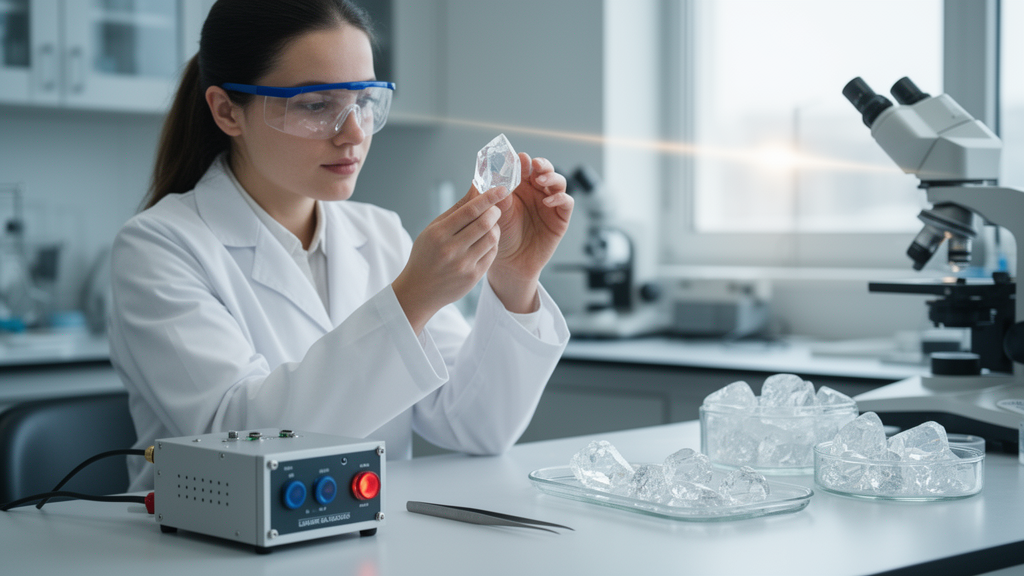
Every trace gas sensor built around quartz-enhanced photoacoustic spectroscopy, or QEPAS, lives and dies by a tiny mechanical heart: a quartz tuning fork that converts faint acoustic waves into electrical signals. The trouble is that quartz, for all its reliability, is a mediocre piezoelectric material. Its piezoelectric charge constants are modest, and its electrodes corrode in harsh environments, capping the sensitivity of the most advanced laser spectrometers. Now a team at Shanxi University in China has deployed an upgraded artificial intelligence model to comb through tens of thousands of crystalline materials in search of something better — crystals that are not only strongly piezoelectric but also respond to visible light, a combination that could unlock a new generation of self-sensing photoacoustic and photothermal detectors.
The research, published in Frontiers in Physics, tackles a long-standing bottleneck in materials science. Piezoelectricity in a crystal is dictated by its atomic structure, while the range of light it can absorb is governed by its electronic band structure. Both properties can, in principle, be computed from first principles using density functional theory, or DFT. But DFT calculations become exponentially more expensive as the number of atoms grows, making them impractical for screening entire databases. Machine learning offers a shortcut that is orders of magnitude faster, and graph neural networks in particular have emerged as the tool of choice for predicting the properties of crystalline materials, because they can learn flexible representations directly from atomic structure rather than relying on fixed, hand-crafted descriptors.
The Shanxi team, led by Peng Chen, Gaiying Meng, Yongming Fu, and Jie Ma, started from the crystal graph convolutional neural network, or CGCNN, a landmark architecture developed at MIT that represents a crystal as a graph: atoms become nodes, and the interactions between neighboring atoms become edges. CGCNN achieved accuracy comparable to first-principles calculations, but it has a blind spot. It updates the feature vectors of atoms during its convolutional layers yet leaves the bond feature vectors — the mathematical descriptions of interatomic connections — frozen. In a crystal, where the geometry and strength of bonds largely determine both elastic and electronic behavior, that omission wastes information.
The researchers’ answer is an improved version they call I-CGCNN. The model adds a dedicated algorithmic module that learns bond feature vectors through a hidden fully connected layer, extracts the most salient bond characteristics with a maximum pooling operation, and normalizes the results with a one-dimensional batch normalization layer to speed convergence. Crucially, during each round of convolution the network synchronously updates both the atomic and the bond feature vectors: the updated bond information, enriched by gated convolution with the atom vectors, is folded back into the atomic representation, and both carry forward into the next layer. The team also tailored the network depth to crystal size, using three convolutional layers for crystals with fewer than 20 atoms and five layers for larger structures, so that feature extraction scales with structural complexity.
To train and test the model, the researchers assembled a formidable dataset. They screened the Materials Project database for crystals belonging to the 20 piezoelectric point groups — a set spanning 130 space groups — and, after merging duplicates and carefully handling transition metal dichalcogenides whose properties depend on layer count and stacking, arrived at 46,389 piezoelectric materials. Restricting the set to crystals with fewer than 30 atoms, for synthetic feasibility, they faced a subtle data-quality problem: a large fraction of entries carried zero values for bandgap or piezoelectric modulus, some because calculations confirmed the property was genuinely absent and others simply because the database had never run the calculation. Including those ambiguous zeros would have injected label noise and distorted the model’s learning, so the team trained only on samples with confirmed non-zero values, then used the trained model in a second pass to fill in the gaps across the full database.
The performance gains were substantial. On the bandgap task, I-CGCNN converged within the first 20 training epochs and matched the original model’s best accuracy in just 40, ultimately reaching a mean absolute error of 0.265 electronvolts — a 25 percent improvement over the original CGCNN’s 0.35. On the piezoelectric modulus task, the improved model achieved an error of 0.655 against 0.812 for the baseline, a 20 percent gain. Head-to-head against four other benchmark architectures — the graph convolutional network, MEGNet, message-passing neural networks, and SchNet — I-CGCNN cut bandgap prediction errors by roughly 8.7 to 36 percent, with its largest advantage, nearly 40 percent, coming against the message-passing model. A visualization analysis using t-distributed stochastic neighbor embedding confirmed that the model’s internal representations clustered crystal structures with similar properties more cleanly than its competitors.
Perhaps most convincingly, the team validated the model against ground truth. They randomly selected 20 piezoelectric materials, computed their bandgaps with first-principles methods, and compared the results with I-CGCNN’s predictions. For materials in the critical 0.8 to 1.8 electronvolt screening window, the discrepancies were just 0.153 and 0.269 electronvolts; for six materials with zero bandgap, errors ranged from 0.02 to 0.08 electronvolts; and for wider-gap materials, errors stayed between 0.02 and 0.3 electronvolts. That level of agreement, the authors report, places the neural network’s accuracy on par with DFT itself — at a tiny fraction of the computational cost.
With the model validated, the researchers turned it loose on the corrected database, which after prediction and deduplication comprised 21,791 light-responsive piezoelectric candidates. The chemical census is telling: sulfides dominate the pool at roughly 35.8 percent of entries, with transition-metal cations accounting for nearly 43 percent of that family, followed by oxides at about 31.4 percent, rich in lanthanide-containing compounds, and nitrides at around 10.6 percent. Applying filters for structural simplicity, a visible-light bandgap between 0.8 and 1.8 electronvolts — a window widened deliberately because the database’s standard calculations systematically underestimate bandgaps by 40 to 50 percent — and a piezoelectric modulus above 5 coulombs per square meter, the team distilled a shortlist of high-value crystals.
Several names on that shortlist stand out. NaBiS2 and TlNO2 had already been flagged as promising piezoelectric semiconductors in earlier high-throughput studies, an independent check on the new model’s reliability. But the standout candidates are CdGeO3, Sm2CdSe4, and BaNiO3, each predicted to have a piezoelectric modulus exceeding 15 coulombs per square meter — orders of magnitude above that of alpha-quartz — while maintaining moderate atomic counts and documented optical properties. Even more intriguing is La2O3, a compound known as an efficient electrocatalyst for oxygen evolution reactions but never before recognized as piezoelectric. The model predicts it possesses both a visible-range bandgap and a meaningful piezoelectric response, suggesting an entirely overlooked resonator material hiding in plain sight.
The implications reach beyond a single sensor architecture. The piezo-phototronic effect — the coupling of semiconductor physics, piezoelectricity, and photoexcitation first demonstrated in zinc oxide nanorods in 2010 and extended to monolayer molybdenum disulfide in 2014 — can dramatically enhance charge generation, transport, and separation in optoelectronic devices. Yet its integration with photoacoustic and photothermal transduction has remained largely unexplored. A resonator that itself absorbs the excitation laser could enable compact, multi-modal gas sensors in which the detection element is simultaneously the transducer and an optical receiver. The Shanxi researchers caution that predicted bandgaps and piezoelectric moduli are only indicators of potential; turning any of these crystals into a practical quartz tuning fork replacement will require experimental work on mechanical quality factor, elastic properties, dielectric loss, resonator geometry, and crystal orientation. Still, the study demonstrates that a smarter graph neural network can compress years of trial-and-error materials discovery into a computational sweep — and that the next breakthrough in laser gas sensing may already be sitting, unassuming, in a public crystal database.
Subject of Research: Deep learning screening of visible-light-responsive piezoelectric crystals for photoacoustic and photothermal spectroscopy
Article Title: Deep learning assisted screening of light-responsive piezoelectric crystals for next-generation photoacoustic and photothermal spectroscopy
Article References: Chen, P., Meng, G., Fu, Y., & Ma, J. (2026). Deep learning assisted screening of light-responsive piezoelectric crystals for next-generation photoacoustic and photothermal spectroscopy. Frontiers in Physics, 14, Article 1992795. https://doi.org/10.3389/fphy.2026.1992795
Image Credits: AI Generated
DOI: 10.3389/fphy.2026.1992795
Keywords: piezoelectric materials, graph neural networks, photoacoustic spectroscopy, QEPAS, bandgap prediction, materials discovery, piezo-phototronics, deep learning, crystal graph convolutional neural network, gas sensing, Materials Project, photothermal spectroscopy
Cite Scienmag News
Blake Davidson. (October 16, 2026). AI Hunts for Crystals That Could Replace Quartz in Laser Gas Sensors. Scienmag. https://scienmag.com/ai-hunts-for-crystals-that-could-replace-quartz-in-laser-gas-sensors/
Blake Davidson. "AI Hunts for Crystals That Could Replace Quartz in Laser Gas Sensors." Scienmag, 16 October 2026, https://scienmag.com/ai-hunts-for-crystals-that-could-replace-quartz-in-laser-gas-sensors/. Accessed 16 October 2026.
Blake Davidson. "AI Hunts for Crystals That Could Replace Quartz in Laser Gas Sensors." Scienmag. October 16, 2026. https://scienmag.com/ai-hunts-for-crystals-that-could-replace-quartz-in-laser-gas-sensors/


