A study published in PLOS One presents a mathematical model of how knowledge spreads through organizations when artificial intelligence reshapes the channels of acquisition. Researchers Yanhua Lv, Yadong Wang, Huanhuan Wang and Sida Kang developed a multi-stage dynamic model that combines an SEIR-type framework with cellular automata to capture both the progression of knowledge among employees and its spatiotemporal evolution across an organization.
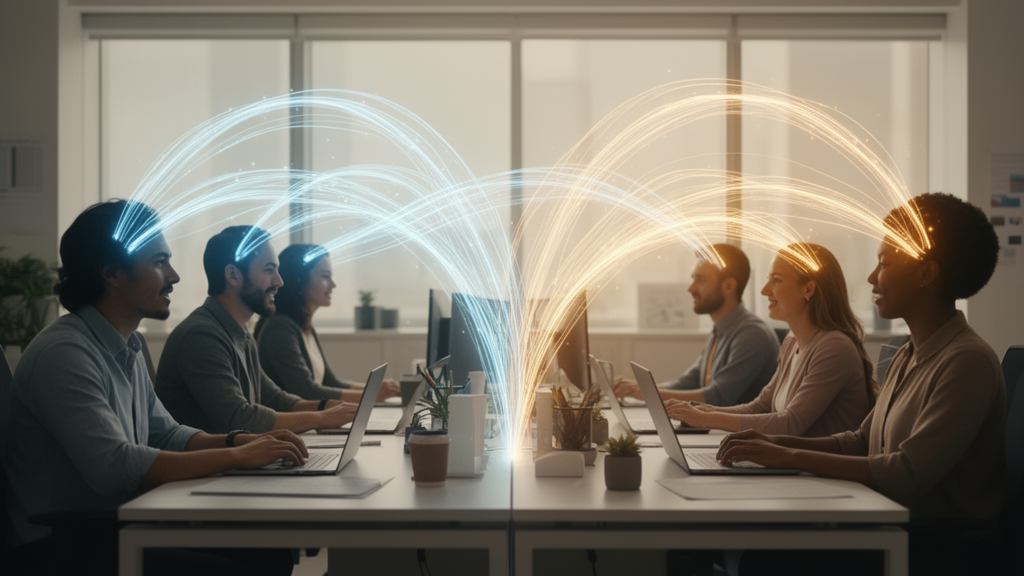
The model classifies employees into five states: those who have not yet mastered the knowledge, those with limited mastery, those with strong mastery, knowledge-disseminating employees, and knowledge-exited employees. Dissemination occurs through a dual-channel mechanism pairing traditional interpersonal interaction with AI-enabled human-machine interaction. Using the next-generation matrix method, the authors calculate a basic reproduction number for the system and analyze the existence and stability of equilibrium points.
The results indicate a pronounced threshold effect: when key dissemination parameters exceed their critical levels, knowledge continues to diffuse within the organization, but below those levels it gradually decays. According to the model, the AI-enabled mechanism enhances knowledge transformation efficiency and contact intensity, promoting the transition of employees with strong knowledge mastery into active disseminators.
The researchers also formulated an optimal control model to derive strategies for promoting dissemination under resource constraints. They report that this strategy can optimize transformation pathways across different stages, improving overall dissemination efficiency while maintaining the structural stability of the dissemination system. Cellular automaton simulations further suggest that, under optimal regulation, knowledge dissemination can form a stable diffusion pattern with high coverage.
The authors emphasize that these findings hold under the assumptions and parameter settings of the proposed model. As a theoretical and simulation-based contribution rather than an empirical study of specific firms, the work offers model-based insights into the dynamics of AI-enabled knowledge dissemination and potential implications for organizational knowledge management practices.
Subject of Research: Mathematical modeling of AI-enabled dual-channel knowledge dissemination in organizations
Article Title: Dynamic analysis and spatiotemporal evolution of multi-stage knowledge dissemination under AI-enabled dual-channel “Interpersonal–Human-Machine” interaction
Article References: Lv, Y., Wang, Y., Wang, H., & Kang, S. (2026). Dynamic analysis and spatiotemporal evolution of multi-stage knowledge dissemination under AI-enabled dual-channel “Interpersonal–Human-Machine” interaction. PLOS One, 21(10), e0361482. https://doi.org/10.1371/journal.pone.0361482
Image Credits: AI Generated
DOI: 10.1371/journal.pone.0361482
Keywords: knowledge dissemination, artificial intelligence, SEIR model, cellular automata, optimal control, knowledge management, organizations, threshold effect, human-machine interaction, Dynamic, analysis, spatiotemporal
Cite Scienmag News
Bianca Avery. (October 30, 2026). AI-Enabled Dual-Channel Model Shows Threshold Effect in Workplace Knowledge Spread. Scienmag. https://scienmag.com/ai-enabled-dual-channel-model-shows-threshold-effect-in-workplace-knowledge-spread/
Bianca Avery. "AI-Enabled Dual-Channel Model Shows Threshold Effect in Workplace Knowledge Spread." Scienmag, 30 October 2026, https://scienmag.com/ai-enabled-dual-channel-model-shows-threshold-effect-in-workplace-knowledge-spread/. Accessed 31 October 2026.
Bianca Avery. "AI-Enabled Dual-Channel Model Shows Threshold Effect in Workplace Knowledge Spread." Scienmag. October 30, 2026. https://scienmag.com/ai-enabled-dual-channel-model-shows-threshold-effect-in-workplace-knowledge-spread/