

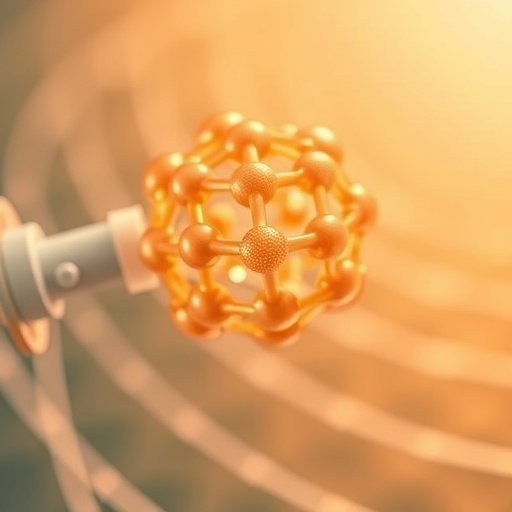
In the rapidly evolving landscape of biotechnology, lipid nanoparticles (LNPs) have emerged as the unsung heroes behind groundbreaking mRNA therapies, including the transformative COVID-19 vaccines. Yet, the complexity inherent in designing these nanoparticles has posed a formidable challenge: each formulation requires a delicate balance of multiple lipid components, where the ratios directly impact the efficiency and targeting of genetic material delivery within cells. This intricate interplay remains poorly understood, largely due to an overarching scarcity of comprehensive data that can map chemical variations to biological outcomes. Until now, this data bottleneck has stymied researchers’ ability to leverage the full potential of artificial intelligence (AI) in LNP design.
Enter LIBRIS—short for “LIpid nanoparticle Batch production via Robotically Integrated Screening”—a revolutionary platform developed by engineers at the University of Pennsylvania that promises to upend the pace and scale at which LNP formulations can be generated. Utilizing cutting-edge automation and microfluidics technology, LIBRIS can produce roughly 1,000 distinct lipid nanoparticle samples per hour, a staggering increase—nearly 100 times faster—over traditional manual microfluidic workflows. This leap in productivity not only accelerates discovery but also holds the key to generating the vast and precise datasets AI requires to decode the nuanced relationships between nanoparticle composition and therapeutic impact.
The challenge with LNP formulation lies not only in the sheer number of possible combinations—estimated to be on the order of 10^15—but also in the precision required to mix these components. Conventional methods demand painstaking serial processing: ingredients are mixed one batch at a time, with laborious cleaning and setup between runs. Such processes not only consume valuable time but introduce variability, complicating the consistency and reliability of experimental data. Even robotic liquid handlers, while adept at preparing large libraries of lipid ingredients, suffer from inconsistent mixing techniques, further limiting the reproducibility of LNP formulations.
LIBRIS radically transforms this paradigm by integrating a microfluidic chip equipped with multiple parallel channels—up to eight simultaneously—that mix lipid components in tightly controlled conditions. This parallelization enables continuous operation, as the system swiftly cleans each channel post-formulation, thereby eliminating downtime that historically hampered throughput. The microchip itself is encased in an aluminum housing with carefully calibrated pressure controls, ensuring that the mixing environment remains stable and reproducible at the microscale. Beneath the chip, an agile plastic well-plate dynamically captures discrete nanoparticle streams, effectively turning the platform into a tiny factory for LNP production.
What sets LIBRIS apart is not just its speed but its precision. By maintaining strict control over the ratios and chemical properties of each lipid component, the platform produces highly defined nanoparticle libraries. This is critical for training machine learning models, which rely on large datasets of well-characterized examples to detect subtle patterns and generate predictive insights. According to David Issadore, professor of bioengineering and co-senior author of the study, the ability of AI to unlock the full therapeutic potential of LNPs depends on the availability of such comprehensive and consistent data sets—a gap LIBRIS directly addresses.
Historically, LNP development has been driven by trial-and-error methodologies, where researchers generate families of related nanoparticles, test them in vitro or in vivo, and then retrospectively analyze which formulations perform best. While this approach paved the way for successes like FDA-approved mRNA vaccines, it remains a slow and inefficient process that offers little foresight into the behavior of novel formulations. LIBRIS promises a shift from this reactive paradigm to a proactive, rational design process where specific particle properties can be targeted and synthesized on demand.
This vision of rational design entails not just asking “Which particle works best?” but fundamentally inverting the question: “What properties do we want the particle to have, and how can we engineer it to achieve those goals?” Realizing this requires a detailed map that connects chemical inputs to biological outcomes—a map that emerges only from massive, high-quality datasets. With its unprecedented throughput and reproducibility, LIBRIS provides precisely the foundation researchers need to begin constructing this map and training predictive AI models capable of guiding the future of LNP therapeutics.
The implications of LIBRIS extend far beyond academic inquiry. LNPs underpin diverse therapeutic applications, from vaccines and gene editing to targeted cancer therapies and treatments for genetic disorders. Accelerating formulation development not only shortens the pipeline from concept to clinic but also expands the ability to tailor nanoparticles to specific diseases and patient populations. This convergence of microfluidic engineering, robotics, and artificial intelligence sets the stage for a new era in precision medicine—one where bespoke nanoparticles are designed systematically rather than discovered by chance.
Underpinning this breakthrough are fundamental technical innovations. The microfluidic chip’s aluminum casing ensures thermal and mechanical stability during the mixing process, while precisely regulated microchannels control fluid dynamics at a microscale level, minimizing variations that could impede reproducibility. The platform’s ability to clean channels rapidly between formulation cycles mitigates cross-contamination risks, which historically limited the scale of studies. Together, these innovations culminate in a platform capable of delivering robust, high-throughput experimentation suited to the stringent demands of AI-driven research.
The LIBRIS project, spearheaded by Associate Professor Michael J. Mitchell and Professor David Issadore at the University of Pennsylvania School of Engineering and Applied Science, represents a collaborative effort propelled by interdisciplinary expertise spanning bioengineering, microfluidics, and computational modeling. Supported by prominent funding agencies including the National Science Foundation and the American Cancer Society, the initiative underscores the critical intersection of engineering innovation and biomedical research in advancing healthcare frontiers.
Looking ahead, the research team envisions leveraging LIBRIS for iterative nanoparticle design cycles, wherein AI models trained on LIBRIS-generated data inform the next round of formulations in a feedback loop. Such an approach would continually refine nanoparticle properties in silico before physical synthesis, vastly enhancing efficiency and precision. This synergistic integration of robotics and machine learning could revolutionize not only LNP therapeutics but also a broader range of nanomedicine applications where complex formulation design is a persistent bottleneck.
In summary, the development of LIBRIS heralds a transformative moment for lipid nanoparticle research. By enabling rapid, automated, and parallelized production of large and finely tuned nanoparticle libraries, this platform breaks through longstanding data limitations, unleashing the potential of AI to guide rational design. As the biomedical community increasingly embraces AI-driven methodologies, tools like LIBRIS will be indispensable in translating vast chemical spaces into clinically impactful therapies, charting a new path toward precision nanomedicine.
Subject of Research: Cells
Article Title: Automated and Parallelized Microfluidic Generation of Large and Precisely Defined Lipid Nanoparticle Libraries
News Publication Date: 26-Dec-2025
Web References: DOI:10.1021/acsnano.5c15613
References: University of Pennsylvania School of Engineering and Applied Science
Image Credits: Bella Ciervo
Keywords
Lipid Nanoparticles, Microfluidics, Automated Nanoparticle Synthesis, Artificial Intelligence, Drug Delivery, mRNA Therapeutics, Nanomedicine, Parallelized Screening, Rational Nanoparticle Design, Bioengineering, Microfluidic Chip, High-throughput Nanoparticle Production


