


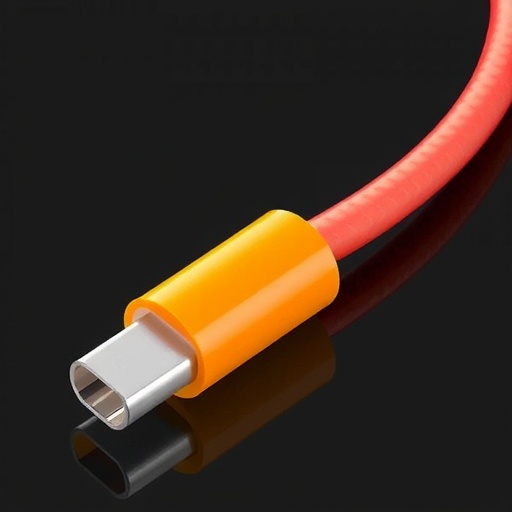
In the rapidly evolving landscape of wearable technology, the quest for electronics that can effortlessly conform to the complex contours of the human body has reached a pivotal milestone. Recently, researchers have unveiled a groundbreaking development in the form of a three-dimensional stretchable core–shell cable, designed to revolutionize the interface between soft electronics and electronic units whether soft, rigid, or hybrid in nature. This innovation promises to address the critical challenge of creating multiscale, patternable, and reliable interconnects that maintain both mechanical resilience and electrical integrity under extreme deformation.
Wearable devices demand components that are not only flexible but stretchable to an exceptional degree, seamlessly integrating with the dynamic movements of the wearer. Traditional wiring and interconnect technologies have long struggled to accommodate this need due to limitations in material flexibility, stretchability, and interface reliability. The novel three-dimensional cable presented by Wu, Jia, Li, and their team transcends these barriers by combining a core–shell architecture that is both mechanically robust and electrically conductive, all while being recyclable and compatible with scalable manufacturing techniques.
At the heart of this innovation lies a stretchable cable with a Young’s modulus of approximately 0.9 MPa, which situates it firmly within the soft material regime, facilitating natural movement without causing discomfort or damage to the device or wearer. Remarkably, the cable exhibits a maximum stretchability nearing 800%, a feature that allows it to undergo substantial elongation without compromising its function. This elasticity is particularly vital for applications in wearable physiological monitoring, where the cable must respond resiliently to body movement without signal degradation.
Resistance stability under strain is a notable hallmark of the core–shell cable. Conventional stretchable conductors typically experience increased electrical resistance as they are elongated, resulting in signal noise and reduced reliability. In contrast, the cable developed here demonstrates almost negligible resistance change even when stretched to its maximum capacity. This attribute is instrumental in maintaining the fidelity of signals, which is essential for sensitive physiological monitoring and other precise electronic measurements.
The cable’s core–shell design contributes significantly to its enhanced durability and electrical performance. The inner core, responsible for electrical conduction, is encapsulated by a stretchable shell that provides mechanical integrity and protection from environmental factors. This configuration not only prolongs the lifespan of the cable but also minimizes mechanical interference effects that commonly plague stretchable electronic interconnects.
Addressing the practicalities of device integration, the researchers devised a room-temperature connection process that enables the cables to form reliable and robust interfaces with various conductive pads. This approach eliminates the need for high-temperature soldering, which can damage sensitive components or substrates and limits the scope of materials that can be joined. The compatibility with low-temperature processing broadens the cable’s applicability across diverse electronic platforms, ranging from soft, flexible substrates to rigid circuit boards.
Moreover, the stretchable cable is patternable, enabling precise and customizable cable geometries that can be tailored to the specific requirements of different devices and applications. This feature not only supports mass manufacturing but also facilitates the creation of complex circuitry layouts that retain mechanical resilience, a crucial step towards the commercialization of soft wearable electronics.
Equally impressive is the high recycling rate of the cable’s manufacturing process, reaching up to 95%. Sustainability is an increasingly critical aspect of materials development, particularly in consumer electronics, where rapid obsolescence and disposal contribute to environmental burden. By integrating recyclability without compromising performance, this technology sets a new standard for responsible innovation in stretchable electronics.
In practical demonstration, the stretchable core–shell cables were used to construct hybrid electronic systems that maintained electrical performance under extensive mechanical stretching. These hybrid systems blend soft and rigid electronic components, a combination traditionally difficult to interconnect stably due to mismatched mechanical properties. The core–shell cables harmonize these disparate elements into cohesive devices capable of enduring real-world wearable scenarios.
The reliability of the cable under mechanical interference extends beyond mere stretching; it also exhibits resistance to noise induced by motion artifacts and external environmental disturbances. This makes it particularly suitable for physiological monitoring, where accurate signal acquisition amidst daily activity-induced noise is paramount. The prospect of wearable health devices delivering consistent and accurate data brings immense potential for personalized medicine and continuous health monitoring.
Underlying the success of this technology is a fabrication process that is versatile across multiple scales. From microfabricated sensors to larger wearable platforms, the compatibility of the cable’s production with existing manufacturing infrastructures promises feasible integration into existing supply chains. This scalability is key for transitioning from laboratory prototypes to commercially viable products.
The impact of this development extends beyond wearables to encompass soft robotics, implantable devices, and flexible displays. Any device demanding mechanically compliant but electrically reliable interconnects stands to benefit from the three-dimensional stretchable core–shell cable. By resolving the persistent challenge of creating stretchable cables that combine reliability, ease of patterning, and sustainability, this technology charts a course for the next generation of soft electronics.
Looking forward, the potential to integrate this cable technology with emerging conductive materials such as liquid metals, nanowires, or conductive polymers could further enhance its performance envelope. Additionally, ongoing work to refine the interfacial chemistry and mechanical properties may pave the way for even greater stretchability and durability.
In summary, the introduction of this three-dimensional stretchable core–shell cable represents a seminal step forward in soft and hybrid electronics. Its unique confluence of exceptional mechanical properties, electrical stability, patternability, recyclability, and noise resistance addresses several critical pain points in wearable and flexible electronics design. As these cables begin to find their way into next-generation devices, they promise to unlock new possibilities for seamless human-technology integration, embedded health monitoring, and beyond.
Cite Scienmag News
Denise Maddox. (March 31, 2026). 3D Stretchable Core-Shell Cable: Soft, Recyclable, Noise-Resistant. Scienmag. https://scienmag.com/3d-stretchable-core-shell-cable-soft-recyclable-noise-resistant/
Denise Maddox. "3D Stretchable Core-Shell Cable: Soft, Recyclable, Noise-Resistant." Scienmag, 31 March 2026, https://scienmag.com/3d-stretchable-core-shell-cable-soft-recyclable-noise-resistant/. Accessed 4 September 2026.
Denise Maddox. "3D Stretchable Core-Shell Cable: Soft, Recyclable, Noise-Resistant." Scienmag. March 31, 2026. https://scienmag.com/3d-stretchable-core-shell-cable-soft-recyclable-noise-resistant/


