

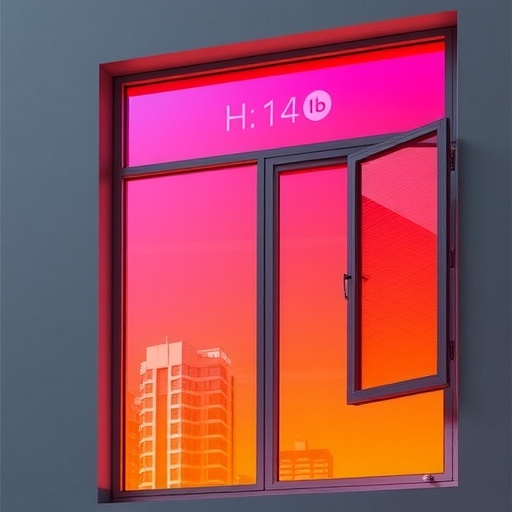
As urban landscapes continue to rise skyward with towering structures and dense cityscapes, the demand for sustainable and efficient energy solutions grows ever more critical. The integration of solar energy directly onto building surfaces represents a transformative approach to mitigating the climate crisis, particularly in heavily urbanized environments. Windows, despite comprising significant portions of building exteriors, remain a largely untapped resource for harvesting solar energy. Traditional semitransparent solar technologies, however, face substantial drawbacks, notably unsatisfactory color appearances and compromised efficiency, which hinder their adoption across architectural, automotive, and consumer electronics sectors.
In a groundbreaking leap forward, recent research published in Opto-Electronic Advances introduces an innovative design methodology that couples artificial intelligence with advanced optical modeling to revolutionize solar window technology. This approach achieves a remarkable breakthrough by enabling full-color customization of semitransparent perovskite solar cells without sacrificing their power-generating capabilities. Prior strategies predominantly relied on metallic filters to produce color effects, which unfortunately absorb and waste light, detracting from overall efficiency. Instead, this work employs sophisticated, non-metallic dielectric coatings—materials renowned for their transparency and high refractive index contrast—to produce vivid, customizable hues such as cyan, magenta, red, green, and gray.
The core novelty of this design hinges upon an AI-guided inverse design process that iteratively optimizes the thickness and layering of dielectric coatings. By leveraging interference optics principles, these transparent layers manipulate incoming light wavelengths, selectively enhancing specific colors while permitting maximal photon absorption by the underlying perovskite layer. Remarkably, this tailored interference not only improves aesthetic appeal but also boosts the device’s photovoltaic efficiency by up to 20% in comparison to conventional transparent solar cells. This contradicts the previously accepted trade-off between color vibrancy and solar generation, effectively reinventing how solar windows are conceptualized.
The implementation of such dielectric coatings marks a significant departure from metal-based filters, which remain semi-opaque and detrimental to energy conversion. The authors demonstrate that the dielectric approach can achieve its color tuning objectives purely through optical interference phenomena, leveraging multilayer stacks that modulate phase and amplitude of reflected light. This precise control enables windows to be both architecturally harmonious and energetically productive, a duality that lays the foundation for new generations of smart, energy-harvesting building envelopes that seamlessly blend aesthetics with function.
Furthermore, this technology’s versatility is underscored by its compatibility with both rigid glass substrates and flexible plastic films. Such adaptability signals broad applicability—from skyscraper façades to automotive windows and even wearable electronics—creating pathways for integrating solar energy harvesting technologies across diverse surfaces and form factors. The coatings’ high durability and optical clarity promise practical implementation across varied climatic conditions, enhancing their potential for widespread commercial adoption.
What distinguishes this innovation is its intelligent integration of AI-driven design workflows with physics-based optical modeling. Instead of relying on heuristic or trial-and-error material selection, the inverse design algorithm explores an expansive parameter space, identifying optimal coating configurations that meet user-defined color and efficiency criteria. This convergence of AI and material science propels solar window development into a new paradigm where customization and performance coexist harmoniously, empowering designers and engineers to tailor products to aesthetic preferences without compromising renewable energy output.
The implications of this development extend beyond mere cosmetic enhancements. As cities worldwide push toward net-zero carbon goals, building-integrated photovoltaics (BIPV) become instrumental in decentralized energy generation. Smart, colorful solar windows could transform urban skyscrapers into vertical power plants, significantly offsetting electricity consumption without altering the visual identity of the built environment. Simultaneously, automotive manufacturers could integrate solar harvesting into vehicle glass components, expanding the energy autonomy of electric and hybrid models without sacrificing design appeal.
Addressing the challenge of energy generation while preserving user comfort and design flexibility, this research strikes a rare balance in the renewable energy sector. It promises that future windows won’t represent a compromise between natural light transmission, color preference, and power production. By enhancing the visual integration of solar devices, it invites an accelerated penetration of renewable technologies into everyday consumer and industrial domains, hastening the transition to sustainable urban habitats.
The research group led by Prof. Sun-Kyung Kim, renowned for work in high-index contrast dielectric and metal/dielectric hybrid photonic materials, brings extensive expertise to this innovation. Prof. Kim’s team has advanced light management techniques across a wide spectral range—from ultraviolet to microwave—exemplified by previous breakthroughs such as record-efficiency silicon nanowire photovoltaics, next-generation InGaN/GaN LEDs with superior light extraction, and directional radiative cooling devices for personal electronics. This body of knowledge situates the current work at the forefront of practical photonic device engineering.
By deploying materials with engineered optical dispersions and complex nanostructures, the research achieves a sophisticated synergy among light absorption, reflection, and transmission. This creates colored solar windows that harness sunlight more effectively while offering design customization once thought unattainable in solar photovoltaic systems. Such advances highlight the transformative potential of photonic and AI technologies acting in concert to redefine the boundaries of solar energy applications.
In summary, this pioneering AI-guided design strategy opens a new chapter for semitransparent perovskite photovoltaics, where architectural aesthetics and sustainable energy goals align without compromise. It provides architects, urban planners, and product designers a versatile tool to seamlessly incorporate solar energy technologies into color-customizable windows and surfaces. As the global community intensifies sustainability commitments, such innovations will be pivotal in driving the widespread adoption of renewable energy solutions essential for carbon-neutral cities, climate-resilient infrastructure, and decentralized clean energy ecosystems. This fusion of materials science, photonics, and artificial intelligence heralds a promising future where solar power generation is as visually vibrant as it is efficient.
Subject of Research:
Semitransparent perovskite photovoltaic devices with AI-optimized dielectric coatings for full-color solar window applications.
Article Title:
Modelling-guided inverse design strategy for semitransparent perovskite photovoltaics with customized colors.
Web References:
http://dx.doi.org/10.29026/oea.2026.250218
Image Credits:
OEA
Keywords:
semitransparent device, building-integrated photovoltaic, color engineering, inverse design, active learning, dielectric coating, interference optics


