An AI-powered cough analysis tool deployed by frontline health workers in rural Andhra Pradesh screened nearly 7,900 people in six weeks, flagging about one in ten as being at medium or high risk of tuberculosis and leading to 11 confirmed diagnoses, four of them in people with no symptoms at all. The deployment, reported in Frontiers in Public Health, was a feasibility and implementation study rather than a diagnostic accuracy trial, but it offers one of the first real-world tests of whether smartphone-based acoustic screening can function inside routine community healthcare workflows.
The tool, called Swaasa, is a software-as-a-medical-device product developed by Salcit Technologies in Hyderabad. It uses machine learning algorithms to analyze voluntary cough sounds recorded on ordinary smartphones, extracting acoustic biomarkers that previous research has linked to respiratory conditions, and combines this with guided questions about symptoms to generate risk assessments for tuberculosis, chronic obstructive pulmonary disease (COPD), and asthma. Unlike conventional TB screening, which primarily targets people who already report symptoms, the platform supports symptom-agnostic screening of whole communities.
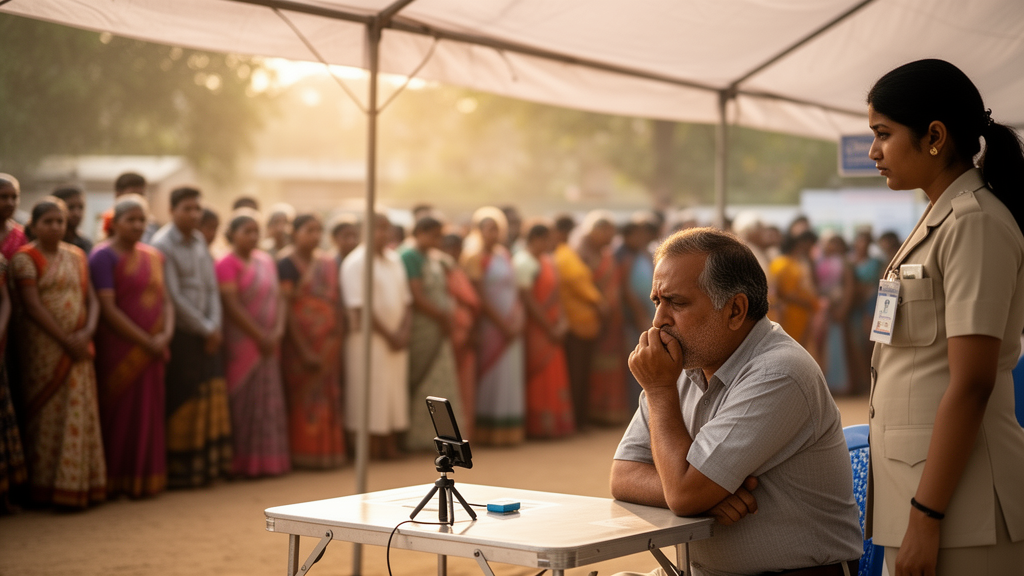
The deployment took place between 18 February and 7 April 2026 across two primary health centers, Rajanagaram and Chagallu, in East Godavari district, a largely rural area of about 1.83 million people where access to chest X-rays and spirometry is often limited by cost and infrastructure. Trained Accredited Social Health Activists and Auxiliary Nurse Midwives conducted house-to-house visits, recording cough audio and collecting symptom information after obtaining electronic informed consent. Of an eligible vulnerable population of 18,684 people, 7,879 were screened, roughly 42 percent coverage in six weeks, averaging about 225 screenings per day.
The platform stratified each participant into green, amber, or red risk categories, and those classified at medium or high TB risk were referred for confirmatory testing with nucleic acid amplification tests, the WHO-recommended molecular method for TB diagnosis. In total, 780 people, about 10 percent of those screened, were flagged and referred, and 11 were confirmed to have tuberculosis, an observed yield of 1.41 percent among referred individuals. Notably, 36 percent of the confirmed cases, four people, were asymptomatic, which the authors say illustrates the tool’s potential to detect cases that symptom-based pathways would miss.
Among the small subset of flagged individuals who reported symptoms, the yield was far higher: seven of 23 symptomatic Swaasa-positive people were diagnosed with TB, an observed yield of 30.4 percent. The authors also compared their results descriptively with historical active case finding data from the same district, which reported a pooled positivity of 1.34 percent (24 of 1,791 tests), but they caution that this comparison mixes different cohorts, screening periods, and referral pathways, since the historical data included both community screening and outpatient referrals, and should be read only as context, not as evidence of superiority.
Beyond tuberculosis, the platform flagged 6.5 percent of the screened population at Rajanagaram and 9.5 percent at Chagallu as being at high risk of COPD, and 1.9 percent and 1.6 percent respectively as being at risk of asthma. Many of these flagged individuals were asymptomatic, including 82 percent of the high-risk COPD group at Chagallu. Spirometry using a portable device was performed on a subset of high-risk participants, 58 of 333 at Rajanagaram and 102 of 261 at Chagallu, and 93 to 95 percent of those tested showed abnormal results, with complete concordance between the tool’s obstructive-risk flags and spirometry-confirmed obstructive patterns. The authors stress, however, that spirometry was not performed systematically on all flagged or unflagged participants and that no low-risk comparison group was tested, so these figures represent follow-up of a selected subgroup rather than independent validation.
The study also reported overlapping respiratory risks: 2.17 percent of participants were classified at high risk for both TB and COPD, and 0.85 percent for both TB and asthma, patterns the authors note may reflect shared risk factors such as smoking, which both worsens COPD and increases susceptibility to TB through weakened lung immune defenses.
Usability proved strong. Of 42 frontline health workers involved in the field deployment, 32 completed the System Usability Scale survey, yielding mean scores of 83.8 at Chagallu and 92.6 at Rajanagaram on a 0-to-100 scale, both well above the threshold generally considered satisfactory. Perceived usefulness, measured on a five-point scale, averaged 4.37 and 5 at the two sites. Health workers reported that the system simplified and accelerated door-to-door screening and reduced dependence on manual processes, and the platform recorded a screening error rate below 1 percent.
The authors are careful about what these results do and do not show. Because confirmatory testing was directed mainly at people the algorithm flagged as medium or high risk, disease status among low-risk individuals was never systematically established, meaning sensitivity, specificity, and diagnostic accuracy cannot be calculated from this dataset. The relatively low proportion of confirmed TB cases among the 780 referred people also indicates a substantial burden of false-positive or unconfirmed referrals, which the authors say underscores the need to evaluate downstream diagnostic capacity and the burden on patients sent for testing they may not need.
As a pilot restricted to two health centers in one district over six weeks, the findings may not generalize to other populations, seasons, or health systems. Still, the study demonstrates that AI-assisted, cough-based screening can be operated by community health workers with basic smartphones and half a day of training, integrated into existing referral workflows, and accepted by both operators and participants. The authors position the technology as an initial risk-stratification tool for prioritizing people for confirmatory testing in settings with limited specialist access, rather than a diagnostic substitute, and suggest the real-world data collected can support future algorithm refinement across more diverse community settings.
Subject of Research: Feasibility of AI-based cough sound screening for tuberculosis, COPD, and asthma in a community setting in Andhra Pradesh, India
Article Title: Prospective field deployment of Swaasa® AI for community-based screening of tuberculosis and other respiratory diseases in Andhra Pradesh: a feasibility and implementation study
Article References: Nammi, V., Rao Sripada, N., De, P., Palreddy, S. D., & Pullae, S. R. M. (2026). Prospective field deployment of Swaasa® AI for community-based screening of tuberculosis and other respiratory diseases in Andhra Pradesh: a feasibility and implementation study. Frontiers in Public Health, 14, Article 1951831. https://doi.org/10.3389/fpubh.2026.1951831
Image Credits: AI Generated
DOI: 10.3389/fpubh.2026.1951831
Keywords: tuberculosis, artificial intelligence, cough analysis, community screening, COPD, asthma, digital health, Andhra Pradesh, frontline health workers, spirometry, software as a medical device, diagnostic yield
Cite Scienmag News
Ophelia Keating. (October 29, 2026). AI cough screening flags tuberculosis risk in large Indian community pilot. Scienmag. https://scienmag.com/ai-cough-screening-flags-tuberculosis-risk-in-large-indian-community-pilot/
Ophelia Keating. "AI cough screening flags tuberculosis risk in large Indian community pilot." Scienmag, 29 October 2026, https://scienmag.com/ai-cough-screening-flags-tuberculosis-risk-in-large-indian-community-pilot/. Accessed 29 October 2026.
Ophelia Keating. "AI cough screening flags tuberculosis risk in large Indian community pilot." Scienmag. October 29, 2026. https://scienmag.com/ai-cough-screening-flags-tuberculosis-risk-in-large-indian-community-pilot/