

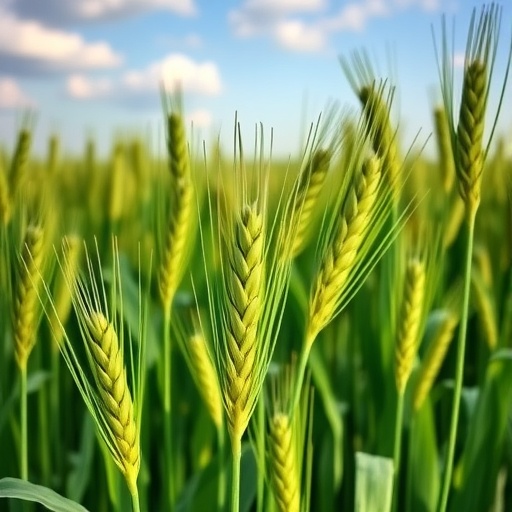
In the quest to maximize crop yields amidst the mounting challenges of climate change and environmental variability, scientists have turned their focus to a critical but complex aspect of plant biology: the interaction between genotype and environment. This interaction, the dynamic interplay between a plant’s genetic makeup and the conditions in which it grows, fundamentally influences agricultural productivity and stability. Understanding and precisely modeling these genotype-environment (G×E) interactions could revolutionize how crop varieties are selected and bred, tailoring them to specific local conditions for peak performance.
A recent pioneering study has pushed this frontier by integrating massive datasets that encompass genetic, phenotypic, and environmental variables to develop predictive models that do not just forecast average crop yields but project how individual wheat varieties would perform under distinct environmental parameters. This nuanced approach has significant implications for breeding winter wheat—a staple crop for much of the world. The research analyzed data spanning over a decade, dissecting the performance of more than 13,200 genotypes evaluated across 31 diverse locations in Central Europe, a region characterized by complex microclimates and variable farming conditions.
Crucially, the researchers combined phenotypic data, which captures observable characteristics like grain yield, with rich genomic information. Approximately 10,000 genetic markers were used to access the underlying genetic variability of these wheat lines and hybrids. These vast genotypic datasets were then aligned with fine-grained environmental data encompassing daily temperature fluctuations, precipitation patterns, and other climatic factors. This holistic data fusion represented one of the most comprehensive attempts to encode the multifaceted nature of crop performance into predictive models.
The significance of modeling G×E interactions is akin to moving from off-the-rack suits to bespoke tailoring. Traditional yield prediction methods often apply a ‘one-size-fits-most’ approach, basing decisions on average varietal performance across a broad range of environments. This approach disregards the subtle but important ways environmental conditions modulate genetic expression, often underestimating the performance potential of certain varieties in specific locales. By contrast, environmentally informed predictions enable a precise, tailored forecast of how each genotype interacts with and responds to its unique growing conditions, dramatically improving the accuracy of yield predictions.
Among the suite of models tested—including classical statistical frameworks and state-of-the-art deep learning architectures—the best-performing model was able to predict the performance of novel wheat hybrids in distinct environments with an improvement in accuracy of up to 23 percent relative to traditional prediction methods. This enhanced accuracy is transformative; improved yield forecasts can directly influence decision-making in breeding programs, seed distribution, and farm management strategies, thereby optimizing productivity and resilience.
The study also demonstrated the tangible benefits of applying these refined predictions in practice. By selecting only the top ten percent of genotypes specifically adapted to particular environments rather than those with the highest average yields, researchers achieved an additional yield gain approaching four quintals per hectare. This is not a trivial increase; it is equivalent to the yield advances typically attained from a dozen years of conventional breeding efforts—a testament to the latent potential that precision phenotyping and genotyping unlock.
This research underpins a paradigm shift in plant breeding, transitioning from generalized varietal recommendations towards location-specific, environment-tailored cultivar deployment. It encapsulates an interdisciplinary synergy of genomics, phenomics, climatology, and computational science—an approach destined to become indispensable amid rapid environmental change. As climate patterns grow increasingly erratic, the need to cultivate crops that are resilient and productive in specific ecological niches becomes ever more urgent.
At the heart of this breakthrough is the application of deep learning techniques that assimilate vast, multidimensional datasets to uncover patterns invisible to traditional methods. These algorithms excel at deciphering non-linear relationships and complex interactions embedded in genetic and environmental data, enabling breeders to predict performance of untested genotypes with unprecedented fidelity. The integration of sensor-collected environmental parameters ensures these models remain sensitive to temporal and spatial variation, capturing the dynamic nature of growth environments.
Furthermore, the broad collaboration with industry stakeholders like KWS SAAT SE & Co. KGaA underscores the practical relevance and potential for rapid adoption of these advanced prediction models in commercial breeding pipelines. This partnership bridges the gap between academic innovation and agronomic application, fostering the translation of scientific insights into tangible improvements in crop production.
The implications extend beyond yield enhancement. Tailored genotype recommendations per environment can also mitigate risks associated with climate variability, reduce dependency on inputs by selecting varieties naturally adapted to local stressors, and ultimately contribute to more sustainable agricultural systems. Predictive breeding based on G×E interactions aligns with global goals of food security, environmental stewardship, and adaptation to climate change.
Experts in the field applaud this approach for unveiling a previously hidden layer of yield potential masked by averaging effects in traditional breeding methods. By systematically incorporating environmental responsiveness into selection criteria, the research reveals a new frontier for maximizing genetic gains and accelerating breeding cycles.
In conclusion, the integration of extensive genomic, phenotypic, and environmental data with cutting-edge predictive modeling heralds a new era in agricultural science. Precision modeling of genotype-environment interactions empowers breeders with the tools to select varieties tailored to precise locales, unlocking substantial yield gains and resilience. This research not only advances scientific understanding but holds profound promise for sustainable intensification of crop production, vital for meeting the demands of a growing global population under changing climates.
Subject of Research: Modeling genotype-environment interactions to predict and select wheat varieties optimized for specific environmental conditions.
Article Title: Predicting enviromically adapted varieties for refining candidate selection in advanced breeding stages
News Publication Date: 7-Jan-2026
Web References: 10.1186/s13059-025-03914-x
Keywords: Genotype-environment interaction, wheat breeding, yield prediction, deep learning, phenomics, genomics, climate adaptation, crop modeling, precision agriculture


