


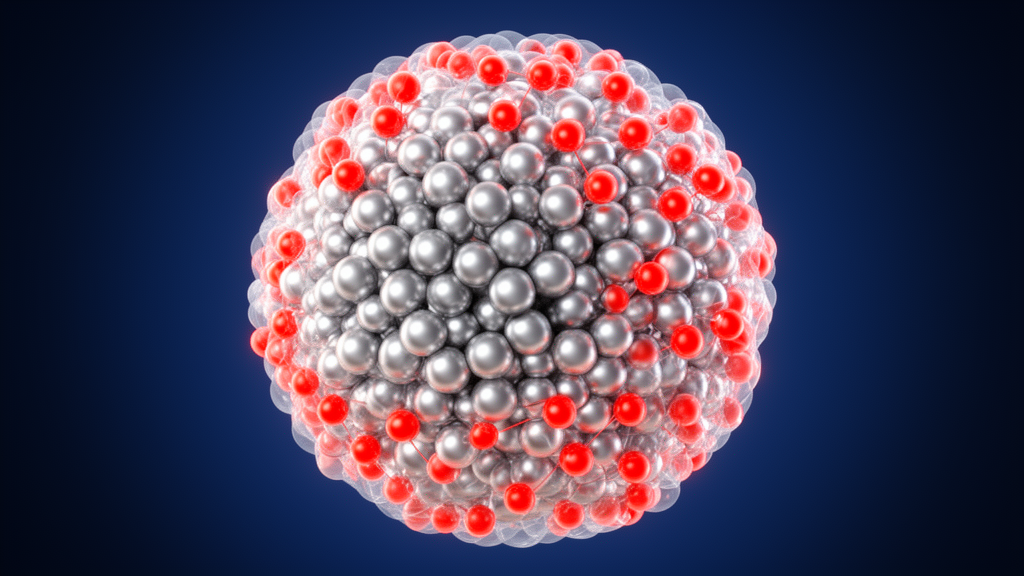
Researchers at the Advanced Institute for Materials Research at Tohoku University have developed a human-supervised artificial intelligence framework called MLP Copilot to construct accurate atomic interaction models and simulate the oxidation mechanisms of aluminum nanoparticles. Reported in the Proceedings of the National Academy of Sciences, the investigation demonstrated how multi-agent computational coordination can track complex atomic forces and uncover distinct physical behaviors governing how aluminum nanoparticles interact with oxygen.
Constructing models that describe how atoms interact has traditionally presented significant computational challenges, requiring materials scientists to manually select calculations, test iterative models, and trace interaction mechanisms. MLP Copilot addresses these bottlenecks by learning atomic energies and forces directly from quantum calculations. The resulting models make larger-scale simulations computationally feasible, while establishing reusable coordination protocols that can be adapted across diverse materials systems by tailoring training data, quantum calculations, and validation procedures to specific applications.
To evaluate the framework, the research team focused on the oxidation dynamics of aluminum nanoparticles, which hold substantial chemical energy but are constrained by a protective surface oxide shell. Across approximately 80 active-learning iterations, the team assembled a comprehensive dataset of 88,833 atomic configurations. Uncertain configurations identified during iterative cycles guided targeted quantum calculations and subsequent model training. The resulting models were validated against reference benchmarks, thermodynamic properties, and independent cluster tests before being deployed in dynamic oxidation simulations.
The atomic-scale simulations identified two distinct thermal behaviors in aluminum nanoparticles possessing an existing oxide shell. At moderate temperatures within the study, the shell exhibited a temporary nanoscale pathway that permitted continuous oxidation while restricting overall material transport, a phenomenon characterized as a breathing mode. At higher temperatures, shell rupture exposed the aluminum core to oxygen and accelerated oxidation. Mechanistic analyses supported outward aluminum transport as the dominant diffusion pathway under the examined conditions.
Throughout the computational workflow, specialized artificial intelligence agents organized project knowledge, retrieved relevant evidence, and supported validation planning, while linked computational tools preserved datasets, model iterations, and evaluation reports. Despite this automated assistance, researchers maintained direct authority over critical scientific decisions, determining which models met acceptance criteria, directing where simulations were applied, and interpreting the underlying physical results.
According to the authors, the framework functions analogously to an autopilot system, enhancing efficiency across materials investigations without removing expert human judgment from the research workflow. The methodology demonstrates a broader transition from deploying machine learning tools for isolated calculation tasks toward structuring end-to-end scientific investigations through human-agent collaboration. This structure provides a foundation for recursive self-improvement workflows, wherein validated outcomes refine the planning and tool-use strategies of future artificial intelligence agents under rigorous human supervision.
The study was published as a direct submission in the Proceedings of the National Academy of Sciences on October 15, 2026, by researchers affiliated with Tohoku University’s Advanced Institute for Materials Research. Operating under Japan’s World Premier International Research Center Initiative, the institute conducts interdisciplinary materials research combining physics, chemistry, engineering, and mathematics to generate reusable computational frameworks and fundamental physical insights for subsequent research cycles.
Subject of Research: Artificial intelligence frameworks for atomic modeling and aluminum nanoparticle oxidation
Article Title: AI agents advance atomic modeling and reveal how aluminum nanoparticles oxidize
Article References: AI agents advance atomic modeling and reveal how aluminum nanoparticles oxidize. Original publication (Bibliographic details unavailable.)
Image Credits: AI Generated
DOI: Not provided
Keywords: materials science, artificial intelligence, atomic modeling, aluminum nanoparticles, MLP Copilot, quantum calculations, active learning, computational physics, agents, advance, atomic, modeling
Cite Scienmag News
Katie Riggs. (November 10, 2026). AI Agent Framework Resolves Atomic Dynamics During Aluminum Nanoparticle Oxidation. Scienmag. https://scienmag.com/ai-agent-framework-resolves-atomic-dynamics-during-aluminum-nanoparticle-oxidation/
Katie Riggs. "AI Agent Framework Resolves Atomic Dynamics During Aluminum Nanoparticle Oxidation." Scienmag, 10 November 2026, https://scienmag.com/ai-agent-framework-resolves-atomic-dynamics-during-aluminum-nanoparticle-oxidation/. Accessed 10 November 2026.
Katie Riggs. "AI Agent Framework Resolves Atomic Dynamics During Aluminum Nanoparticle Oxidation." Scienmag. November 10, 2026. https://scienmag.com/ai-agent-framework-resolves-atomic-dynamics-during-aluminum-nanoparticle-oxidation/




