


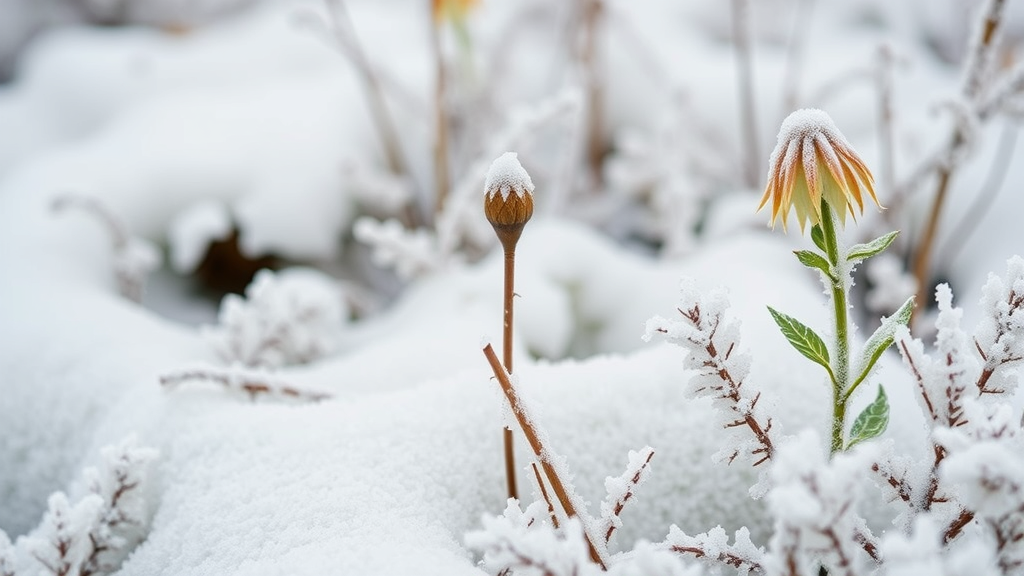
When a late-spring frost sweeps across a landscape, the damage can look devastating: young leaves blackened at the edges, tender shoots collapsed, and a canopy that had only just begun to green suddenly stripped of its promise. For decades, ecologists have treated these events as unambiguous losses, moments when a season’s productivity is permanently erased. A new study published in Nature Plants challenges that assumption on a continental scale. Analyzing vegetation across the Northern Hemisphere, the researchers report that ecosystems frequently do more than recover from late-spring frost — they overcompensate, ultimately reaching productivity levels that exceed what they would have achieved without the freeze. The finding reframes spring frost not simply as a hazard but as a disturbance that terrestrial vegetation can, under many circumstances, convert into a stimulus for renewed growth.
The study, led by H. Qiu and colleagues, documents that this overcompensation is widespread across terrestrial ecosystems rather than confined to a few resilient species or particular biomes. The authors identify two mechanisms acting in concert: a reduction in the ultimate damage inflicted by the frost, and an enhancement of regrowth in the weeks and months that follow. In other words, plants are simultaneously losing less than the initial visual damage suggests and gaining more during recovery than a simple return to baseline would predict. Together, these two processes push post-frost productivity above the level of an undisturbed year, producing the signature of overcompensation rather than mere resilience.
The concept of overcompensation is not new to plant science. Ecologists have long observed it in the context of herbivory, where plants browsed by animals sometimes regrow with such vigor that their final biomass exceeds that of unbrowsed counterparts. A 2000 review in Trends in Plant Science by A. A. Agrawal synthesized evidence for these overcompensatory responses and discussed how such effects might arise as by-product benefits of mutualistic interactions. What the new Nature Plants study adds is evidence that a similar phenomenon operates at ecosystem scale in response to an abiotic disturbance — cold, not consumption — and that it is a routine feature of vegetation dynamics across the Northern Hemisphere rather than an ecological curiosity.
The timing of spring frost exposure is itself changing, and this is where the climate dimension of the work becomes critical. Earlier research by Liu and colleagues, published in Nature Communications in 2018, showed that the extension of the growing season increases vegetation’s exposure to frost: as warming prompts earlier leaf-out, developing leaves and shoots emerge into a window when sub-zero temperatures remain a real threat. A longer growing season, paradoxically, can mean more frost days encountered by vulnerable tissue. This sets up a tension at the heart of contemporary vegetation dynamics — warming advances the start of the growing season while late-season cold snaps continue to arrive, and the intersection of the two determines how often plants face the challenge the new study examines.
Previous work has also established that frost damage leaves fingerprints well beyond the immediate season. A 2025 study in Nature Climate Change by Wang and colleagues reported that late spring frost delays tree spring phenology in the subsequent year by reducing photosynthetic productivity in the current year. Frost, in that framing, is a debt carried forward: a damaged canopy fixes less carbon, and the following spring’s budburst and leaf expansion are pushed later as a consequence. The new findings complicate this picture in an intriguing way. If vegetation can overcompensate within the growing season, the net effect of a frost event on annual productivity may be far more variable — and in some cases positive — than the damage-centric view implies. Understanding when frost leads to carryover deficits and when it triggers surplus growth is now a central question for ecosystem modeling.
The compensatory capacity of plants has been documented in other stress contexts as well. A 2022 review in Frontiers in Plant Science by Zhou and colleagues examined compensatory growth in grasslands following drought, a phenomenon in which water-stressed vegetation rebounds with accelerated growth once conditions improve. The mechanisms discussed there — reallocation of stored carbohydrates, activation of dormant meristems, shifts in allocation between roots and shoots — overlap conceptually with the processes the frost study invokes. Similarly, work by Zohner, Rockinger and Renner published in New Phytologist in 2019 showed that temperate trees can compensate for spring frost damage through increased autumn productivity: when early leaves are lost, a second cohort of leaves emerges, and the delayed autumn phenology associated with this second flush extends the season’s carbon gain enough to offset the spring deficit. The new study’s finding of widespread overcompensation suggests that such compensatory pathways, once thought to be species-specific or context-dependent, may be general properties of terrestrial vegetation.
The joint contribution of reduced damage and enhanced regrowth deserves particular attention, because it implies that the apparent severity of a frost event is a poor guide to its true ecological cost. Initial assessments of frost impact — often based on visible leaf necrosis or satellite-observed greening anomalies — may systematically overestimate the loss. Damaged tissue can be shed and replaced; canopies can rebuild through additional flushing; and the plants that survive a frost event may face reduced competition from neighbors whose tissues were more severely hit, freeing resources for the survivors. Each of these pathways contributes to the damage-reduction side of the ledger. On the regrowth side, the loss of apical dominance when growing tips are killed can stimulate branching and tillering, and the sudden availability of nutrients and carbohydrates from killed tissue can fuel replacement growth. The study’s synthesis across the Northern Hemisphere indicates that these mechanisms, individually documented in controlled settings, add up to a detectable and pervasive signal in ecosystem productivity.
Perhaps the most consequential claim in the paper is its forward-looking one: overcompensation is predicted to become more prevalent with climate warming. The logic follows from the changing frost regime. As winters warm, vegetation tends to de-hardened earlier and leaf out sooner, increasing the frequency with which late cold snaps intercept active, vulnerable tissue — the exposure effect documented by Liu and colleagues. At the same time, warmer conditions during the recovery period support faster regrowth, longer remaining seasons, and greater photosynthetic capacity in replacement foliage. More frequent frost encounters combined with more favorable recovery conditions is precisely the combination that favors overcompensation. If the prediction holds, the ecological consequences could be far-reaching: carbon cycle models that treat frost years as uniformly negative would need revision, and the interannual variability of ecosystem carbon uptake could be reshaped by a phenomenon most models currently ignore.
There are, of course, limits and caveats that temper any celebratory reading of the results. Overcompensation at the level of productivity does not necessarily translate into benefits for every component of an ecosystem: reproductive output, wood formation, and long-term tree vigor may respond differently from canopy photosynthesis, and a second flush of leaves late in the season may not achieve the same quality or phenology as the first. The carryover effects documented by Wang and colleagues — delayed phenology in the year after a frost — suggest that any within-season surplus may be paid back later, and the net multi-year balance remains an open question. Extreme frost events that kill buds outright or damage woody tissue may exceed the compensatory capacity of even the most resilient vegetation. The study’s strength lies in establishing the widespread pattern and its two driving mechanisms; the task ahead is to map the boundary conditions that determine when overcompensation occurs and when it fails.
Even so, the study marks a genuine shift in how spring frost should be understood in a warming world. A disturbance once treated as a pure loss emerges as a dynamic interaction between damage and response, one in which vegetation across the Northern Hemisphere frequently ends the season ahead of where it would have been without the freeze. For scientists projecting future carbon budgets, the message is that recovery processes are not a footnote to disturbance — they can dominate the outcome. For anyone who has walked through a frost-bitten forest in May and assumed the damage was done, the new evidence offers a different ending: the season, in many places, was just beginning.
Subject of Research: Vegetation overcompensation of productivity following late-spring frost in terrestrial ecosystems
Article Title: Vegetation overcompensation after late-spring frost is widespread across terrestrial ecosystems
Article References: Vegetation overcompensation after late-spring frost is widespread across terrestrial ecosystems. (2026). Nature Plants. https://doi.org/10.1038/s41477-026-02406-5
Image Credits: AI Generated
DOI: 10.1038/s41477-026-02406-5
Keywords: late-spring frost, overcompensation, vegetation productivity, ecosystem ecology, climate warming, phenology, compensatory growth, Northern Hemisphere, carbon cycle, frost damage, regrowth, Nature Plants
Cite Scienmag News
Gavin Prescott. (September 24, 2026). After the Frost: Damaged Plants Bounce Back Stronger Across the Northern Hemisphere. Scienmag. https://scienmag.com/after-the-frost-damaged-plants-bounce-back-stronger-across-the-northern-hemisphere/
Gavin Prescott. "After the Frost: Damaged Plants Bounce Back Stronger Across the Northern Hemisphere." Scienmag, 24 September 2026, https://scienmag.com/after-the-frost-damaged-plants-bounce-back-stronger-across-the-northern-hemisphere/. Accessed 4 October 2026.
Gavin Prescott. "After the Frost: Damaged Plants Bounce Back Stronger Across the Northern Hemisphere." Scienmag. September 24, 2026. https://scienmag.com/after-the-frost-damaged-plants-bounce-back-stronger-across-the-northern-hemisphere/


