

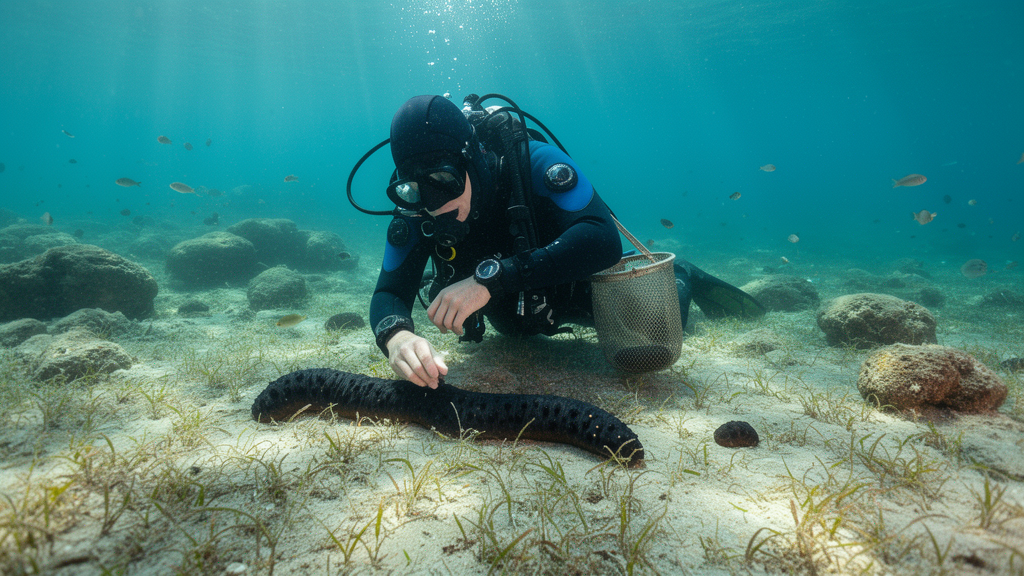
A 12-month observational field study of 327 Mediterranean sea cucumbers, Holothuria tubulosa, collected near Ayvalık on Türkiye’s northeastern Aegean coast found negative allometric growth, seasonal differences in condition factor, and size-related changes in body composition. The animals ranged from 9.00 to 30.00 cm in total length and from 27.25 to 440.14 g in wet weight, providing a population sample that included multiple size classes.
The overall length–weight model produced an allometric exponent of b = 1.458, significantly below the isometric reference of 3 (P < 0.001). This indicates that length increased faster than wet weight across the sampled population. The pooled model had a coefficient of determination of R² = 0.565, while separate estimates were 1.208 for males and 1.584 for females, both significantly different from 3. The researchers reported no differences in growth dynamics among the sex- and month-specific models. Monthly coefficients of determination ranged from 0.012 in October to 0.734 in August, showing that the explanatory power of length varied substantially among sampling months.
Researchers sampled shallow-sublittoral waters around islands near Ayvalık from October 2018 through September 2019. Divers hand-picked the animals at depths generally between 2 and 10 metres and transported them to the laboratory in seawater tanks. Total length was measured from the mouth to the anus to the nearest 0.1 cm. Wet weight was recorded to 0.01 g after surface moisture was removed. Ventral dissection allowed researchers to weigh the body wall, viscera and gonads separately, and sex was assigned macroscopically from gonad colour: pale white indicated males, while pink to orange indicated females. The sample comprised 109 males, 142 females and 76 individuals classified as indeterminate.
Mean wet weight was 144.94 ± 60.99 g, and mean total length was 18.55 ± 3.98 cm. Mean gutted body-wall weight was 69.31 ± 21.06 g. Viscera weight was recorded for 301 individuals and averaged 31.69 ± 15.64 g, while gonad weight was available for 274 animals and averaged 5.01 ± 6.79 g. The measurements document broad variation in body size and composition, although the authors noted that dissection caused excessive contraction from mouth to anus, so total length measured before dissection was used in the subsequent calculations.
Fulton’s condition factor, calculated from wet weight and cubed total length, averaged 2.42 ± 1.04 and ranged from 0.51 to 6.66. Mean values were 2.32 ± 0.91 for females, 2.42 ± 1.06 for males and 2.62 ± 1.21 for indeterminate animals, with no statistically significant differences among the three groups. Condition factor did differ among months: one-way analysis of variance followed by Tukey’s HSD post-hoc test identified February and October as the high-value months, with means of 3.26 ± 1.17 and 3.31 ± 1.26, respectively. May, June, July, August and September formed a lower-value group, with means from 1.91 ± 1.09 to 2.28 ± 0.89. Five other months occupied an intermediate statistical group. The measurements establish a seasonal pattern but do not identify the mechanisms behind it.
Condition factor also varied with wet-weight class, although the pattern was not uniform across the full size range. Animals below 100 g had a mean condition factor of 2.89 ± 1.06, significantly higher than the values for the 100–150 g, 150–200 g and 200–250 g classes in post-hoc comparisons at P < 0.05. The class above 300 g also differed significantly from the 100–150 g, 150–200 g and 200–250 g classes. By contrast, the intermediate and heavier classes from 100 to 300 g did not differ significantly from one another. The study therefore measured higher condition-factor values in some smaller and largest individuals rather than a consistent decline across every successive size class.
Wet and gutted weight were positively associated in a linear model expressed as BW = 32.23 + 0.26 × WW, with R² = 0.549 and P < 0.001. Gutted weight represented 57.08% ± 8.30 of wet weight among animals below 100 g, compared with 54.88% ± 9.02 in the 100–150 g class, 47.07% ± 7.71 in the 150–200 g class, 39.80% ± 8.30 in the 200–250 g class and 28.42% ± 5.82 among the six animals above 300 g. Residual analysis suggested mild heteroscedasticity at higher wet weights, although the overall residual pattern supported the linear model across the observed range.
Body composition shifted with size. Total water content increased from 21% in the smallest class to 48% in the largest, while mean gonad weight percentage rose from 1.53% ± 3.15 to 5.63% ± 3.35. Internal-organ weights also varied through the year: mean viscera weight began increasing in March and reached higher levels from April through June, while mean gonad weight increased from March and peaked in June. Gonad weights were lowest from September through February. These observations are consistent with seasonal gonadal development, but the field study did not directly measure the physiological or environmental processes that produced the changes.
The study provides locally calibrated relationships for converting between sea cucumber length and weight and characterizes monthly and size-related variation in condition and body composition. Its scope is bounded: it covered one location and one annual sampling cycle, monthly samples were relatively small, some biometric measurements were unavailable for subsets of animals, and the 2020 quota system for sea cucumber harvesting in Türkiye postdated the fieldwork. The results therefore characterize the sampled population and cannot by themselves establish long-term trends, effects of exploitation or changes under the quota system.
Subject of Research: Biometric growth, condition and body-composition patterns in Mediterranean sea cucumber from Türkiye’s northeastern Aegean coast
Article Title: Length–weight relationship, condition factor, and biometric characteristics in the Mediterranean temperate sea cucumber Holothuria tubulosa ( Echinodermata , Holothuroidea , Holothuriidae ) from the northeastern Aegean Sea, Türkiye
Article References: Tolon, M. T., Engin, S., & Tokaç, A. (2025). Length–weight relationship, condition factor, and biometric characteristics in the Mediterranean temperate sea cucumber Holothuria tubulosa (Echinodermata, Holothuroidea, Holothuriidae) from the northeastern Aegean Sea, Türkiye. Acta Ichthyologica et Piscatoria, 55, 247-257. https://doi.org/10.3897/aiep.55.167883
Image Credits: AI Generated
Keywords: Holothuria tubulosa, sea cucumber, length–weight relationship, allometric growth, condition factor, body composition, Aegean Sea, fisheries biology, Türkiye, Length, weight, relationship
Cite Scienmag News
Scienmag. (October 20, 2026). Aegean sea cucumber field study finds negative allometric growth and seasonal shifts in body condition. https://scienmag.com/aegean-sea-cucumber-field-study-finds-negative-allometric-growth-and-seasonal-shifts-in-body-condition/
Scienmag. "Aegean sea cucumber field study finds negative allometric growth and seasonal shifts in body condition." Scienmag, 20 October 2026, https://scienmag.com/aegean-sea-cucumber-field-study-finds-negative-allometric-growth-and-seasonal-shifts-in-body-condition/. Accessed 20 October 2026.
Scienmag. "Aegean sea cucumber field study finds negative allometric growth and seasonal shifts in body condition." Scienmag. October 20, 2026. https://scienmag.com/aegean-sea-cucumber-field-study-finds-negative-allometric-growth-and-seasonal-shifts-in-body-condition/


