

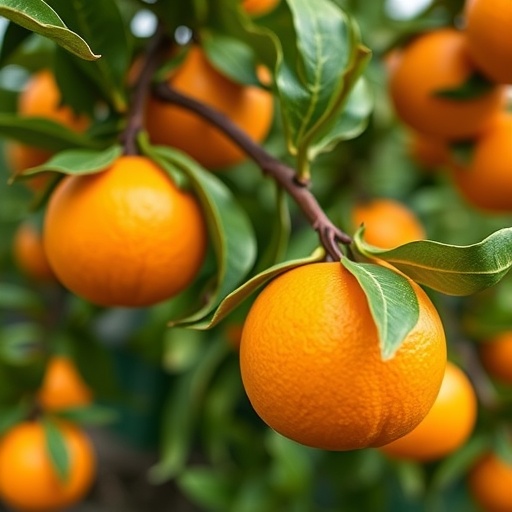
In a groundbreaking investigation that bridges the often-wide gap between controlled agricultural studies and the realities of commercial farming, researchers from Japan’s RIKEN Center for Sustainable Resource Science (CSRS) have unveiled nuanced insights into how pesticide and fertilizer use shapes mandarin orange cultivation across the country. Led by Yasunori Ichihashi, this research employs sophisticated statistical methodologies to analyze real-world data collected from diverse orchards spanning 12 Japanese prefectures, offering unprecedented clarity on the trade-offs inherent in sustainable farming practices.
Traditional agronomic research frequently occurs under tightly regulated laboratory settings or confined experimental plots. While these conditions allow for the control of variables and precise hypothesis testing, they struggle to encapsulate the complex environmental variability and management decisions encountered by farmers in situ. Recognizing this critical disconnect, Ichihashi’s team ventured into Japanese orchards to gather comprehensive fruit and soil samples, capturing an authentic snapshot of contemporary cultivation methods.
One of the unique challenges in analyzing this dataset stemmed from the heterogeneous nature of farming practices and environmental contexts across the sampled orchards. Elements such as citrus cultivar variations, tree age, local climate patterns—including temperature profiles, precipitation levels, and sunlight exposure—and soil type all exert substantial influence on crop outcomes and microbial ecosystems. To account for these multifaceted covariates, the researchers employed inverse probability weighting, a cutting-edge statistical technique often harnessed in economics and epidemiology to mimic randomized control conditions when such experimentation is impractical or unethical.
This methodology allowed the team to adjust observational biases arising from farmers’ discretionary use of pesticides and fertilizers, effectively isolating the impact of these agrochemicals on soil health and fruit quality. Their findings illuminated a striking paradox: reducing chemical pesticide application enhanced the microbial diversity within orchard soils—an ecological boon associated with improved nutrient cycling and resilience to perturbations—yet simultaneously precipitated a rise in foliar diseases, indicating an increased vulnerability to certain leaf pathogens.
Such a dichotomy underscores the complexity of sustainable agriculture, where interventions designed to bolster one aspect of the ecosystem can inadvertently compromise another. Importantly, these results suggest that soil microbial communities and above-ground plant health do not always move in concert, necessitating carefully balanced management strategies that optimize both dimensions.
Further complicating this landscape, the study revealed that widespread assumptions about organic fertilizers directly augmenting soil carbon sequestration might be oversimplified. Contrary to expectations, carbon content improvements correlated more robustly with reductions in overall chemical inputs, particularly nitrogen-based fertilizers, rather than the mere addition of organic amendments. This insight challenges prevalent narratives in sustainable agriculture, highlighting the potential benefits of minimizing fertilization intensity to enhance carbon storage and soil function.
The comprehensive nature of the data underscores significant heterogeneity in farming practices among Japanese mandarin producers. The predominant regime combined chemical pesticides with both organic and chemical fertilizers. However, subsets of growers adopted purely organic pesticides or exclusively organic fertilizer regimens, with application frequencies also varying widely. This diversity, coupled with confounding environmental factors, demands analytical approaches like those employed in this study to avoid misleading conclusions based on raw comparisons.
First author Fuki Fujiwara emphasizes that such methodological rigor is critical for accurately capturing causal relationships in agricultural systems rife with interdependent variables and practical constraints. The adjustment for covariate imbalances allowed the researchers to generate actionable knowledge tailored to the realities encountered by farmers rather than hypothetical models.
Beyond immediate scientific contributions, these findings hold profound implications for agricultural extension services, policymakers, and growers striving to reconcile productivity with ecological stewardship. By elucidating how pesticide and fertilizer typologies directly influence disease prevalence, soil microbial ecology, and nutrient dynamics under authentic farming conditions, this study equips stakeholders with evidence-driven criteria to refine best practices and inform policy frameworks that promote sustainability without sacrificing crop yield.
Looking toward the future, Ichihashi’s team plans to expand this approach to other crop species and geographic regions, leveraging their integrative statistical framework to propagate data-driven insights throughout agricultural landscapes. This strategy promises to usher in an era of precision agriculture informed by comprehensive real-world data and advanced analytics, catalyzing shifts toward environmentally responsible yet economically viable farming.
Crucially, the research group emphasizes a collaborative model that loops scientific discovery back to field practitioners. By forging stronger partnerships among researchers, farmers, agricultural businesses, and local governing bodies, they aspire to enhance both the granularity of data collection and the practical translation of findings into everyday agricultural management. This integrative feedback mechanism is poised to accelerate the adoption of innovative techniques tailored to site-specific contexts and evolving environmental pressures.
In summary, this study represents a pivotal step toward harmonizing agricultural productivity with ecological balance by uncovering the subtle interplays between chemical input regimes, soil microbial diversity, and plant health under authentic commercial conditions. The application of inverse probability weighting stands out as a transformative analytic tool that can reconcile observational complexity, setting a new standard for sustainable agriculture research.
By illuminating the nuanced costs and benefits of current pesticide and fertilizer practices, the work not only challenges simplistic assumptions but also provides a scientifically grounded pathway forward—one where sustainability and crop quality are not opposing goals but interconnected objectives that can be strategically optimized.
Subject of Research: Effects of pesticides and fertilizers on mandarin orange orchards, soil microbial diversity, and fruit disease incidence in commercial farms.
Article Title: (Not specified in the provided content)
News Publication Date: (Not specified in the provided content)
Web References:
DOI: 10.5511/plantbiotechnology.25.0605a
References: (Not specified in the provided content)
Image Credits: RIKEN
Keywords: Life sciences, Sustainable development, Applied sciences and engineering, Agriculture, Farming, Sustainable agriculture, Horticulture, Plant sciences, Agronomy, Crops, Crop science, Fertilizers, Pesticides, Microbiology, Soil bacteria, Soil science, Chemistry, Cohort studies


