


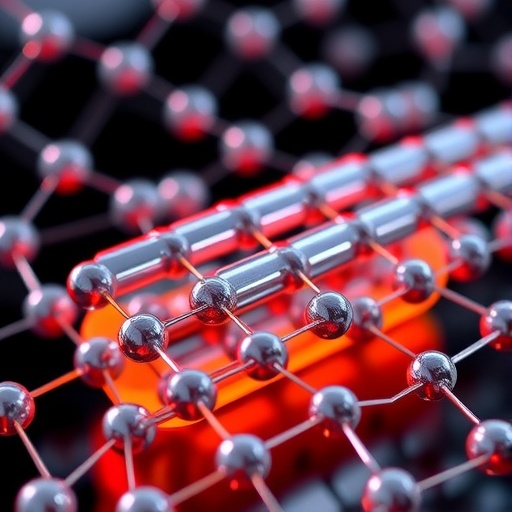
Recent advancements in energy storage technology have led researchers to explore innovative materials capable of enhancing the performance of supercapacitors. One such breakthrough is the defect-engineered BiFe1−xInxO3 nanoparticles, which were developed through an aliovalent doping process. This research has the potential to revolutionize the way we approach energy storage, particularly in high-performance applications. The implications of these findings could be far-reaching, influencing not only electronics but also renewable energy systems and electric vehicles.
In the quest for efficient energy storage, supercapacitors have emerged as an attractive alternative to traditional batteries. They offer rapid charge and discharge capabilities, high power density, and a long cycle life. However, enhancing their energy density, a key performance metric, has remained a significant challenge. The introduction of defect-engineered materials, specifically the BiFe1−xInxO3 nanoparticles, demonstrates a promising pathway to overcome this challenge.
BiFeO3 is a widely studied multiferroic material known for its high dielectric properties and significant potential in energy applications. By incorporating indium as a dopant, researchers aim to introduce lattice defects that could significantly alter the electronic properties of the material. This alteration promotes an increased ability to store charge, thus enhancing the overall performance of supercapacitors. The research showcases how tailored modifications at a molecular level can lead to substantial improvements in material functionality.
The process of aliovalent doping involves substituting one species for another in a crystal lattice while maintaining charge balance. Through the careful selection of indium ions, which possess a different valency than iron, researchers can create defects that modify the electronic landscape of BiFeO3. This defect engineering is key to enhancing the electrochemical activity of the resultant nanoparticles, enabling them to function more effectively in supercapacitor applications.
Experimental results indicate that these defect-engineered nanoparticles exhibit improved specific capacitance compared to their undoped counterparts. The enhanced electrochemical behavior can be attributed to increased conductivity and improved ion transport within the material. These properties are critical for achieving high-performance supercapacitor electrodes, which require not only sufficient charge storage but also rapid charge/discharge cycles to meet the demands of modern electronic devices.
The performance metrics of the newly engineered BiFe1−xInxO3 nanoparticles have been rigorously tested under various conditions. This research underscores the importance of stability and cycling retention, which are vital for practical applications in energy storage solutions. The nanoparticles demonstrated exceptional stability over prolonged cycles, a characteristic that could favor their adoption in commercial applications.
Moreover, the incorporation of indium does not merely enhance charge storage but also contributes to the material’s structural integrity. This dual benefit positions BiFe1−xInxO3 as a highly competitive option among advanced supercapacitor materials, capable of enduring the stresses associated with repeated charge and discharge cycles.
The technique of defect engineering represents a paradigm shift in materials science, inviting further investigation into the vast potential of this approach across different compounds. By continuing to explore how various dopants can modify material properties, researchers can discover new avenues for innovation in energy storage and beyond.
The implications of this research extend into the realm of sustainable energy. As the world increasingly seeks alternatives to fossil fuels, enhancing energy storage capabilities becomes paramount. Materials like defect-engineered BiFe1−xInxO3 could play a crucial role in bridge-building between renewable energy sources and consumer applications, leading to a greener, more energy-efficient future.
Further investigations are needed to understand the full scope of the interactions in defect-engineered nanoparticles. The dynamics of how these engineered defects affect ionic and electronic conduction require deeper exploration, which could unveil even more sophisticated materials suitable for next-generation energy storage devices. Incorporating machine learning and modeling techniques could expedite this research, allowing for the rapid evaluation of potential candidate materials.
As researchers continue to refine and develop these innovative materials, the potential for commercial applications grows. The technology could transition from laboratory environments to real-world implementations, especially in sectors demanding high-performance energy storage solutions, such as transportation and consumer electronics. The ongoing commitment to innovation within the field of supercapacitors is demonstrated not only by successful research but also by the collaboration across disciplines necessary to bring these ideas to fruition.
In conclusion, the potential of defect-engineered BiFe1−xInxO3 nanoparticles to transform supercapacitor technology emphasizes the significance of materials science in addressing global energy challenges. As we move closer to achieving significant advancements in charge storage capabilities, the research community remains optimistic about the future and the incredible possibilities that lie ahead for energy-efficient technologies.
Das, R., Shelake, A.R., Kannan, S.K. et al. Defect-engineered BiFe1−xInxO3 nanoparticles via aliovalent doping for high-performance supercapacitor electrodes.
Ionics (2025). https://doi.org/10.1007/s11581-025-06645-y
Cite Scienmag News
Faith Mcneil. (August 23, 2025). Advancing Supercapacitor Electrodes with Doped BiFeO3 Nanoparticles. Scienmag. https://scienmag.com/advancing-supercapacitor-electrodes-with-doped-bifeo3-nanoparticles/
Faith Mcneil. "Advancing Supercapacitor Electrodes with Doped BiFeO3 Nanoparticles." Scienmag, 23 August 2025, https://scienmag.com/advancing-supercapacitor-electrodes-with-doped-bifeo3-nanoparticles/. Accessed 3 September 2026.
Faith Mcneil. "Advancing Supercapacitor Electrodes with Doped BiFeO3 Nanoparticles." Scienmag. August 23, 2025. https://scienmag.com/advancing-supercapacitor-electrodes-with-doped-bifeo3-nanoparticles/


