

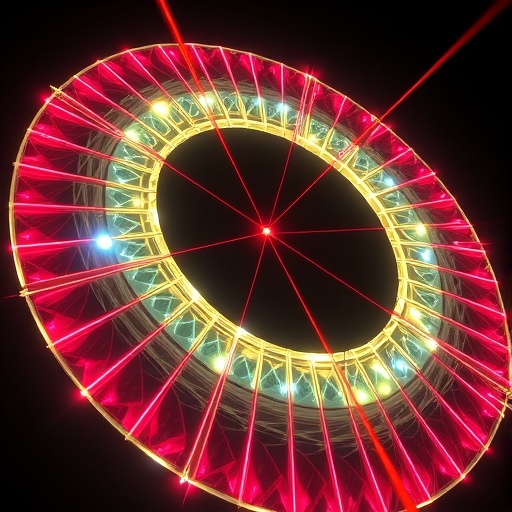
In the quest to revolutionize spacecraft propulsion, a groundbreaking advancement has emerged from the field of nanophotonics. Traditional space missions depend heavily on chemical rockets that necessitate carrying substantial fuel loads, directly impacting the mass of the spacecraft and constraining both speed and range. Overcoming these limitations demands innovative approaches. One promising alternative, light sail propulsion, harnesses the momentum transfer from photons reflecting off a surface. When powered by a high-intensity laser, such sails promise continuous acceleration without the burden of onboard propellant, radically enhancing mission profiles within our solar system.
Conventional designs for light sails predominantly employ metal-coated polymer films, prized for their reflective qualities. Despite effectively bouncing back incident radiation, these metallic coatings absorb a portion of the laser energy, manifesting as undesired heating. Enhancing reflectivity typically requires adding layers or materials, a tradeoff that increases sail mass and paradoxically diminishes propulsion efficiency. This fundamental challenge has hindered the deployment of practical, high-performance light sail systems, pushing researchers to explore fundamentally new material architectures.
Addressing these challenges head-on, a team of researchers recently unveiled a novel photonic crystal light sail design featured in the Journal of Nanophotonics. Departing from the conventional binary composition of reflective films, this innovative structure leverages a carefully engineered nanoscale pattern integrating three dielectric regions: high-refractive-index germanium nanopillars, low-index air voids, and a sturdy polymer matrix composed of poly(methyl methacrylate). This tri-material configuration creates a photonic crystal that selectively manipulates light at the propulsion-specific wavelength, offering a refined control over reflectivity coupled with minimal mass addition.
Photonic crystals, by their nature, consist of periodic nanoscale patterns that engineer the propagation of light through constructive and destructive interference. By combining materials with disparate refractive indices in a meticulously designed lattice, these composites establish photonic band gaps—spectral regions where specific wavelengths of light are forbidden from propagating and are instead reflected. In this new photonic crystal sail, the researchers have sculpted a narrow and well-defined photonic band gap precisely aligned with the operating wavelength of the propulsion laser, approximately 1.2 micrometers. This strategic tuning achieves a highly efficient reflection band tailored to the engine of propulsion while allowing transparency to other wavelengths such as ambient solar radiation.
The selective wavelength reflectivity represents a significant advantage for spacecraft operations, as it minimizes overheating and energy losses that plague metallic sail coatings. Assistant Professor Dimitar Dimitrov of Tuskegee University highlights this benefit, stating that “By designing a narrow photonic band gap aligned with the propulsion laser frequency, the sail remains largely transparent to other solar spectrum components, reducing unwanted heating while optimizing thrust.” This dual-functionality promises robust propulsion with significantly enhanced longevity and reliability.
To bring theory into practice, the researchers applied rigorous design methodologies, including plane-wave expansion and finite-difference time-domain simulations, to predict the photonic band gap and reflectivity characteristics with high precision. These sophisticated computational tools enabled the optimization of pillar dimensions, spacing, and polymer matrix parameters for maximum efficacy. Their simulations project a reflectivity approaching 90% at the targeted wavelength, a milestone indicative of practical propulsion capabilities far surpassing previous designs.
The fabrication of these highly intricate nanostructures posed considerable challenges, which the team addressed using advanced nano-manufacturing techniques. The membranes were created through an elaborate sequence involving electron-beam lithography and vacuum deposition. This process included patterned polymer templating followed by selective germanium deposition, lift-off steps to sculpt the architecture, and secondary electron-beam structuring to fine-tune features down to sub-200-nanometer scales, ensuring both functional fidelity and manufacturability.
Electron microscopy analysis of the fabricated samples confirmed the success of this multi-step process, revealing germanium nanopillars approximately 100 nanometers wide interspersed with air holes roughly 400 nanometers in diameter, all embedded within a 200-nanometer-thick polymer film. The precision achievable in such multi-dielectric photonic crystal architectures marks a breakthrough, affirming the viability of fabricating complex, lightweight photonic structures at scales compatible with practical mission requirements.
With the structural design validated, the team modeled the propulsion performance of a hypothetical one-square-meter sail illuminated by a high-powered 100-kilowatt laser. Results from these simulations suggest that the light sail could sustain continuous thrust capable of accelerating the craft to speeds of several hundred meters per second within just one hour. Although this velocity falls short of interstellar travel needs, it represents a transformative enhancement suitable for high-speed probes designed for interplanetary reconnaissance and exploration missions.
These promising preliminary results serve as a foundation for future refinements and experimental campaigns but also underscore the challenges that remain. The reliance on idealized conditions in simulations necessitates subsequent evaluations involving factors such as laser beam quality, environmental perturbations, and long-term material stability in space. Yet, the scalable fabrication approach gives hope that photonic crystal light sails could advance rapidly from lab prototypes to flight-ready technologies.
This research exemplifies a paradigm shift in light sail engineering by exploiting multi-component photonic crystals to finely tune optical properties while minimizing mass—a balance previously elusive in conventional designs. By uniting nanoscale engineering, materials science, and optical physics, the study opens avenues for next-generation spacecraft propulsion systems that marry efficiency with practicality, augmenting humanity’s capability to probe deeper and faster within our cosmic neighborhood.
Assistant Professor Dimitrov remarks, “Our work paves the way toward experimentally validated, scalable, and lightweight devices tailored for laser-driven propulsion. This technology platform may ultimately enable sustainable interplanetary exploration with drastically reduced onboard mass.” As interest in laser-based propulsion accelerates alongside advances in photonic materials, such innovations could soon become central to the future architecture of space missions.
The comprehensive details of this pioneering work can be found in the Gold Open Access paper “Design and manufacture of a photonic crystal light sail,” by Dimitar Dimitrov and Elijah Taylor Harris, published in the Journal of Nanophotonics, volume 19, issue 04, article 046008 (2025). This study not only extends the theoretical framework of photonic crystal applications but also illustrates a pathway from computational design to tangible manufacturing, bringing the dream of efficient and lightweight laser sails within closer grasp.
Article Title: Design and manufacture of a photonic crystal light sail
News Publication Date: 27-Dec-2025
Web References: https://doi.org/10.1117/1.JNP.19.046008
References: Dimitrov, D., & Harris, E. T. (2025). Design and manufacture of a photonic crystal light sail. Journal of Nanophotonics, 19(4), 046008. https://doi.org/10.1117/1.JNP.19.046008
Image Credits: Dimitrov and Harris
Keywords
Laser propulsion, photonic crystal, light sail, nanoscale fabrication, germanium nanopillars, dielectric structures, photonic band gap, space propulsion, nanolithography, finite-difference time-domain simulation, interplanetary exploration, polymer matrix


