

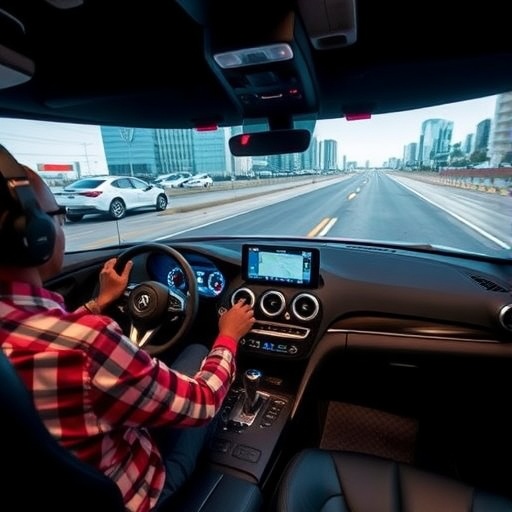
In the rapidly evolving field of automotive technology, the need for advanced simulation tools has become increasingly evident. The development of motion control systems for highly dynamic, self-propelled driving simulators stands at the forefront of this innovation. These simulators serve a crucial role in the automotive industry as they provide a controlled environment to test and refine various vehicular systems without the inherent risks associated with real-world testing. The research conducted by Ottensmeier and Prokop highlights the significance of creating sophisticated motion control programs that can accurately mimic real-world driving scenarios, a necessity for understanding vehicle dynamics under various conditions.
The authors emphasize the critical aspects of motion control in their research, detailing how these systems are designed to interface seamlessly with simulation environments. By employing cutting-edge technology and methodologies, they seek to create simulators that can replicate the complex interplay between vehicle speed, acceleration, and environmental factors. This is not just about making the simulator operational; it’s about ensuring that it produces realistic responses that can be utilized for serious analysis and development purposes. The work outlined by Ottensmeier and Prokop strongly indicates that the future of vehicle development might heavily rely on the fidelity of simulation technologies.
A significant challenge faced in this domain is achieving a balance between realism and computational efficiency. The simulator’s motion control system must not only respond accurately to input commands but must also process vast amounts of data in real-time. This means that every aspect of vehicle dynamics, including the influence of terrain, road conditions, and even atmospheric variables, must be considered during the simulation. The necessity to create algorithms that can effectively manage these complexities is a focal point of their research.
Another critical component of their investigation involves the integration of user feedback into motion control systems. As users interact with driving simulators, their responses must provide valuable data that can further refine the motion algorithms. This feedback loop enables developers to adapt the simulations to better align with real-world driver behavior, ultimately enhancing the simulator’s applicability in training, research, and development phases within the automotive sector. The work aims at not just an advancement in technology but also a fundamental shift in how vehicles can be designed and tested.
Ottensmeier and Prokop have chosen to focus on the various algorithms that govern the motion controls of their simulator. These algorithms are the backbone of the system, providing the necessary guidelines for how the vehicle will respond to different input scenarios. By meticulously analyzing and adjusting these algorithms, the authors are able to create a simulator that not only looks realistic but also behaves in a convincing manner when subjected to diverse inputs. Moreover, the development process includes thorough testing phases to ensure that the motion control system operates smoothly under various conditions.
The advancements in motion control described in their research are also noteworthy for their potential applications beyond traditional driving simulations. The principles guiding the development can similarly benefit other fields, such as robotics and aerospace, where high degrees of precision and control are paramount. By creating robust simulations that account for numerous variables, broader industries can adapt these technologies for various uses, ensuring that the benefits of their findings extend far beyond automotive engineering.
A unique aspect of their research lies in the exploration of user interface design within the driving simulator. An intuitive interface is essential for ensuring that users can fully engage with the simulator, obtaining the maximum benefit from the technology. The authors investigate how different interfaces can influence user reactions and how these reactions can, in turn, impact the effectiveness of training and development. This dual focus on the technical and human aspects of simulated driving experiences is vital in creating a holistic approach to vehicle testing and training.
Furthermore, the implications of their findings stretch into the educational realm. As driving simulators become more advanced, they can serve as invaluable educational tools for future automotive engineers. By incorporating motion control systems that replicate real-world driving scenarios, universities and training institutions can better prepare students for the challenges they will face in automotive design and development. This educational integration could lead to more innovative thinking in the next generation of engineers.
Collaboration within the automotive industry is equally crucial for the success of their motion control systems. By working with various stakeholders—car manufacturers, research institutions, and technology developers—Ottensmeier and Prokop emphasize the need for a communal effort to push the envelope of simulation technology. This collaborative spirit could lead to breakthroughs that not only enhance simulator fidelity but also accelerate the pace of vehicular innovation.
In conclusion, the work conducted by Ottensmeier and Prokop on developing a motion control system for a highly dynamic, self-propelled driving simulator opens new doors in automotive technology. Their focus on realism, user interaction, and collaborative development represents an exciting shift in how we approach vehicle testing and training. As the automotive industry continues to evolve, the insights and advancements from this research will undoubtedly contribute to more effective, safe, and innovative vehicle designs. Their pioneering strides exemplify how simulation technologies will play a pivotal role in shaping the future of transportation.
The potential impact of such innovations fuels our anticipation for what lies ahead. As we move deeper into the era of automation and highly advanced driving technologies, the foundations laid by research like that of Ottensmeier and Prokop may define our experiences behind the wheel. The automotive landscape is shifting, and with each development, we move closer to a future where the driving simulator is an indispensable tool in the evolution of automotive engineering and design.
Subject of Research: Development of a Motion Control for a highly dynamic, self-propelled driving simulator
Article Title: Development of a Motion Control for a highly dynamic, self-propelled driving simulator
Article References:
Ottensmeier, M., Prokop, G. Development of a Motion Control for a highly dynamic, self-propelled driving simulator.
Automot. Engine Technol. 8, 17–42 (2023). https://doi.org/10.1007/s41104-022-00124-6
Image Credits: AI Generated
DOI: https://doi.org/10.1007/s41104-022-00124-6
Keywords: Motion control, driving simulator, vehicle dynamics, automotive technology, simulation systems, user interface design, education in automotive engineering.


