


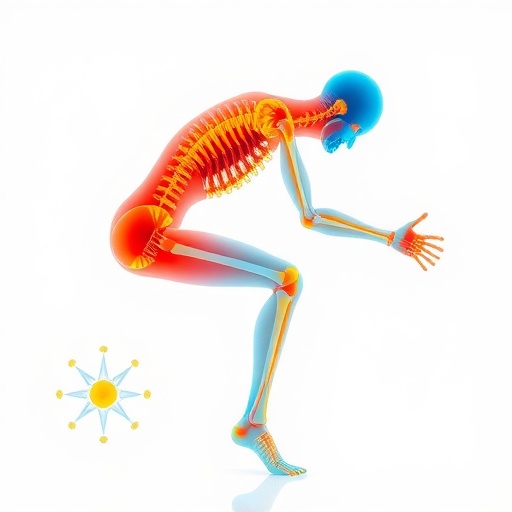
In the ever-evolving realm of biomechanics and human movement science, recent advancements have opened new avenues for understanding the intricate responses of biomechanical systems. The study conducted by Hartlen and Cronin focuses on a novel methodology that enhances the analysis of multivariate biomechanical responses, specifically through the utilization of Statistical Parametric Mapping (SPM) and Arc-Length Re-parameterization. This innovative approach allows researchers to dissect complex biomechanical data with unprecedented precision, enhancing our grasp of how different variables interplay in human movement dynamics.
At its core, the study emphasizes the importance of hypothesis testing within biomechanics, where researchers heavily rely on statistical methods to derive meaningful conclusions about human motion. Traditional statistical techniques often fall short when faced with the multifaceted nature of biomechanical data. By integrating Statistical Parametric Mapping, Hartlen and Cronin have crafted a methodology that is well poised to handle the inherent complexity and high dimensionality of biomechanical measures.
Statistical Parametric Mapping (SPM) is a powerful tool that allows for the visualization and analysis of complex spatial and temporal data. In this study, the authors utilize SPM to uncover hidden patterns within the biomechanical responses captured during physical activities. This technique stands apart because it allows researchers to observe how specific factors influence movement patterns over time, providing a more comprehensive picture of human biomechanics than traditional static analyses might reveal.
The introduction of Arc-Length Re-parameterization into their methodology further refines the analysis process. By re-parameterizing data according to the arc-length of the movement trajectory, the authors can effectively normalize variation in movement speed and duration across different subjects or trials. This ensures that the resulting data is not just zoomed in on points in time, but rather reflects a smoother, more continuous representation of movement, making the findings more robust and informative.
As biomechanics increasingly demands precision, the combination of SPM and Arc-Length Re-parameterization stands to revolutionize the way we interpret and analyze data. The implications of this research extend far beyond academic interest; they have real-world applications in fields such as rehabilitation, sports performance optimization, and even ergonomic design. For instance, trainers and doctors could better understand how specific movements contribute to injuries, leading to more targeted prevention strategies.
The study also emphasizes the need for a shift in how researchers approach hypothesis testing within this domain. Traditional methods often lead to conclusions that lack the depth and nuance required to fully capture the complexity of human movement. By adopting SPM in conjunction with innovative re-parameterization techniques, researchers can craft more defined hypotheses that take into account the multifactorial nature of biomechanics. This can lead to greater insights and breakthroughs in treating and understanding human motion.
The methodological advances presented in this research have prompted a reevaluation of data analysis standards in biomechanics. As the field continues to develop and embrace these sophisticated techniques, researchers are now equipped to ask more relevant and complex questions about human movement. This will no doubt shift the paradigm in how biomechanics is studied and understood, inviting a broader scope of inquiry that was previously untapped.
To validate these innovative methods, the research also includes a comprehensive demonstration through empirical data. This part of the study details how they collected biomechanical measurements during dynamic activities, applied their methodology, and interpreted the results. Through rigorous analysis, Hartlen and Cronin showcase the increased sensitivity and specificity of their findings, ultimately shedding light on nuanced aspects of human movement that were previously overlooked.
The implications for clinical and athletic performance settings are profound. As athletes push their bodies to the limits, understanding the biomechanical responses they exhibit can lead to better training programs that reduce injuries and enhance performance. Similarly, clinicians can utilize the findings from this research to refine rehabilitation techniques, ensuring patients receive personalized care that considers their unique movement patterns.
Moreover, the advantages of using SPM in biomechanical research extend to educational settings as well. As future scientists and practitioners learn about these advanced statistical methods, they will be better equipped to conduct research that not only answers current questions but also generates new inquiries regarding human movement. This foundational knowledge could pave the way for the next generation of biomechanics, leading to even more innovations.
As Hartlen and Cronin’s study gains attention, it is essential to recognize the collaborative nature of scientific research. Their exploration into advanced methodologies illustrates the importance of interdisciplinary approaches, merging biomechanics with advanced statistical techniques. This collaboration not only amplifies the research’s impact but also inspires other disciplines to draw upon similar synergies to tackle complex problems.
In summary, Hartlen and Cronin’s research offers a groundbreaking framework for analyzing multivariate biomechanical responses. By harnessing the power of Statistical Parametric Mapping and Arc-Length Re-parameterization, they create a more nuanced understanding of human movement dynamics. This work stands as a testament to the potentially transformative effects that innovative statistical methods can have in the field of biomechanics, ultimately enhancing our understanding of human performance and injury risk. As the dialogue around these methods continues, the broader scientific community may find itself on the cusp of a paradigm shift in the study of biomechanics, driven by the desire to unlock the secrets of human movement.
The developments made in this research explain why biomechanics is not just a field concerned with the physics of movement, but also one deeply intertwined with statistical analysis and data interpretation. This approach serves as a model for how future studies might be conducted, pushing the boundaries of what we know about our bodies and how they move. The journey into the depths of biomechanical responses has only just begun, and as techniques evolve, so too will our understanding of the remarkable capabilities of the human body.
In conclusion, Hartlen and Cronin’s pioneering investigation serves as an essential stepping stone into the future of biomechanical research, driving home the importance of applying advanced statistical methods to explore the complexities of human movement. With hypotheses being informed by innovative techniques, researchers will continue to unveil the intricate layers of biomechanics, paving the way toward more informed interventions, improved athletic performance, and enhanced quality of life.
Hartlen, D.C., Cronin, D.S. Hypothesis Testing of Multivariate Biomechanical Responses using Statistical Parametric Mapping and Arc-Length Re-parameterization.
Ann Biomed Eng (2025). https://doi.org/10.1007/s10439-025-03788-x
Cite Scienmag News
Ophelia Keating. (August 30, 2025). Advancing Hypothesis Testing in Biomechanics with SPM. Scienmag. https://scienmag.com/advancing-hypothesis-testing-in-biomechanics-with-spm/
Ophelia Keating. "Advancing Hypothesis Testing in Biomechanics with SPM." Scienmag, 30 August 2025, https://scienmag.com/advancing-hypothesis-testing-in-biomechanics-with-spm/. Accessed 3 September 2026.
Ophelia Keating. "Advancing Hypothesis Testing in Biomechanics with SPM." Scienmag. August 30, 2025. https://scienmag.com/advancing-hypothesis-testing-in-biomechanics-with-spm/


