


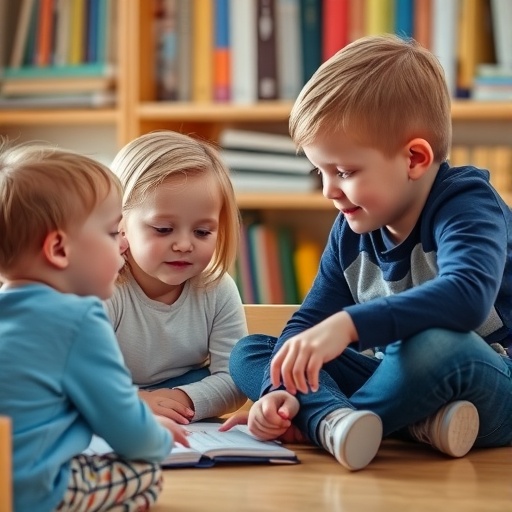
In a groundbreaking study, researcher S. Zhao delves into the intricate interplay between biobehavioral and environmental factors that shape children’s social skill development. The study is notable for its innovative application of a self-attentive adversarial network, a powerful machine learning model that has the potential to reshape our understanding of social skills in children. The research is not just a theoretical exploration; it offers practical insights that could benefit educators, psychologists, and parents alike.
Social skills are fundamental to children’s overall development. They influence how children interact with their peers, engage in cooperative play, and navigate the complexities of social environments. In the digital age, understanding the factors that contribute to social skill development is more crucial than ever. Zhao’s study addresses this pressing need by combining advanced machine learning techniques with biological and environmental data sources.
The methodology employed in the study is noteworthy. Zhao utilizes multimodal deep clustering, a process that allows for the integration of various types of data, including biobehavioral metrics and environmental factors. The self-attentive adversarial network is critical in this context, as it provides an efficient framework for identifying complex patterns within large datasets. This approach not only enhances the accuracy of the findings but also opens up new avenues for research in child development.
One of the primary objectives of the research is to isolate the key factors that influence social skills during critical developmental stages. By analyzing a wide array of biobehavioral indicators—such as emotional regulation, communication abilities, and social engagement—Zhao’s study sheds light on the nuanced ways these factors interact with environmental contexts. For instance, some children may demonstrate stronger social competencies when exposed to nurturing and supportive environments, while others may thrive in more challenging social settings.
The implications of Zhao’s findings extend beyond academic discourse. Educators and policymakers may find valuable insights that can inform curriculum development and social training programs. The integration of machine learning into this research field presents an exciting frontier for developing targeted interventions that address specific needs in children’s social skill acquisition. The potential for customizing educational approaches based on individual profiles is particularly compelling.
Moreover, the study contributes to ongoing discussions about the impact of technology on social development. In an era where digital interactions often overshadow face-to-face communication, understanding how virtual environments influence social skills is pertinent. Zhao’s model offers a lens through which researchers can explore the dual impact of real-world and virtual experiences on children’s social competencies. This aspect of the research resonates in today’s context, where online interactions frequently shape social behavior.
An essential aspect of Zhao’s study is the validation of the self-attentive adversarial network. By employing rigorous testing protocols, the research establishes the reliability and effectiveness of this model in predicting social skill outcomes. The network’s ability to process and interpret complex data sets sets a new standard for future studies in developmental psychology and education. The potential applications of this technology are vast, ranging from improving educational strategies to designing more effective therapeutic interventions for children who struggle with social skills.
Importantly, Zhao’s work emphasizes the role of interdisciplinary collaboration. By merging insights from psychology, education, and computer science, the study embodies a holistic approach to understanding child development. This collaborative ethos is vital as researchers seek to address multifaceted issues that impact children’s lives. The intersection of diverse fields fosters innovation and leads to more comprehensive strategies for promoting healthy social skill development.
In summary, Zhao’s research represents a significant advancement in the exploration of children’s social skills. The integration of biobehavioral and environmental data through cutting-edge machine learning techniques opens new pathways for understanding the factors that contribute to successful social interactions in children. As the study outlines, the implications of this research are far-reaching, offering valuable tools for educators, psychologists, and parents aiming to support children’s social growth.
As this research continues to gain attention, it is poised to influence how society views child development, underlining the importance of fostering strong social skills during formative years. The intricate relationship between biological, behavioral, and environmental components creates a landscape full of opportunities for targeted interventions that can profoundly impact children’s lives. As educators and researchers engage with these findings, the dialogue surrounding social skills in children will undoubtedly evolve, leading to more effective practices and policies.
By leveraging the insights provided by Zhao’s study, there lies a potential to cultivate environments that foster social growth, helping children navigate the complexities of life with confidence and competence. In a world where social skills are increasingly vital, understanding the underlying factors that influence their development is a step toward ensuring a brighter, more socially adept future for generations to come.
Zhao, S. Multimodal deep clustering of biobehavioral and environmental factors in children’s social skill development using a self-attentive adversarial network.
Discov Artif Intell 5, 380 (2025). https://doi.org/10.1007/s44163-025-00621-1
Cite Scienmag News
Blake Davidson. (December 11, 2025). Advancing Children’s Social Skills with Deep Learning. Scienmag. https://scienmag.com/advancing-childrens-social-skills-with-deep-learning/
Blake Davidson. "Advancing Children’s Social Skills with Deep Learning." Scienmag, 11 December 2025, https://scienmag.com/advancing-childrens-social-skills-with-deep-learning/. Accessed 3 September 2026.
Blake Davidson. "Advancing Children’s Social Skills with Deep Learning." Scienmag. December 11, 2025. https://scienmag.com/advancing-childrens-social-skills-with-deep-learning/


