

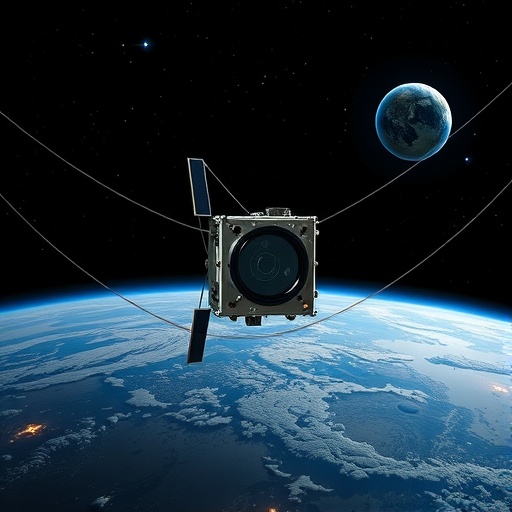
In the dynamic field of aerospace engineering, spacecraft formation flight has emerged as a pioneering domain that integrates nonlinear control theory with practical applications in space missions. The complexities of coordinating multiple spacecraft to work in tandem require innovative approaches to control strategies, particularly in unpredictable and uncertain environments. In a groundbreaking study set to be published in 2025, researchers Stewart and Damaren delve into the intricacies of nonlinear ({\mathcal {H}}_\infty) control, presenting a novel framework that promises to transform how we understand and implement spacecraft formations in orbit. Their research could potentially redefine the operational paradigms of space exploration.
At the heart of this study lies the foundational principle of nonlinear control theory, which diverges from traditional linear methods by accommodating the multifaceted behaviors of dynamic systems. Nonlinear control approaches are essential in tackling the complexities posed by interacting vehicles in space, where external disturbances, sensor noise, and model uncertainties can significantly impact the stability and performance of formations. The authors argue that adopting ({\mathcal {H}}_\infty) control frameworks allows for robust performance amidst these variabilities, ensuring that the collective behavior of spacecraft meets desired specifications even under adverse conditions.
The significance of this study is magnified by the increasing number of missions that utilize multiple spacecraft operating in formation. These missions, including satellite constellations, planetary exploration teams, and even large-scale space telescopes, all rely on precise formation flying to achieve mission objectives efficiently. However, traditional control strategies may falter when faced with the unpredictable nature of space environments. Stewart and Damaren’s research addresses this limitation by proposing a methodology that utilizes nonlinear control techniques to achieve both robustness and adaptability, crucial traits for the successful execution of such complex missions.
Central to their approach is the concept of robust stability and performance. The researchers explain that the ({\mathcal {H}}_\infty) control methodology seeks to minimize the worst-case effects of disturbances on system performance. This robust performance criterion is vital in scenarios where spacecraft encounter unexpected challenges that could disrupt formation stability. The authors elucidate their findings with mathematical rigor, clearly laying out the stability conditions necessary for successful implementation of their proposed framework. Such insights not only bolster theoretical understanding but also provide practical guidelines for engineers working on future missions.
Moreover, the potential applications of these nonlinear control strategies extend beyond mere theoretical interests. In practice, the ability to sustain a robust formation in challenging environments holds significant implications for satellite communications, Earth observation, and interplanetary missions. Efficiently coordinating formations minimizes fuel consumption, makes better use of sensor capabilities, and enhances overall mission success. As the research points out, these advantages could be decisive in shaping the future of space exploration and utilization, making the findings even more pertinent.
Throughout the publication, the authors emphasize the role of simulation and real-world testing to validate their theoretical models. In the context of aerospace engineering, simulations serve as essential tools that allow researchers to explore the potential behavior of their proposed control strategies in safe, controlled environments. By leveraging advanced simulation techniques, Stewart and Damaren also highlight the importance of creating adaptable algorithms that can adjust to real-time data from spacecraft, ensuring continued compliance with the set performance metrics.
Furthermore, this study contributes to a burgeoning dialogue within the aerospace community regarding the integration of artificial intelligence (AI) in spacecraft operations. As the complexity of space missions increases, the availability of advanced computational resources means that AI could play a pivotal role in enhancing decision-making processes. Stewart and Damaren’s research sheds light on the intersection of nonlinear control and AI, opening avenues for the development of intelligent control systems capable of autonomously managing spacecraft formations under varying conditions.
Importantly, the timing of this publication aligns with the increasing investment in space technology by various nations and private enterprises, signifying a robust interest in innovative control solutions. As missions designed to explore Mars, harvest asteroids, and establish lunar bases proliferate, the need for reliable formation flying techniques becomes paramount. The revolutionary insights presented by Stewart and Damaren cater directly to this demand, positioning their research at the forefront of aerospace innovation.
Moreover, this work emphasizes an interdisciplinary approach necessary in addressing the challenges of spacecraft formation flying. By integrating principles from control theory, systems engineering, and AI, Stewart and Damaren create a comprehensive framework that encapsulates the multifaceted nature of aerospace challenges. This holistic perspective is essential for the next generation of engineers and researchers working in this domain.
As the scientific community eagerly awaits the detailed findings of this study, the anticipation surrounding the advancements in spacecraft formation controls builds. The documented success of nonlinear ({\mathcal {H}}_\infty) control methodologies could potentially catalyze a shift in how future missions are planned and executed, ultimately pushing the boundaries of human capability in space exploration.
In conclusion, the research by Stewart and Damaren promises to carve new pathways in nonlinear control strategies, specifically within the context of spacecraft formation flying. Their findings advocate for a paradigm shift in the aerospace engineering landscape, suggesting that the answer to current challenges rests within the adoption of robust and adaptable control solutions. As we look ahead to an era of increased interplanetary collaboration and exploration, the importance of such research cannot be understated. It is the diligent exploration of concepts like those presented by Stewart and Damaren that will propel humanity closer to understanding and navigating the vast expanses of space.
Furthermore, the publication of their findings in a prominent journal signifies a vital step in disseminating these innovative control strategies to a broader audience. As researchers and engineers absorb the insights provided in their work, the implications for future missions may well redefine the boundaries of our technological capabilities in the cosmos. The future of spacecraft formation flight looks promising, fueled by the rigorous scientific exploration and dedication of those like Stewart and Damaren.
Subject of Research: Nonlinear ({\mathcal {H}}_\infty) control for spacecraft formation flight
Article Title: Nonlinear ({\mathcal {H}}_\infty) control for spacecraft formation flight
Article References:
Stewart, P., Damaren, C.J. Nonlinear \({\mathcal {H}}_\infty \) control for spacecraft formation flight.
AS (2025). https://doi.org/10.1007/s42401-025-00377-7
Image Credits: AI Generated
DOI:
Keywords: Nonlinear Control, Spacecraft Formation Flight, ({\mathcal {H}}_\infty) Control, Robust Stability, Aerospace Engineering


