


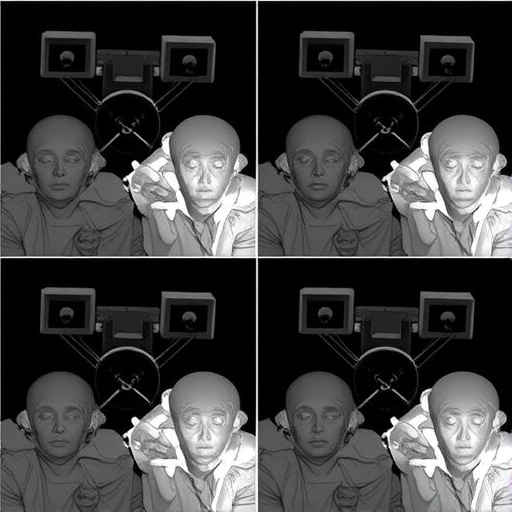
In the rapidly evolving field of structural analysis and materials testing, the advent of multi-camera stereo-digital image correlation (stereo-DIC) marks a transformative leap forward. Traditionally, digital image correlation techniques relied on binocular systems with a single field of view (FOV), which inherently limited both the measurement area and the level of detail achievable. However, by harnessing multiple synchronized camera systems, researchers have broadened the horizons of measurement capabilities to encompass expansive and complex surfaces while preserving precise accuracy. This new paradigm, encapsulated in multi-camera stereo-DIC, presents a distributed full-field measurement framework designed to overcome classical trade-offs between coverage and measurement uncertainty.
Essentially, multi-camera stereo-DIC divides a target surface into manageable subregions, each observed by a coordinated stereo-DIC subsystem. These localized observations are subsequently transformed into a unified global coordinate system, allowing seamless integration of measurements across a larger spatial domain. By “measuring separately and integrating globally,” this approach strikes a crucial balance between scaling up the measurement area and maintaining submillimeter displacement sensitivity, thus enabling applications on structures and materials of unprecedented size and complexity.
The technical implementation of multi-camera stereo-DIC bifurcates into two distinct categories. The first approach involves integrating results from multiple binocular stereo-DIC subsystems within a global coordinate framework. This method excels in handling complex curved surfaces and facilitates full-surface assessments. In contrast, the second strategy employs multiview geometry principles for direct three-dimensional reconstruction from multiple camera perspectives. This latter method sidesteps ambiguities caused by overlapping fields of view and enhances three-dimensional accuracy, particularly valuable when multiple viewpoints yield competing correspondence solutions.
These dual technical pathways have catalyzed significant progress in expanding measurement capabilities. Innovations include area scaling without compromising uncertainty, integrating multi-scale datasets, leveraging high dynamic range imaging for better detail preservation under variable lighting, and executing high-speed measurements for dynamic testing scenarios. As a result, multi-camera stereo-DIC has evolved beyond just a tool for enlarging the field of view, now serving as a versatile platform for multifaceted measurement objectives in research and industrial settings alike.
One compelling application highlighted the monitoring of a sizeable box-type structure subjected to dynamic loading on a shaking table. Using two synchronized stereo-DIC subsystems alongside a real-time method for correcting extrinsic parameters, researchers achieved displacement measurement accuracy at the submillimeter scale and conducted thorough, reliable acceleration analyses. This demonstration underscored the technology’s robustness in maintaining measurement stability amidst strong vibrations, reinforcing its potential for field deployment in dynamic structural health monitoring.
Addressing a critical challenge where conventional displacement sensors falter—tracking complex spatial displacements during progressive structural collapse—the integration of unmanned aerial vehicle (UAV) assisted close-range photogrammetry with a multi-camera stereo-DIC system marks a significant breakthrough. This hybrid system enabled real-time displacement monitoring of a suspended dome structure during both tensioning and collapse phases. Impressively, the system attained a displacement measurement accuracy of 0.05 mm and a relative error near 0.02%, furnishing comprehensive nodal displacement data vital for failure mode analysis and numerical simulations.
Beyond extended field views and dynamic tracking, multi-camera stereo-DIC also demonstrates unique strengths in panoramic measurement scenarios, particularly for cylindrical or circumferentially closed geometries. By arranging multiple cameras around such specimens, each pair forming stereo measurement subsystems with overlapping FOVs, researchers can achieve continuous 360-degree full-field displacement mapping. This approach enables intricate mechanical experiments including through-thickness strain measurement and the derivation of true stress–strain curves, vital for characterizing anisotropic material behavior.
In pushing the boundaries from localized field expansion toward comprehensive full-surface measurement, multi-camera stereo-DIC opens avenues for previously unattainable analyses. These capabilities extend into multi-scale integration, where data collected at varying spatial resolutions coalesce, and high-speed, high-dynamic-range imaging essential for capturing transient phenomena. Each of these aspects contributes to a powerful, flexible measurement system attuned to the demands of real-world complexities.
Looking forward, the research community acknowledges that further technological maturation is critical for establishing multi-camera stereo-DIC as a ubiquitous tool in challenging environments. Key frontiers for advancement include enhancing heterogeneous camera collaboration to foster interoperability among disparate sensors, enabling real-time data transmission and computational pipelines to support instantaneous feedback, and developing robust algorithms resilient to environmental noise and occlusions. Additionally, leveraging artificial intelligence and deep learning for end-to-end measurement solutions could unlock unprecedented automation and accuracy.
In parallel, these improvements align well with the growing trend toward intelligent sensing and edge computing, underpinning large-scale structural monitoring and advanced manufacturing inspection with enhanced efficiency. Multi-camera stereo-DIC stands poised to play a pivotal role in domains where large-scale, high-fidelity, and dynamic full-field measurements are indispensable—making it a linchpin technology for future experimental mechanics and smart infrastructure diagnostics.
This comprehensive evolution encapsulates a promising fusion of optical imaging principles, computational geometry, and data science, heralding a new era where digital image correlation transcends its traditional boundaries. As researchers refine the integration and scalability of these systems, the potential for broad adoption across aerospace, civil engineering, and materials science will exponentially grow, signaling a new chapter in precision structural analysis.
Ultimately, multi-camera stereo-DIC transforms digital image correlation from a niche laboratory technique into a distributed, high-capacity measurement platform responsive to the challenges inherent in complex geometries, dynamic conditions, and large-scale structures. Its trajectory of innovation not only addresses existing limitations but also pioneers capabilities previously deemed unattainable, reinforcing its status as a flagship method for contemporary and future experimental mechanics.
Cite Scienmag News
Denise Maddox. (May 20, 2026). Advances in Multi-Camera Stereo Digital Image Correlation: A Comprehensive Review. Scienmag. https://scienmag.com/advances-in-multi-camera-stereo-digital-image-correlation-a-comprehensive-review/
Denise Maddox. "Advances in Multi-Camera Stereo Digital Image Correlation: A Comprehensive Review." Scienmag, 20 May 2026, https://scienmag.com/advances-in-multi-camera-stereo-digital-image-correlation-a-comprehensive-review/. Accessed 3 September 2026.
Denise Maddox. "Advances in Multi-Camera Stereo Digital Image Correlation: A Comprehensive Review." Scienmag. May 20, 2026. https://scienmag.com/advances-in-multi-camera-stereo-digital-image-correlation-a-comprehensive-review/


