

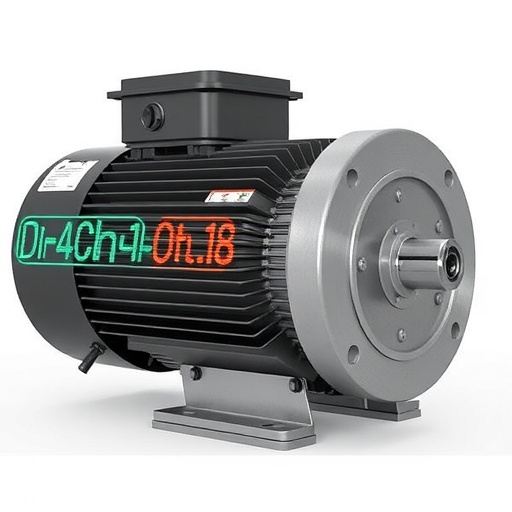
In an era where the demand for efficient, reliable, and intelligent control systems in electrical machinery is ever-increasing, pioneering research has emerged that may revolutionize the operation of multiphase induction machines. The work led by Carrillo-Rios, J., Cordoba-Ramos, M., Lara-Lopez, R., and collaborators takes a significant leap forward by introducing a multivector model predictive control (MPC) strategy that incorporates dead-time knowledge into the control paradigm. Their research, soon to be published in Scientific Reports, addresses longstanding challenges in the domain of machine control, effectively combining theoretical sophistication with practical foresight.
Multiphase induction machines are indispensable components across numerous industrial applications due to their robustness and efficiency. However, the complexity of controlling their operation, especially in the presence of non-ideal effects such as dead-time, has historically impeded optimal performance. Dead-time refers to the finite delay introduced in power electronic converters, particularly during the switching process, which leads to performance degradation, reduced efficiency, and unintended harmonic distortion. The novel approach championed in this study proposes a model predictive control framework that explicitly accounts for these dead-times, resulting in markedly improved machine operation.
At its core, model predictive control is a control strategy that anticipates future system behavior over a prediction horizon. It leverages an internal model of the machine to forecast responses and calculates control inputs by optimizing a cost function subject to system constraints. Traditional MPC methods have achieved commendable results in machine control; however, the incorporation of multiple vectors for reference tracking in a multiphase setup, combined with the integration of dead-time knowledge, marks a significant advancement. By extending MPC to a multivector configuration, the researchers enable more precise handling of the complex dynamics inherent in multiphase machines.
The dead-time associated delays in power converter switching are typically considered a nuisance, often addressed by heuristic or post-processing compensation methods. This new methodology neuralizes dead-time as a fundamental aspect of the system dynamics within the MPC formulation. Instead of treating dead-time as a disturbance, it is innovatively modeled and predicted to optimize control sequences, minimizing the deleterious effects on machine voltage and current waveforms. This intrinsic understanding empowers the control system to preemptively counteract errors caused by dead-time, vastly improving torque smoothness and reducing electromagnetic interference.
In the experimental and simulation phases, the multivector MPC strategy demonstrated superior performance compared to conventional control schemes. Torque ripple, a common issue in multiphase machines adversely impacting longevity and operational stability, was significantly mitigated. This enhancement is critical in applications such as electric vehicle propulsion, industrial drives, and renewable energy systems where consistent, high-quality torque output is mandatory. Furthermore, the strategy showcases enhanced robustness in the face of parameter uncertainties and variations in operating conditions, a testament to the adaptability of the predictive control framework.
A particularly compelling feature of this research is its potential impact on system efficiency and energy savings. With the integration of dead-time knowledge, the control framework reduces the occurrences of voltage overshoot and undershoot, thereby minimizing losses incurred due to switching inefficiencies and electromagnetic stress. Such optimizations not only extend the life of power electronic components but also contribute to lowering the overall energy consumption, aligning with global trends favoring sustainable engineering solutions.
From a theoretical perspective, the formulation involves an intricate state-space representation of the multiphase induction machine coupled with discrete-time predictive models that explicitly incorporate the delayed switching actions. This decomposition allows the MPC algorithm to operate with high computational efficiency, making real-time implementation feasible despite the increased complexity of the multivector and dead-time-inclusive model. Moreover, the researchers devised novel constraint handling techniques to ensure that voltage and current limits are respected throughout the predictive horizon, preserving machine safety and operational constraints.
The versatility of the multivector MPC approach also opens new avenues for expanding the control of even more complex multiphase systems. Future investigations could extend this framework to machines with higher phase counts and variable geometries, including reluctance and synchronous machines. The methodology’s scalability and robustness present an attractive opportunity for the electrification of diverse sectors, including aerospace, robotics, and maritime propulsion where fault tolerance and precision are indispensable.
Integration of artificial intelligence and machine learning with this predictive control paradigm poses another exciting possibility. By leveraging real-time data streams and adaptive learning algorithms, the MPC scheme could continuously refine its internal models and dead-time estimates, thereby enhancing performance over machine operational lifetimes. Such synergies between model-based control and data-driven adaptation propose a future where electrical machines operate autonomously with peak efficiency and resilience against component aging and environmental fluctuations.
Despite its promising advances, the approach carries challenges that require further exploration. The computational load associated with multivector MPC—while manageable in laboratory settings—must be optimized for deployment in resource-constrained embedded systems typical of many industrial environments. Additionally, the accuracy of dead-time modeling relies on precise characterization of power electronics and switching behavior, which can vary with thermal effects and device aging. Addressing these factors will be critical to achieving widespread commercialization of this technology.
Nonetheless, the innovation presented is a prime example of how addressing fine-grained system dynamics through advanced control theories can precipitate substantive improvements in performance. By turning a traditionally problematic phenomenon—dead-time—into a parameter actively harnessed within the control loop, the research provides a paradigm shift that challenges conventional approaches to electrical machine control. The results herald a future of smarter, cleaner, and more efficient electric machines that meet the demands of increasingly complex industrial applications.
In conclusion, the multivector model predictive control framework developed by Carrillo-Rios and colleagues signifies a groundbreaking stride in the field of electrical machine control. With its detailed incorporation of dead-time knowledge and sophisticated predictive capabilities, it enhances torque quality, operational robustness, and system efficiency in multiphase induction machines. As industries push for electrification with stringent performance standards, such pioneering control methodologies are poised to become cornerstones of next-generation electromechanical systems, facilitating their integration into ever more challenging and diversified applications. The ripple effects of this research will resonate far beyond laboratory confines, spurring innovations in control theory, power electronics, and sustainable technologies globally.
Subject of Research:
Multivector model predictive control strategies and dead-time compensation techniques for multiphase induction machines.
Article Title:
Multivector model predictive control for multiphase induction machines with dead-time knowledge.
Article References:
Carrillo-Rios, J., Cordoba-Ramos, M., Lara-Lopez, R. et al. Multivector model predictive control for multiphase induction machines with dead-time knowledge. Sci Rep (2026). https://doi.org/10.1038/s41598-026-46936-6
Image Credits: AI Generated
DOI: 10.1038/s41598-026-46936-6
Keywords:
Multiphase induction machines, model predictive control, dead-time compensation, torque ripple mitigation, power electronics, electric machine control, real-time optimization, sustainable energy systems


