

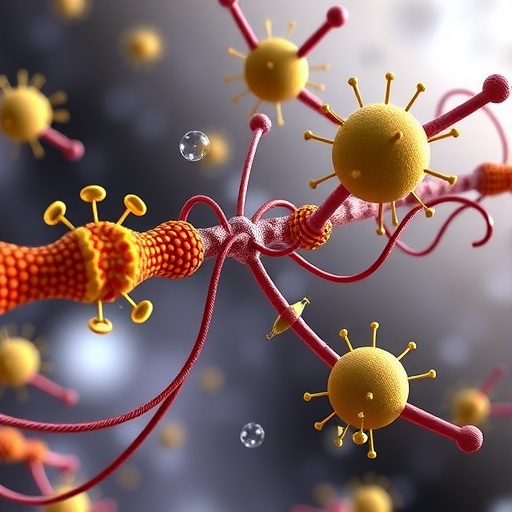
In a groundbreaking study poised to reshape our comprehension of intercellular communication, researchers have unveiled a novel mechanism by which adhesion G-protein-coupled receptors (aGPCRs) facilitate the formation and release of specialized extracellular vesicles (EVs). These vesicles, known as migrasomes and retractosomes, represent previously unidentified subtypes of EVs implicated in signal transmission between cells. This discovery, detailed by Huang, G., Li, N., Chen, Y., and colleagues in a recent publication in Nature Chemical Biology, elucidates a complex and hitherto unrecognized pathway through which active GPCRs can propagate signals across cellular boundaries, thus opening fresh horizons in cell biology and cancer research.
At the heart of this discovery is the insight that adhesion GPCRs, a unique subset of the diverse GPCR family characterized by extensive extracellular adhesion-like domains, are capable of orchestrating the biogenesis of migrasomes and retractosomes. These specialized EVs serve as cellular parcels, encapsulating activated GPCRs and ferrying them to recipient cells. Through this process, aGPCRs not only mediate adhesion and mechanical sensing but also transmit bioactive signals in a form previously unappreciated, effectively extending their signaling reach beyond the confines of the originating cell membrane.
Migrasomes, intriguing organelles recently characterized for their role in cellular waste disposal and intercellular communication, emerge from cellular retraction fibers during cell migration. Retractosomes are a related but distinct EV subtype involved in similar yet mechanistically discrete signaling activities. The study reveals that the activation of aGPCRs triggers these vesicles’ formation primarily via their extracellular adhesion-like domains coupled with intracellular G-protein signaling, particularly through the G_12/13 subfamily. This bifurcated mechanism underscores a sophisticated coupling of extracellular interactions and intracellular pathways that culminate in the excision and release of receptor-laden EVs.
A pivotal aspect of this mechanism involves ectocytosis—an active cellular process whereby portions of the plasma membrane bud off to form extracellular vesicles carrying specific cargo. Here, activated aGPCRs undergo ectocytosis, effectively packaging themselves into migrasomes and retractosomes. These vesicles, once released, carry functional GPCR complexes capable of engaging with recipient cells. This process is not passive; the receptors housed within the EV membrane remain competent to activate downstream signaling cascades upon internalization by target cells, thereby replicating GPCR-mediated signal transduction in new cellular contexts.
The implications of this mechanism are profound, particularly in the context of tumor biology. The researchers provide compelling evidence that cancer-cell-derived migrasomes serve as vehicles for the intercellular transfer of aGPCRs such as GPR56. By transferring these active receptors to endothelial cells in the tumor microenvironment, migrasomes potentiate angiogenesis, a critical process in tumor growth and metastasis. This finding suggests that migrasome-mediated GPCR signaling could be a hitherto unrecognized driver of angiogenic remodeling, possibly furnishing new therapeutic targets for vascular intervention in solid tumors.
Delving deeper into the molecular underpinnings, the study elucidates that the G_12/13-protein signaling axis exerts a central role in the formation of migrasomes and retractosomes. These heterotrimeric G-proteins, upon activation by aGPCRs, initiate downstream signaling cascades involving Rho family GTPases, which regulate cytoskeletal dynamics and membrane remodeling. This precise orchestration enables the generation of membrane blebs and cellular protrusions necessary for migrasome biogenesis. The coupling of extracellular adhesion events with G_12/13 signaling thus bridges environmental sensing with vesicle formation, ensuring spatial and temporal control over EV release.
Interestingly, the extracellular adhesion-like domains of aGPCRs themselves appear indispensable for migrasome formation. These domains enable the receptors to engage with the extracellular matrix or other cell surfaces, transmitting mechanical or biochemical cues that prime cellular machinery for vesicle biogenesis. This finding aligns with the recognized roles of aGPCRs in cell adhesion and migration but now extends their functional repertoire to include direct involvement in EV-mediated signaling—a conceptual leap in understanding GPCR functional diversity.
The fate of migrated GPCRs within recipient cells reveals yet another layer of complexity. Once internalized through endocytosis of migrasomes or retractosomes, these receptors maintain their signaling capacity, capable of activating G-protein signaling de novo in the recipient cytoplasm. This phenomenon of signal transduction propagation via EV-mediated receptor transfer challenges classical paradigms of membrane receptor localization and function, underscoring a dynamic mode of receptor redistribution and signal initiation in multicellular contexts.
Given the extensive involvement of GPCRs across physiological and pathological processes, the discovery that aGPCRs exploit EV-mediated ectocytosis for intercellular communication broadens the conceptual framework for understanding signal integration across tissues. It also offers new avenues for therapeutic intervention, particularly in diseases where aberrant GPCR signaling contributes to pathology, such as cancer, neurodegeneration, and immune disorders. Targeting the migrasome formation or receptor packaging mechanisms may yield novel strategies to interrupt maladaptive signal propagation.
Moreover, this study raises intriguing questions about the potential diversity of cargoes within migrasomes. While the focus here is on aGPCRs, migrasomes could carry diverse bioactive molecules, including other membrane proteins, nucleic acids, or metabolites, shaping recipient cell behavior in multifaceted ways. Future research promises to unravel this cargo complexity and its physiological significance, potentially revealing migrasomes as central hubs of intercellular communication beyond classical ligand-receptor paradigms.
The robust experimental approach combining in vitro cellular models and in vivo animal studies strengthens the validity of these findings. Notably, the observation of cancer-cell-derived migrasomes transferring GPR56 in vivo highlights the physiological relevance of this mechanism, affirming that migrasome-mediated receptor transfer is not an artifact of cell culture but a bona fide biological phenomenon with implications for tissue remodeling and disease progression.
In addition to tumor angiogenesis, the capacity of migrasomes to propagate GPCR signals suggests roles in developmental biology, immune responses, and tissue homeostasis. Given that GPCR activity is intricately involved in diverse signaling networks, their expanded reach via migrasome-mediated transfer could coordinate complex cellular behaviors across developmental stages and environmental challenges. Whether similar mechanisms operate across different cell types and physiological conditions remains a fertile ground for exploration.
From a biophysical standpoint, the process of ectocytosis and migrasome formation mediated by aGPCRs reflects a finely balanced interplay between membrane tension, cytoskeletal dynamics, and receptor-ligand interactions. The study invites further scrutiny into the molecular machinery and lipid microdomains involved, which may reveal novel targets for modulating EV biogenesis and release. Understanding these parameters at high resolution could accelerate the design of artificial vesicles for therapeutic delivery or biosensing applications.
In summary, this seminal work illuminates the multifaceted roles of adhesion GPCRs in orchestrating a novel vesicle-mediated signaling axis. By inducing the formation of migrasomes and retractosomes and mediating the intercellular transfer of active GPCRs, aGPCRs establish a new paradigm of cell-to-cell communication that transcends traditional mechanisms. These findings not only advance our mechanistic understanding of GPCR biology but also unveil new therapeutic targets and biomarkers with broad clinical relevance.
The discovery of aGPCR-induced ectocytosis as a driver of intercellular GPCR signal propagation thus represents a significant leap forward in the field, offering a transformative lens through which to view cellular communication, signal transduction, and disease biology. The potential to exploit this mechanism to modulate pathological signaling or enhance regenerative processes heralds an exciting frontier in molecular and cellular medicine.
Subject of Research: Mechanisms of adhesion G-protein-coupled receptor (aGPCR)-mediated extracellular vesicle formation and intercellular signal propagation.
Article Title: Adhesion GPCR-induced ectocytosis mediates intercellular GPCR signal propagation.
Article References:
Huang, G., Li, N., Chen, Y. et al. Adhesion GPCR-induced ectocytosis mediates intercellular GPCR signal propagation. Nat Chem Biol (2026). https://doi.org/10.1038/s41589-026-02148-7
Image Credits: AI Generated


