

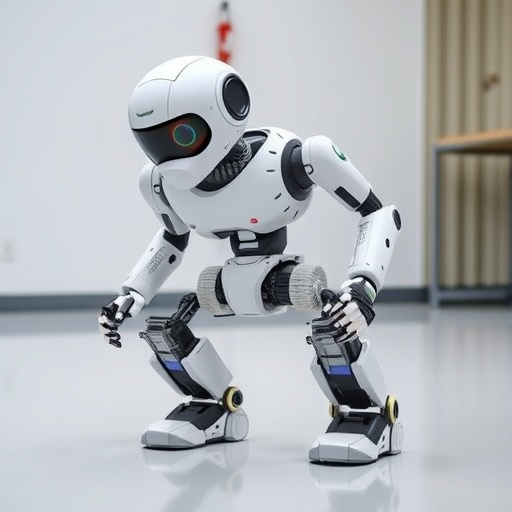
In the rapidly advancing field of robotics, the ability for machines to adapt dynamically to their environments has become a pivotal area of research and development. A groundbreaking study authored by Tejwani, Payne, Velazquez, and their colleagues, titled “Adaptive robot guidance through real-time compliance estimation and dual-modal control,” sets a new benchmark by introducing a sophisticated system that enables robots to perform with unprecedented precision and flexibility. Published in Communications Engineering in 2026, this work represents a significant leap forward in robotic control methodologies, promising transformative implications for industries spanning manufacturing, healthcare, and autonomous systems.
Central to the research is the concept of compliance – the ability of a robot to adjust its posture and force in response to external forces and environmental variability. Prevailing robotic systems often operate based on preprogrammed commands that assume static environments, leading to suboptimal performance or failure in unpredictable settings. The authors address this critical challenge by developing a real-time compliance estimation algorithm that continuously evaluates interaction forces and adapts the robot’s behavior accordingly. This continuous feedback system ensures the robot can gently and precisely handle objects, navigate complex terrain, or collaborate safely with humans without requiring constant human intervention.
What distinguishes this research from existing efforts is the introduction of dual-modal control, an innovative technique that integrates both position-based and force-based controls within a single framework. Traditional controllers typically rely on one or the other, leading to limitations when dealing with tasks demanding high sensitivity to both spatial accuracy and forceful interaction. Dual-modal control leverages the strengths of each mode, dynamically toggling and blending them based on environmental feedback and task requirements. This results in a responsive, fluid system wherein the robot can execute delicate manipulations while maintaining robust force control when needed.
The methodological backbone of this adaptive guidance system involves sophisticated sensor integration—high-fidelity force-torque sensors are embedded within the robot’s joints and end effectors, capturing precise tactile and proprioceptive data. This sensor data feeds into advanced machine learning models trained to interpret subtle variations in compliance and to predict appropriate motor responses. By combining physical sensor inputs with an intelligent inference engine, the system transcends static programming limitations, enabling real-time corrections that mirror a human’s intuitive responses to physical stimuli.
In practical testing scenarios, the research team demonstrated the robot’s capacity to handle a diverse range of tasks that previously posed significant challenges. These included manipulating fragile materials, adjusting to shifting surfaces, and collaborating with human operators in close quarters. The robot’s performance showed marked improvements in task completion speed and accuracy, as well as a notable reduction in wear and tear due to the optimized force application. These results underscore the system’s potential to revolutionize sectors requiring precision and adaptability.
One compelling application outlined is in the realm of surgical robotics. Here, the stakes for precision and responsiveness are immeasurably high. The ability for a surgical robot to sense the compliance of tissue and adjust its force application instantaneously reduces the risk of inadvertent injury. Furthermore, the dual-modal control mechanism allows for deft manipulations where both spatial awareness and force sensitivity are critical, such as suturing or minimally invasive procedures. The integration of this adaptive system could herald a new generation of surgical tools that enhance both surgeon capabilities and patient safety.
Beyond healthcare, this technology also bears tremendous implications for industrial automation. Factories often deal with a variety of materials and assemblies that require flexible handling techniques. Robots equipped with real-time compliance estimation and dual-modal control can seamlessly transition between different tasks, from delicate component placement to heavy-duty assembly, without the need for exhaustive reprogramming. This adaptability could significantly reduce downtime, streamline production lines, and amplify overall efficiency in manufacturing environments.
The underpinning algorithms introduced in this study rely heavily on real-time data processing and computational efficiency. Achieving this necessitated the design of lightweight inference models capable of operating within the constrained processing units typically present on robotic platforms. The team leveraged recent advancements in edge computing and optimized neural network architectures to ensure the system could deliver rapid, reliable compliance estimations without sacrificing performance. This balance between computational demand and responsiveness is critical for deploying such systems at scale.
Another notable innovation within this research is the incorporation of adaptive learning components that allow the robot to refine its compliance estimations over time. Instead of static models trained solely on initial datasets, the system employs continuous learning mechanisms that adjust based on accumulated interaction experiences. This mirrors the human capability for skill refinement and adaptation, where repeated exposure enhances proficiency, thereby evolving the robot’s operational competence with usage.
Safety considerations are also paramount in this study. By employing real-time force feedback and adaptive control, the robot can detect potentially hazardous scenarios and modulate its actions to avoid harm to humans or damage to objects. The dual-modal approach reinforces this by providing layers of control checks: position control ensures spatial boundaries are respected, while force control prevents the exertion of excessive pressure. This duality is essential in collaborative robotics, where machines share workspaces with human counterparts.
The authors also emphasize the importance of transparency and interpretability in the robot’s decision-making process. The compliance estimation outputs and control mode selections are designed to be understandable by operators, facilitating seamless human-robot interactions and troubleshooting. Future iterations of this technology envision augmented reality interfaces that visualize the robot’s compliance states and control modes in real time, enhancing operator situational awareness and fostering trust in automated systems.
Looking forward, the implications for autonomous vehicles and exploration robots are equally profound. Adaptive compliance sensing can empower mobile robots to traverse uncertain terrains, adjusting their mechanical interactions with the environment dynamically to maintain stability and effectiveness. This could accelerate progress in extraterrestrial exploration or disaster response robotics, where operating conditions are inherently unpredictable and the ability to self-adjust is indispensable.
The advent of this adaptive robot guidance framework crystallizes a vision of future robotics where machines no longer require rigid programming but instead learn and adapt actively and safely within their operational domains. It builds upon interdisciplinary advances in mechanical engineering, computer science, and artificial intelligence, showcasing how these fields converge to meet the practical challenges of robotics in the real world. As such, it stands as a beacon of innovation poised to catalyze the next wave of intelligent, collaborative robots.
The comprehensive evaluation and open dissemination of the system’s design principles, as detailed by Tejwani and colleagues, set a foundation for further exploration and application development. Researchers and industry engineers now have a robust blueprint for integrating adaptive compliance and dual-mode control into their robotic platforms, potentially sparking a cascade of advancements and commercial solutions that harness this technology’s capabilities.
In summary, this research represents a paradigm shift in robotic control, combining theoretical acuity with tangible, tested innovations. By enabling adaptive compliance estimation paired with dual-modal control, the authors pave the way for robots that are more capable, sensitive, and ultimately, more human-like in their interaction with the physical world. The ripple effects of this advancement will undoubtedly manifest across diverse domains, transforming how machines assist, augment, and collaborate with humans in everyday and specialized tasks alike.
Subject of Research: Adaptive robotic control systems integrating real-time compliance estimation and dual-modal force-position control mechanisms for enhanced task flexibility and performance.
Article Title: Adaptive robot guidance through real-time compliance estimation and dual-modal control
Article References:
Tejwani, R., Payne, J., Velazquez, K. et al. Adaptive robot guidance through real-time compliance estimation and dual-modal control. Communications Engineering (2026). https://doi.org/10.1038/s44172-026-00632-5
Image Credits: AI Generated


