


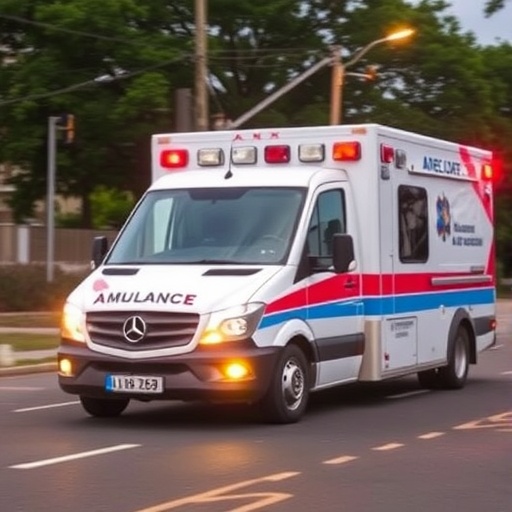
A groundbreaking study spearheaded by Swansea University has brought to light the profound emotional and operational challenges encountered by emergency ambulance personnel throughout the United Kingdom during the Covid-19 pandemic. This research offers an unprecedented glimpse into how frontline emergency responders reconfigured their triage processes and clinical decision-making amid the relentless pressures exerted by a rapidly escalating public health crisis.
Embedded within the scope of the TRIM project—an acronym for “What TRIage model is safest and most effective for the Management of 999 callers with suspected Covid-19″—the study meticulously explores the strategies and adaptations deployed by the UK’s ambulance services. Under the expert leadership of Professor Helen Snooks and oversight by Dr. Alison Porter, Associate Professor in Health Services Research, the investigation underscores the dynamic interplay between operational exigencies and the emotional toll borne by ambulance teams and their hospital-based counterparts.
Utilizing a qualitative observational methodology, the research team conducted 25 comprehensive remote interviews with a diverse cohort of emergency medical professionals, including paramedics, 999 emergency call handlers, and emergency department clinicians. These participants hailed from four distinct NHS ambulance services along with their affiliated regional hospitals, providing a wide-ranging perspective on the pandemic-driven transformations within emergency medical services (EMS).
Central to the study’s findings is the stark evolution of triage paradigms, which pivoted from traditional, in-person clinical assessments to predominantly remote evaluation frameworks. This seismic shift was in response to urgent infection control imperatives, prompting ambulance teams to prioritize cases deemed most critical while simultaneously minimizing direct patient contact. Remote triage emerged as both a clinical necessity and an operational challenge, demanding new protocols, technological integration, and rapid real-time decision-making capabilities.
Moreover, the research highlights the cascading disruption permeating the broader healthcare ecosystem, which significantly impacted patient flow dynamics and operational workflows within emergency ambulance services. The convergence of hospital capacity pressures, shifting admission criteria, and changing public health directives created a multifaceted environment of uncertainty and complexity. Ambulance crews found themselves navigating a labyrinth of newly instituted policies while striving to maintain the continuity and safety of pre-hospital care.
Equally compelling is the psychological dimension revealed through the narratives of frontline workers. The study paints a vivid portrait of sustained emotional strain, ethical quandaries, and the cumulative burden of working under these extraordinary circumstances. Personnel recounted episodes of acute stress, moral distress stemming from resource limitations, and the enduring challenge of balancing professional duties with personal wellbeing. One call handler poignantly described the trauma, “It was probably the toughest thing I’ve ever done […] I was coming home and standing in the corridor taking my uniform off and running in the shower, and sobbing my heart out day after day after day.”
Despite such formidable adversity, the study also captures a prevailing sentiment of professional pride and resilience that animated emergency services during the height of the pandemic. Leaders and frontline clinicians alike articulated a shared recognition of their adaptability and unwavering commitment. An ambulance service manager reflected, “We rose to the challenge during Covid, and we did an absolutely astounding job… showing how flexible, adaptable, and resilient we are as a service.”
Dr. Alison Porter further contextualized the findings, emphasizing the inherently high-stakes nature of emergency ambulance operations which were exponentially intensified by the pandemic’s demands. She remarked on the relentless pace of change, pervasive uncertainty, and the mental and emotional toll imposed on staff, all occurring within a context necessitating unwavering commitment to patient safety and care quality.
The study’s implications extend beyond the immediate crisis, advocating for a future blueprint of emergency services founded on principles of operational flexibility, empathetic leadership, and comprehensive psychological support for staff. These insights catalyze a call to action for healthcare systems to institutionalize mechanisms that safeguard frontline workers’ wellbeing and empower them to deliver adaptable, high-quality care during times of unprecedented demand.
Dr. Mike Brady, Assistant Clinical Director for Remote Clinical Care at the Welsh Ambulance Service University NHS Trust and a contributing member of the research team, underscored the applicability of these findings in current and future clinical transformations. He emphasized their relevance amid ongoing large-scale changes to healthcare delivery models, winter preparedness initiatives, and pandemic readiness strategies across the UK, reinforcing the indispensable role ambulance services play in advancing emergency care research and practice.
Technically, the study provides critical evidence on how remote triage protocols can be effectively operationalized without compromising clinical outcomes, a pivotal consideration for optimizing resource allocation in EMS systems. Additionally, it sheds light on the intricate balance between infection control measures and the preservation of empathetic patient interactions—a tension that future EMS frameworks must adeptly manage.
In summary, the Swansea University-led research profoundly enriches understanding of the complex and multifactorial impacts of Covid-19 on UK ambulance services. By delineating how pandemic conditions reshaped emergency medical response both clinically and emotionally, it charts a vital course for innovative, resilient, and compassionate emergency care models poised to meet evolving healthcare challenges.
Cite Scienmag News
Ophelia Keating. (September 23, 2025). Adaptive resilience of ambulance crews highlighted in new study on Covid-19 response. Scienmag. https://scienmag.com/adaptive-resilience-of-ambulance-crews-highlighted-in-new-study-on-covid-19-response/
Ophelia Keating. "Adaptive resilience of ambulance crews highlighted in new study on Covid-19 response." Scienmag, 23 September 2025, https://scienmag.com/adaptive-resilience-of-ambulance-crews-highlighted-in-new-study-on-covid-19-response/. Accessed 4 September 2026.
Ophelia Keating. "Adaptive resilience of ambulance crews highlighted in new study on Covid-19 response." Scienmag. September 23, 2025. https://scienmag.com/adaptive-resilience-of-ambulance-crews-highlighted-in-new-study-on-covid-19-response/


