


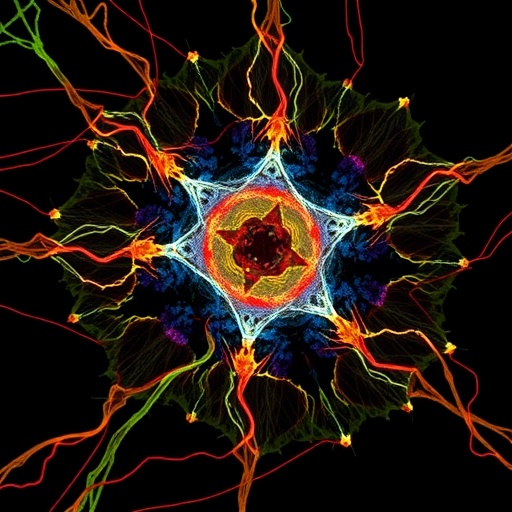
Cancer cells endure intense mechanical stresses during their invasion through constricted spaces within bodily tissues—a hallmark of metastatic progression. This physical compression frequently culminates in breaches of the nuclear envelope, compromising nuclear integrity. Such ruptures often lead to the perilous escape of genomic DNA into the cytoplasm, posing significant threats to genomic stability and cell viability. However, groundbreaking research from the University of Freiburg’s Cluster of Excellence CIBSS has illuminated a novel cellular defense mechanism that rapidly counters this potential catastrophe, safeguarding cancer cells amidst their perilous journey.
At the heart of this defense lies an ultra-fine scaffold of filamentous actin that assembles within the nucleus in mere seconds following nuclear envelope rupture. Actin, an essential cytoskeletal protein widely known for its structural and motility roles in the cytoplasm, reveals a lesser-known but critical function within the nuclear domain. This nuclear actin polymerization is not a spontaneous occurrence; it is meticulously orchestrated through the combined actions of the formin proteins DIAPH1 and DIAPH3 alongside the DNA damage sensor protein ATR. Together, these proteins dynamically stabilize the nuclear architecture, effectively minimizing chromatin leakage and preserving genomic integrity during the migratory stress experienced by cancer cells.
The prevailing question bone researchers sought to address was how exactly this nuclear actin scaffold assembles so swiftly and robustly to reinforce a ruptured nucleus. To investigate this, highly invasive fibrosarcoma cancer cells (HT1080) were cultured within microfluidic channels precisely engineered with constrictions measuring only three to eight micrometers in width. Such extreme spatial constraints reliably induced nuclear envelope rupture, simulating the natural microenvironments metastatic cells face in vivo. Remarkably, the team observed the onset of actin filament polymerization within approximately eighty seconds post-rupture—demonstrating an exceptionally rapid response mechanism.
Quantitative mechanical analyses via atomic force microscopy unveiled critical insights into the nucleus’s biomechanical properties during these events. The nuclear stiffness and resilience were significantly modulated by the actin scaffold’s presence, underscoring its essential role in mitigating mechanical strain. Complementing these mechanical studies, molecular interrogation revealed a signaling cascade where the ATR kinase, traditionally recognized for its role in DNA damage response, transmits biochemical cues to DIAPH3. This interaction catalyzes actin nucleation events within the nucleus, orchestrating rapid filament assembly precisely where mechanical reinforcement is most needed.
The significance of this protective response transcends basic cell biology and dives into the arena of cancer progression and therapeutic strategy. Intriguingly, when the researchers experimentally disrupted ATR or formin proteins DIAPH1 and DIAPH3, the cell nuclei exhibited pronounced instability under mechanical stress, and DNA leakage substantially increased. This destabilization translates to heightened genomic vulnerability, impeding cancer cells’ capacity to survive the rigors of metastatic migration. Therefore, the ATR-formin signaling axis emerges as a tantalizing therapeutic target, with the potential to destabilize cancer cell nuclei, curtail metastatic dissemination, and exacerbate DNA damage pathways to lethal levels.
Profoundly, this discovery also hints at broader implications beyond oncology. Diseases involving compromised nuclear integrity—such as certain laminopathies and muscular dystrophies—might similarly benefit from interventions modulating nuclear actin dynamics. Harnessing or inhibiting this nuclear scaffold formation could open innovative avenues for restoring nuclear robustness or sensitizing pathological cells to mechanical and genotoxic stress.
This advance builds upon a rich history of nuclear mechanics and cytoskeletal research but breaks new ground by identifying the rapid engagement of nuclear actin polymerization as an emergency repair mechanism. While cytoplasmic actin networks have been well-studied, the conceptualization of nuclear actin filaments forming on demand to fortify the genome represents a paradigm shift. It challenges the traditional view of the nucleus solely as a genetic storage sphere, instead portraying it as a biomechanically active and responsive organelle adept at countering physical assaults.
Moreover, the molecular players dissected here, from ATR’s canonical DNA damage sensing to formins’ structural nucleation roles, testify to the intricate crosstalk between signaling pathways and cytoskeletal remodeling inside the nucleus. Such interdisciplinary insights fuse the fields of molecular biology, biophysics, and cancer pathology, showcasing the dynamic adaptability of cancer cells to survive hostile physical microenvironments.
This study’s revelations further underscore the remarkable plasticity of cancer cells, highlighting their evolved mechanisms not only to evade immune surveillance and apoptosis but also to confront and overcome formidable mechanical barriers. The ability to rapidly assemble a protective nuclear actin framework positions these cells advantageously during the metastatic cascade, fostering tumor dissemination and colonization at secondary sites.
Importantly, the researchers emphasize that the temporal precision of actin polymerization post-rupture is critical; a delayed or inadequate response may precipitate irreversible DNA damage and cell death. This points toward a finely tuned, highly regulated process that cancer cells exploit, offering multiple potential molecular checkpoints for therapeutic intervention. By targeting components of this emergency repair system, future treatments might selectively impair metastatic competency while sparing normal cells less reliant on such mechanisms.
In sum, this pioneering investigation into the actin-mediated repair of nuclear ruptures expands our comprehension of cellular resilience under mechanical duress. It paints a vivid picture of the dynamic nuclear landscape during metastasis and sets the stage for novel anti-metastatic strategies grounded in cellular biomechanics and structural biology.
News Publication Date: 2025
Web References: http://dx.doi.org/10.1038/s44318-025-00566-2
References:
Kamaras, C., Frank, D., Wang, H., Drepper, F., Huesgen, P., & Grosse, R. (2025). Nuclear rupture in confined cell migration triggers nuclear actin polymerization to limit chromatin leakage. The EMBO Journal.
Cite Scienmag News
Nathaniel Bowman. (September 29, 2025). Actin Scaffold Within Cell Nucleus Sheds Light on Cancer Cell Survival Mechanisms. Scienmag. https://scienmag.com/actin-scaffold-within-cell-nucleus-sheds-light-on-cancer-cell-survival-mechanisms/
Nathaniel Bowman. "Actin Scaffold Within Cell Nucleus Sheds Light on Cancer Cell Survival Mechanisms." Scienmag, 29 September 2025, https://scienmag.com/actin-scaffold-within-cell-nucleus-sheds-light-on-cancer-cell-survival-mechanisms/. Accessed 5 September 2026.
Nathaniel Bowman. "Actin Scaffold Within Cell Nucleus Sheds Light on Cancer Cell Survival Mechanisms." Scienmag. September 29, 2025. https://scienmag.com/actin-scaffold-within-cell-nucleus-sheds-light-on-cancer-cell-survival-mechanisms/


