


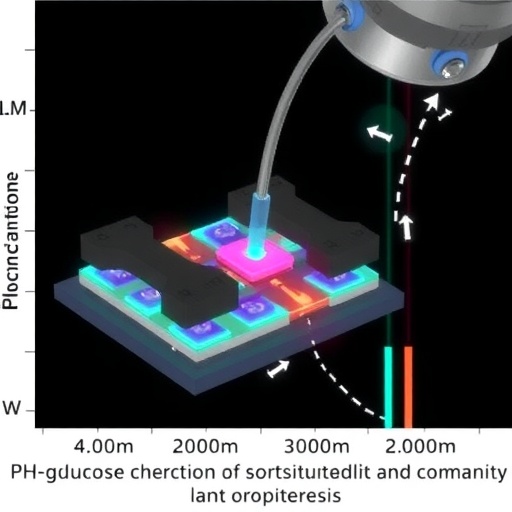
In the relentless pursuit of advanced diabetes management, researchers have long sought non-invasive methods to monitor glucose levels accurately. A groundbreaking study published in Nature Communications now brings us closer to this goal, unveiling an innovative approach that leverages pH calibration to enhance the precision of glucose detection via reverse iontophoresis in interstitial fluid. This advancement not only promises to transform glucose monitoring but also offers a glimpse into the future of wearable biosensors, pushing the boundaries of medical diagnostics.
Reverse iontophoresis—a technique where a mild electrical current extracts molecules through the skin—has been a beacon of hope for non-invasive glucose sensing. However, its widespread adoption has been hindered by challenges related to measurement accuracy. Primarily, the fluctuating pH levels in the skin’s interstitial fluid have interfered with glucose readings, causing discrepancies and limiting clinical utility. Addressing this critical barrier, the new research introduces a refined methodology that calibrates for pH variation, thereby drastically improving the reliability of glucose measurements.
The authors of the study, led by Zhu, W. and colleagues, crafted a sophisticated sensor system capable of dynamically monitoring and adjusting for pH changes in the interstitial fluid during reverse iontophoresis. This dual-parameter sensing strategy facilitates a simultaneous readout of glucose concentration alongside local pH values, effectively compensating for the latter’s influence on glucose detection. Through meticulous experimentation, they demonstrated that this calibration markedly enhances the fidelity of glucose monitoring, even under variable physiological conditions.
In practical terms, this innovation could revolutionize how individuals with diabetes manage their condition. Current glucose monitoring methods often involve invasive finger-pricking or implantable devices, causing discomfort and adherence issues. The non-invasive nature of reverse iontophoresis, now bolstered by pH calibration, presents a painless alternative capable of continuous monitoring. Such continuous feedback could empower users to make real-time decisions about diet, insulin administration, and physical activity with unprecedented confidence.
The researchers optimized their system using in vitro models that mimic human skin and interstitial fluid environments. Simulated pH variations were introduced alongside glucose concentrations, illustrating how conventional sensing approaches faltered without calibration. In contrast, the pH-calibrated sensor consistently provided accurate glucose readings, validating the sensor’s robustness. Subsequent tests on animal models further corroborated these findings, setting the stage for future human clinical trials.
Diving into the technical fabric of this system reveals a smart integration of electrochemical sensing and advanced material science. The sensor surface is functionalized with enzymes that specifically react with glucose molecules, generating electrical signals proportional to glucose concentration. However, these enzymatic reactions are pH-sensitive. The research team ingeniously integrated pH-responsive elements within the sensing matrix, enabling simultaneous pH assessment and real-time correction of the glucose signal.
Another notable aspect of the study is the careful control of the imposed electrical current during reverse iontophoresis. Excessive current can cause skin irritation and disrupt the delicate biochemical milieu, while insufficient current may yield weak molecular extraction. By fine-tuning this parameter, Zhu and colleagues ensured that their sensor system operates within safe and effective boundaries, heralding a practical pathway toward wearable implementation.
The implications of this work stretch beyond glucose monitoring alone. The fusion of pH calibration with iontophoresis could be extrapolated to detect various biomarkers in interstitial fluid, potentially paving the way for multiplexed, non-invasive diagnostics. Chronic conditions such as cardiovascular diseases, kidney dysfunction, and metabolic syndromes might also benefit from such real-time monitoring technologies, enabling earlier intervention and improved patient outcomes.
In addition to technical performance, the study emphasized user comfort and device ergonomics. The researchers developed a compact, skin-adherent prototype that minimizes bulk and maximizes wearability for daily use. This design consideration underlines a growing trend in healthcare technology where patient-centric devices strive to blend seamlessly with everyday life, mitigating the stigma or inconvenience traditionally associated with medical monitoring.
Critically, the authors did not overlook potential challenges in translating this technology to widespread clinical usage. They addressed several issues, such as sensor stability over time, biocompatibility of materials, and the need for individualized calibration protocols to accommodate physiological variability among users. By proposing strategies to overcome these obstacles, the study charts a thoughtful roadmap from laboratory innovation to commercial product realization.
Furthermore, this research underscores the importance of interdisciplinary collaboration that merges expertise from bioengineering, clinical medicine, electrophysiology, and analytical chemistry. Such synergy yields not only cutting-edge technology but also ensures that solutions are grounded in clinical realities and patient needs—a vital ingredient for the successful adoption of novel health technologies.
As the global burden of diabetes continues to escalate, innovations like this pH-calibrated reverse iontophoresis sensor appear timely and transformative. With millions dependent on accurate glucose monitoring to prevent life-threatening complications, this advancement could alleviate the physical and psychological burdens of traditional methods. It stands as a testament to how precise chemical calibration enhances biosensor functionality, translating complex physiological signals into actionable health data.
Looking ahead, the research team is excited about initiating human trials to evaluate device performance in real-world conditions. They also intend to explore machine learning algorithms that could further refine signal interpretation, accounting for additional variables such as temperature, sweat composition, and skin impedance. Such enhancements might elevate the sensor’s adaptability and precision, forging a new era of personalized, non-invasive diagnostics.
In conclusion, the breakthrough reported by Zhu et al. marks a significant milestone in the evolution of glucose monitoring technology. By addressing the confounding effects of pH through a clever calibration mechanism, their approach surmounts a critical obstacle that has long plagued reverse iontophoresis-based sensors. This accomplishment not only holds promise for diabetes care but also exemplifies the power of innovative bioelectronic interfaces to transform medical diagnostics—and potentially every aspect of chronic disease management.
As this compelling technology progresses along the translational pipeline, stakeholders from clinicians to engineers and patients to policymakers must collaborate to harness its full potential. Integration into healthcare ecosystems, regulatory approval, and patient education will be equally important to ensure that the benefits of this sensor reach those who need them most. This harmonious effort could finally realize the longstanding dream of pain-free, precise, and continuous glucose monitoring.
Overall, the study presents a vivid example of how smart sensor design, grounded in biochemical understanding and augmented by engineering finesse, can address critical unmet medical needs. It is an inspiring example that will undoubtedly inspire further research into personalized, minimally invasive biosensing platforms tailored for a variety of health monitoring applications.
Cite Scienmag News
Ophelia Keating. (November 24, 2025). Accurate Glucose Detection via pH-Calibrated Reverse Iontophoresis. Scienmag. https://scienmag.com/accurate-glucose-detection-via-ph-calibrated-reverse-iontophoresis/
Ophelia Keating. "Accurate Glucose Detection via pH-Calibrated Reverse Iontophoresis." Scienmag, 24 November 2025, https://scienmag.com/accurate-glucose-detection-via-ph-calibrated-reverse-iontophoresis/. Accessed 4 September 2026.
Ophelia Keating. "Accurate Glucose Detection via pH-Calibrated Reverse Iontophoresis." Scienmag. November 24, 2025. https://scienmag.com/accurate-glucose-detection-via-ph-calibrated-reverse-iontophoresis/


