

Osaka, Japan – As genomics and precision medicine advances open new avenues for personalized treatments to replace the conventional one-size-fits-all model, who will actually benefit from them? Paradigm shifts in disease treatment can change lives, if only people have access to them. New research has now delved into the challenge of accessing innovative care.
In a study published in Frontiers in Genetics, researchers at Osaka University and the University of Lausanne (Switzerland) focused on equal access, patient autonomy, and affordability of genomic medicine – specifically, on multigene panel testing for cancer. They compared the testing’s status in their respective countries and found that despite ‘universal’ insurance coverage in both countries, barriers related to test availability, comprehensive patient information, and affordability of the entire diagnostic and treatment process are obstacles to patient access.
Multigene panel testing for cancer uses tissue or blood samples to analyze multiple genes simultaneously through next-generation sequencing technology and identify the genetic mutation causing an individual’s cancer. Physicians can then tailor treatment for the patient’s specific genetic makeup, thereby potentially increasing survival rates.
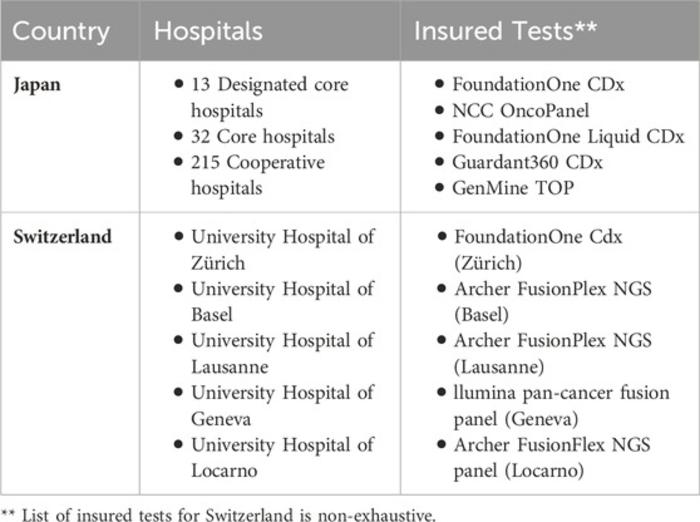
The researchers gathered and analyzed primary and secondary sources and found that, in Japan, multigene panel testing for cancer is offered at 260 designated hospitals, many of which are concentrated in urban areas. In Switzerland, multigene panel testing is available in major teaching hospitals, though the type of panel testing as well as the official language spoken in the area differs between hospitals. These conditions bring respective issues with rural access and potential language barriers.
The research team also pinpointed access to information for patients and insurance coverage as obstacles. In Japan, detailed patient information on panel testing, including specific test types and processes, is available online but may not directly address individual needs. In Switzerland, information available online tends to be overly general or, conversely, aimed at professionals. In Japan, insurance coverage for testing depends on specific criteria, such as a lack of standard cancer treatment options for the patient’s cancer. In Switzerland, basic insurance generally covers genomic analyses, but the tests’ perceived effectiveness and necessity by the patient’s physician or insurance provider can affect reimbursement.
“These are issues that require well-balanced solutions,” the study’s lead author Kate Nakasato says. “For example, while providing reimbursement for all patients is ideal, there is also a need to consider the sustainability of emerging technologies and the potential burden on the healthcare system as a whole.”
“The findings of this study extend beyond Japan and Switzerland,” senior author Kazuto Kato adds. “Ensuring equal access, patient autonomy, and affordable healthcare is crucial to the ongoing dialogue on health equality and human rights.”
###
The article, “Access, autonomy, and affordability: ethical and human rights issues surrounding multigene panel testing for cancer in Japan and Switzerland,” was published in Frontiers in Genetics at
About Osaka University
Osaka University was founded in 1931 as one of the seven imperial universities of Japan and is now one of Japan’s leading comprehensive universities with a broad disciplinary spectrum. This strength is coupled with a singular drive for innovation that extends throughout the scientific process, from fundamental research to the creation of applied technology with positive economic impacts. Its commitment to innovation has been recognized in Japan and around the world, being named Japan’s most innovative university in 2015 (Reuters 2015 Top 100) and one of the most innovative institutions in the world in 2017 (Innovative Universities and the Nature Index Innovation 2017). Now, Osaka University is leveraging its role as a Designated National University Corporation selected by the Ministry of Education, Culture, Sports, Science and Technology to contribute to innovation for human welfare, sustainable development of society, and social transformation.
Website:

Credit: Nakasato K, Manz C and Kato K (2024) Access, autonomy, and affordability: ethical and human rights issues surrounding multigene panel testing for cancer in Japan and Switzerland. Front. Genet. 15:1343720. doi: 10.3389/fgene.2024.1343720
Osaka, Japan – As genomics and precision medicine advances open new avenues for personalized treatments to replace the conventional one-size-fits-all model, who will actually benefit from them? Paradigm shifts in disease treatment can change lives, if only people have access to them. New research has now delved into the challenge of accessing innovative care.
In a study published in Frontiers in Genetics, researchers at Osaka University and the University of Lausanne (Switzerland) focused on equal access, patient autonomy, and affordability of genomic medicine – specifically, on multigene panel testing for cancer. They compared the testing’s status in their respective countries and found that despite ‘universal’ insurance coverage in both countries, barriers related to test availability, comprehensive patient information, and affordability of the entire diagnostic and treatment process are obstacles to patient access.
Multigene panel testing for cancer uses tissue or blood samples to analyze multiple genes simultaneously through next-generation sequencing technology and identify the genetic mutation causing an individual’s cancer. Physicians can then tailor treatment for the patient’s specific genetic makeup, thereby potentially increasing survival rates.
The researchers gathered and analyzed primary and secondary sources and found that, in Japan, multigene panel testing for cancer is offered at 260 designated hospitals, many of which are concentrated in urban areas. In Switzerland, multigene panel testing is available in major teaching hospitals, though the type of panel testing as well as the official language spoken in the area differs between hospitals. These conditions bring respective issues with rural access and potential language barriers.
The research team also pinpointed access to information for patients and insurance coverage as obstacles. In Japan, detailed patient information on panel testing, including specific test types and processes, is available online but may not directly address individual needs. In Switzerland, information available online tends to be overly general or, conversely, aimed at professionals. In Japan, insurance coverage for testing depends on specific criteria, such as a lack of standard cancer treatment options for the patient’s cancer. In Switzerland, basic insurance generally covers genomic analyses, but the tests’ perceived effectiveness and necessity by the patient’s physician or insurance provider can affect reimbursement.
“These are issues that require well-balanced solutions,” the study’s lead author Kate Nakasato says. “For example, while providing reimbursement for all patients is ideal, there is also a need to consider the sustainability of emerging technologies and the potential burden on the healthcare system as a whole.”
“The findings of this study extend beyond Japan and Switzerland,” senior author Kazuto Kato adds. “Ensuring equal access, patient autonomy, and affordable healthcare is crucial to the ongoing dialogue on health equality and human rights.”
###
The article, “Access, autonomy, and affordability: ethical and human rights issues surrounding multigene panel testing for cancer in Japan and Switzerland,” was published in Frontiers in Genetics at
About Osaka University
Osaka University was founded in 1931 as one of the seven imperial universities of Japan and is now one of Japan’s leading comprehensive universities with a broad disciplinary spectrum. This strength is coupled with a singular drive for innovation that extends throughout the scientific process, from fundamental research to the creation of applied technology with positive economic impacts. Its commitment to innovation has been recognized in Japan and around the world, being named Japan’s most innovative university in 2015 (Reuters 2015 Top 100) and one of the most innovative institutions in the world in 2017 (Innovative Universities and the Nature Index Innovation 2017). Now, Osaka University is leveraging its role as a Designated National University Corporation selected by the Ministry of Education, Culture, Sports, Science and Technology to contribute to innovation for human welfare, sustainable development of society, and social transformation.
Website:
Journal
Frontiers in Genetics
Method of Research
Case study
Subject of Research
Not applicable
Article Title
Access, autonomy, and affordability: ethical and human rights issues surrounding multigene panel testing for cancer in Japan and Switzerland
Article Publication Date
26-Jan-2024

