

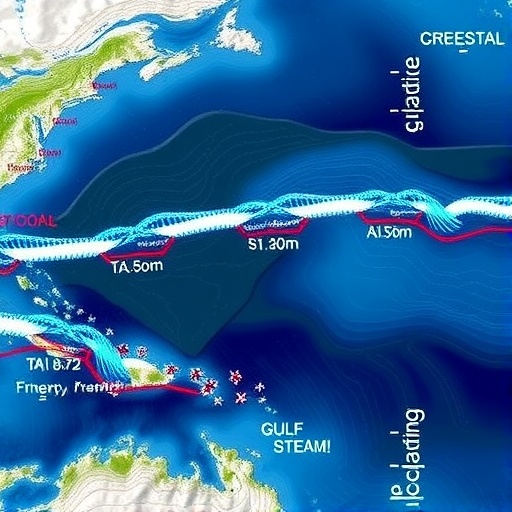
In a groundbreaking study published in Communications Earth & Environment, researchers van Westen and Dijkstra shed new light on the precarious state of the Atlantic Meridional Overturning Circulation (AMOC), a crucial component of Earth’s climate system. Their findings suggest that abrupt shifts in the Gulf Stream’s path could serve as an early-warning signal for a potential AMOC collapse. This revelation could prove transformative for climate science, offering a critical predictive tool for one of the planet’s most disruptive climate tipping points.
The AMOC, often described as a vast conveyor belt of ocean currents in the Atlantic, plays a decisive role in regulating global climate. It moves warm surface waters from the tropics towards the North Atlantic, where cooling and sinking of denser waters drive a return flow at depth. This circulation modulates weather patterns, impacts marine ecosystems, and controls the distribution of heat and carbon dioxide across the globe. Its potential collapse has long been feared as a harbinger of severe climate upheaval, including intensified storms, sea level rise along the eastern seaboard of North America, and droughts in Europe and Africa.
What sets this new study apart is its focus on subtle but sudden shifts in the Gulf Stream’s trajectory. The Gulf Stream acts as a linchpin in the AMOC system, funneling warm water northwards along the eastern United States before veering east towards Europe. Van Westen and Dijkstra utilized advanced coupled ocean-atmosphere climate models integrated with high-resolution ocean current data to identify distinct, abrupt deviations in the Gulf Stream’s path that precede deeper systemic changes in the AMOC.
These deviations arise from complex nonlinear interactions between oceanic and atmospheric dynamics. The researchers describe how localized temperature anomalies and freshwater influxes from melting Arctic ice can destabilize the Gulf Stream’s flow, triggering rapid, sometimes erratic deflections east or west. Crucially, these anomalies occur markedly earlier than any measurable weakening of the AMOC itself, providing a possible predictive window on climate stress.
Their analysis details the mechanistic underpinning of these shifts. Under stable conditions, the Gulf Stream maintains a relatively consistent path, sustained by the balance of pressure gradients, Coriolis forces, and wind-driven surface currents. However, the models reveal thresholds beyond which slight perturbations cascade into abrupt re-routing, often manifesting as pronounced meanders or sudden positional jumps. These events disturb the heat transport balance, undermining the positive feedback loops that sustain the AMOC’s strength.
Perhaps most striking is the study’s proposition that monitoring Gulf Stream path shifts may afford climate scientists an empirical indicator of approaching AMOC transitions. Current observation strategies focus largely on direct measurements of Atlantic water mass properties and flow velocities, which are noisy and logistically challenging. In contrast, satellite altimetry and oceanographic buoys can effectively track Gulf Stream geometry with higher spatial and temporal resolution, enabling real-time surveillance of status changes.
The implications extend well beyond academia. Early detection of AMOC instability via Gulf Stream monitoring could catalyze proactive adaptation policies worldwide. Improved forecasting could help coastal cities brace for accelerated sea level changes, optimize agricultural planning in vulnerable regions, and refine climate mitigation scenarios deployed by governments and the private sector. The study thus bridges a critical gap between fundamental climate physics and tangible societal benefits.
Interestingly, the authors also emphasize the reversibility window suggested by their findings. If Gulf Stream anomalies are detected early, it may be possible to implement geoengineering or emission reduction strategies in a timeframe that could stabilize or restore the AMOC. This underscores the importance of integrating ocean current dynamics into broader climate risk assessment frameworks, which traditionally focus on atmospheric greenhouse gas concentrations alone.
The rigorous approach taken by van Westen and Dijkstra involved an ensemble of coupled climate models subjected to varying freshwater forcing scenarios representative of ongoing Greenland ice melt scenarios. By simulating a wide parameter space, they were able to tease apart the conditions that amplify Gulf Stream path variability. This methodological robustness lends confidence to the reproducibility and generalizability of their results.
Their work also raises new scientific questions about the feedback loops governing ocean-atmosphere coupling in the North Atlantic. For example, shifts in the Gulf Stream alter not only heat transport but also the spatial distribution of salinity and nutrients, potentially affecting regional marine biogeochemistry and fisheries. These secondary effects could compound climatic and ecological disruptions in unforeseen ways, highlighting the interconnectedness of Earth systems.
Moreover, the research adds nuance to the ongoing debate on AMOC’s tipping point dynamics. While previous studies generally treated AMOC collapse as a smooth decline or a binary flip, van Westen and Dijkstra’s results suggest a more complex scenario with multiple stable and unstable states influenced by Gulf Stream positioning. This complexity calls for refined theoretical models to accurately capture the ocean’s real-world behavior under stress.
Critically, the study underscores the urgency of sustained, multidisciplinary ocean observation networks. Maintaining and expanding satellite missions, autonomous floats, and mooring arrays in the Atlantic will be paramount to operationalizing Gulf Stream anomaly detection. International cooperation will play a decisive role, given the transboundary nature of the AMOC’s impacts.
In conclusion, the identification of abrupt Gulf Stream path changes as a precursor to AMOC collapse represents a seminal advancement in climate science. By revealing an accessible early-warning mechanism embedded in ocean current geometry, van Westen and Dijkstra provide both scientists and policymakers a new piece of the puzzle in understanding and managing one of the most consequential climate risks of our era. The Atlantic’s dynamic heartbeat—the Gulf Stream—is telling us its secrets, and it behooves us to listen.
As the planet faces unprecedented climatic volatility, harnessing insights like those from this study will be crucial for building resilient societies. The future of the AMOC may rest not only on emissions projections but also on our ability to decode and interpret the ocean’s subtle signals. With continued research and investment, we can better anticipate and potentially avert the cascading impacts of an Atlantic circulation collapse.
Subject of Research: Atlantic Meridional Overturning Circulation (AMOC) stability and Gulf Stream dynamics as climate system precursors
Article Title: Abrupt Gulf Stream path changes are a precursor to a collapse of the Atlantic Meridional Overturning Circulation
Article References:
van Westen, R.M., Dijkstra, H.A. Abrupt Gulf Stream path changes are a precursor to a collapse of the Atlantic Meridional Overturning Circulation. Commun Earth Environ 7, 197 (2026). https://doi.org/10.1038/s43247-026-03309-1
Image Credits: AI Generated


