


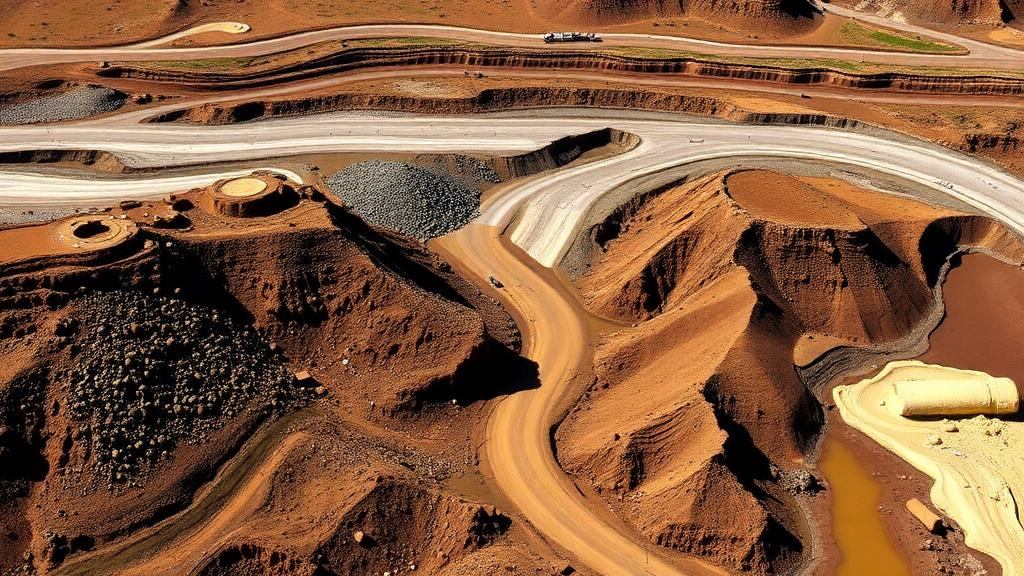
More than a century after gold was first wrested from the Witwatersrand Basin, the mountains of crushed rock left behind by South Africa’s gold industry are still quietly poisoning their surroundings. A new geochemical investigation of the Welkom Goldfield in the Free State Province has found that soils and water near abandoned tailings dams carry elevated concentrations of potentially toxic elements, including arsenic, chromium, lead and, for the first time in this area, uranium. The study, published in Environmental Geochemistry and Health, offers one of the most comprehensive pictures yet of how these aging waste facilities continue to shape the chemistry of the landscapes around them, sometimes just a few hundred metres from people’s homes and grazing land.
The research team, led by Rinae Makhadi of the University of the Free State and the University of Johannesburg, together with Robert Hansen, Kim Dowling and Hassina Mouri, collected sixteen soil samples from eleven locations around four abandoned tailings dams, a tailings footprint, informal residential areas and farming and grazing lands near Welkom and the neighbouring mining towns of Odendaalsrus and Virginia. A control sample was taken from open land in Riebeeckstad, where the underlying geology is similar but mining disturbance is minimal. Nine water samples were also gathered, spanning four groundwater boreholes, two wetlands and three surface water sites near tailings dams. Soils were analysed for both total and leachable element concentrations using inductively coupled plasma mass spectrometry, while water chemistry was resolved with ICP optical emission spectrometry and a suite of standard physicochemical measurements.
The results are stark. Mean soil concentrations were highest for iron at 18,425 milligrams per kilogram, manganese at 273 milligrams per kilogram and chromium at 200 milligrams per kilogram, and these values were frequently highest close to the tailings themselves. Arsenic ranged from 3 to 304 milligrams per kilogram, with the highest reading recorded at a grazing site near Virginia, far exceeding both the Dutch target value of 29 milligrams per kilogram and South Africa’s soil screening value of 5.8 milligrams per kilogram for the most sensitive land uses. Chromium breached regulatory limits at every single sampling site, a finding the authors describe as evidence of the severity of contamination across the study area. Uranium, detected for the first time in Welkom soils, reached 49 milligrams per kilogram at the Virginia site.
That uranium detection carries particular weight. The Witwatersrand gold ores are famously associated with uraninite, and the tailings left after gold extraction remain rich in radioactive and nephrotoxic uranium. Yet South Africa’s national soil screening standards contain no limit for uranium, a regulatory gap the researchers flag as concerning given the country’s substantial uranium reserves and the documented health risks of exposure, which include carcinogenic and renal effects. The team argues that uranium must be added to the national screening framework if compliance monitoring around goldfields is to be meaningful.
To quantify contamination, the researchers deployed a battery of established indices. Geoaccumulation index values showed that aluminium, barium, manganese, iron, cobalt, copper, nickel, titanium and vanadium remained at background levels, but arsenic, chromium, lead and uranium registered clear anthropogenic pollution at several sites. The Virginia grazing land stood out dramatically, with a geoaccumulation index of 12 for arsenic, indicating extreme enrichment, and contamination factors of 63 for arsenic, 17 for lead and 18 for uranium. Pollution load index values ranged from uncontaminated to moderately contaminated, with the tailings footprint and the Virginia site again ranking highest. Spatial distribution maps reinforced the pattern: sites close to tailings dams consistently recorded the highest concentrations, while more distant locations, including the Riebeeckstad control, were comparatively clean, strong evidence that the tailings themselves are the source.
The ecological risk assessment sharpened the picture further. Individual ecological risk values for arsenic reached 630 at the Virginia site and 100 at the tailings footprint, while lead scored 85 at Virginia, both figures signalling considerable potential harm to ecosystems. The comprehensive potential ecological risk index ranged from a very low 14 to a high of 765, with Virginia and the tailings footprint topping the scale. Although the two informal residential sites near the tailings footprint showed low ecological risk in their own soils, their proximity to contaminated ground raises concern, particularly for children, whose ingestion of soil and dust is recognised as a primary exposure pathway to contaminants.
Water told an equally troubling story. Groundwater pH values sat within World Health Organization guidelines, but electrical conductivity and total dissolved solids frequently exceeded permissible limits, with one urban borehole recording a conductivity of 295 millisiemens per metre and dissolved solids of 2,092 milligrams per litre. Manganese in one farm borehole surpassed the WHO limit, and lithium exceeded its guideline value in the urban borehole. The wetlands fared worse still: one showed extreme salinity with total dissolved solids approaching 8,900 milligrams per litre and concentrations of arsenic, fluoride and nickel above drinking water standards. Most striking were the mine waters themselves, where pH dropped as low as 2.5 and sulphate concentrations reached nearly 3,700 milligrams per litre, accompanied by arsenic, iron, manganese, nickel and uranium at levels far beyond South Africa’s discharge limits under the National Water Act.
The chemistry behind these numbers is classic acid mine drainage. Welkom’s tailings are dominated by quartz and mica but contain pyrite, an iron sulphide that oxidises when exposed to air and water, generating sulphuric acid. The resulting acidity dissolves metals from the tailings and mobilises them into soil moisture, groundwater and surface runoff. Piper trilinear diagrams classified the mine waters and three groundwater samples as calcium-magnesium-sulphate type, a signature the authors identify as a key indicator of sulphide oxidation in acid mine environments. Gibbs diagrams pointed to rock weathering and evaporation as the dominant geochemical processes, with the high dissolved solids of the mine waters reflecting long residence times and intense evaporation. The interconnectedness of groundwater, wetlands and surface water means contamination from the tailings does not stay put; it migrates through the whole hydrological system.
Water quality index calculations, which compress physical and chemical parameters into a single score from 0 to 100, delivered a sobering verdict: three of the four groundwater samples were rated poor and unsuitable for drinking, and one of the two wetlands was rated very poor. Only the borehole farthest from the tailings, on an Odendaalsrus farm, returned good quality, and it was also the only groundwater sample plotting in the sodium-bicarbonate facies associated with fresher, less mining-affected water. Because small farming communities in the region depend on groundwater for domestic supply, and wetlands are used for household purposes, these ratings translate directly into potential human exposure.
The authors are careful to note what the study does not cover. Airborne dust and food crops were not analysed, leaving open questions about inhalation and dietary exposure pathways, and they recommend detailed follow-up work on dust, crops, grazing grass and community health through questionnaire-based investigations. In the meantime, they offer practical guidance for residents: avoid growing food in contaminated soils or add clean topsoil, limit children’s play near tailings, encourage hand washing after outdoor play, and consider dust masks during windy seasons. Farmers grazing livestock on the Virginia land should be informed of the risks to both animals and families. The broader message is unambiguous: abandoned tailings dams are not inert relics of a finished industry but active chemical reactors, still acidifying, still leaching and still dispersing toxic elements into the soils and waters on which Welkom’s communities depend. Without systematic monitoring, regulatory closure of the uranium gap and a comprehensive strategy to contain seepage, the gold that built this region will keep exacting a heavy environmental price.
Subject of Research: Geochemical contamination of soil and water around abandoned gold mine tailings dams in the Welkom Goldfield, South Africa
Article Title: Geochemical assessment of soil and water around abandoned gold mine tailings dams: evidence from the Welkom Goldfield, South Africa
Article References: Makhadi, R., Hansen, R., Dowling, K., & Mouri, H. (2026). Geochemical assessment of soil and water around abandoned gold mine tailings dams: evidence from the Welkom Goldfield, South Africa. Environmental Geochemistry and Health, 48(15), Article 618. https://doi.org/10.1007/s10653-026-03513-0
Image Credits: AI Generated
DOI: 10.1007/s10653-026-03513-0
Keywords: gold mining, mine tailings, soil contamination, water quality, arsenic, uranium, acid mine drainage, South Africa, Witwatersrand, ecological risk, heavy metals, geochemistry
Cite Scienmag News
Sloane Callahan. (October 4, 2026). Abandoned Gold Tailings Leave Toxic Legacy in South African Soils and Water. Scienmag. https://scienmag.com/abandoned-gold-tailings-leave-toxic-legacy-in-south-african-soils-and-water/
Sloane Callahan. "Abandoned Gold Tailings Leave Toxic Legacy in South African Soils and Water." Scienmag, 4 October 2026, https://scienmag.com/abandoned-gold-tailings-leave-toxic-legacy-in-south-african-soils-and-water/. Accessed 4 October 2026.
Sloane Callahan. "Abandoned Gold Tailings Leave Toxic Legacy in South African Soils and Water." Scienmag. October 4, 2026. https://scienmag.com/abandoned-gold-tailings-leave-toxic-legacy-in-south-african-soils-and-water/


