

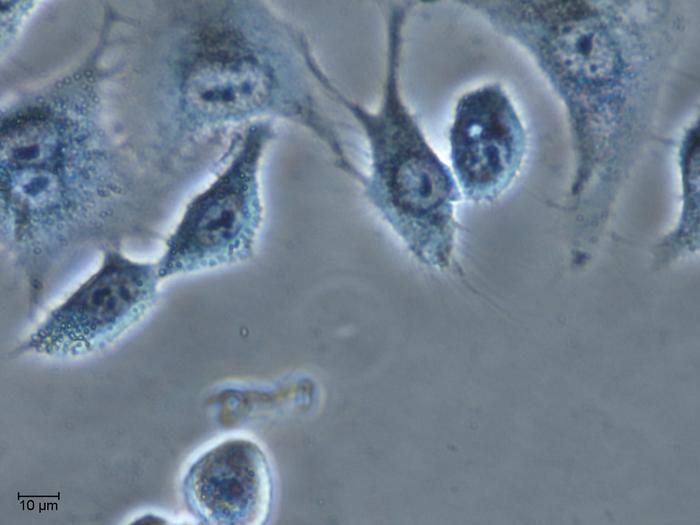
Chemotherapy saves lives of cancer patients. However, these treatments are not without side effects and other limitations, which encourages basic research to focus on these challenges. This is demonstrated by a recent study published in Cell Reports Physical Science, which proposes the use of molecular ‘cages’ (made of pseudopeptides) to selectively eliminate cancer cells in acidic microenvironments. To achieve this, an extensive study was conducted using a broad family of ‘cages’ to understand how they act. This research is led by a scientific team from the Institute for Advanced Chemistry of Catalonia (IQAC-CSIC) of the Spanish National Research Council (CSIC), in collaboration with the University of Burgos and with the participation of the Institute of Environmental Assessment and Water Studies (IDAEA-CSIC).

Credit: IQAC-CSIC
Chemotherapy saves lives of cancer patients. However, these treatments are not without side effects and other limitations, which encourages basic research to focus on these challenges. This is demonstrated by a recent study published in Cell Reports Physical Science, which proposes the use of molecular ‘cages’ (made of pseudopeptides) to selectively eliminate cancer cells in acidic microenvironments. To achieve this, an extensive study was conducted using a broad family of ‘cages’ to understand how they act. This research is led by a scientific team from the Institute for Advanced Chemistry of Catalonia (IQAC-CSIC) of the Spanish National Research Council (CSIC), in collaboration with the University of Burgos and with the participation of the Institute of Environmental Assessment and Water Studies (IDAEA-CSIC).
These results are relevant for the preclinical development of new ionophores (ion-transporting molecules) with potential therapeutic applications in cancer treatment.
Challenges in the fight against cancer
Chemotherapy against cancer faces two main challenges: lack of selectivity, which causes undesirable side effects, and the emergence of chemoresistance, since cells can develop resistance to the chemical agents used in chemotherapy, rendering ineffective treatments for some patients. Additionally, one characteristic of cancer cells is that their metabolism creates an acidic pH in the environment of solid tumors. This gives these cells special characteristics, making them more resistant and capable of migrating to other areas of the body (a process known as metastasis).
There is an increasing evidence of the potential of ionophores (ion-transporting molecules) as new chemotherapeutic agents in cancer. However, controlling their activity to limit toxicity has become a challenge so far. The use of molecular ‘cages’ that selectively act in the slightly acidic pH of the solid tumor microenvironment is a way to overcome these hurdles and advance their development.
Molecular ‘cages’ to eliminate cancer cells
These ‘cages,’ derived from fluorine-substituted amino acids, kill cancer cells at slightly acidic pH levels (below 7, as observed around tumors), but are harmless at the physiological pH of healthy tissues. “In a previous study published in 2019, we designed a molecule with a three-dimensional ‘cage’ structure that showed good selectivity for killing cancer cells in slightly acidic environments,” explains Ignacio Alfonso, a researcher at IQAC-CSIC and the lead author of the study. These ‘cages’ had a fluorine atom at each of the three side chains and efficiently encapsulated a chloride ion in acidic environments. Furthermore, they were able to transport chloride across lipid bilayers, and this transport was more efficient when there was a pH gradient with an acidic environment, making them more toxic to cells in a slightly acidic pH, like the microenvironment of a solid tumor.
“In this work, we wanted to go one step further and understand the mechanism of action of these molecules,” explains the IQAC-CSIC researcher. “For this, we have conducted an exhaustive study with a broad family of ‘cages’ with different numbers of fluorine atoms in various positions to understand the chloride capture capacity, the transport process, and the toxicity at different pHs in cell cultures,” Alfonso clarifies.
The process has been extensively studied at the molecular level using cutting-edge theoretical and experimental approaches (fluorescence, nuclear magnetic resonance, and computational studies). The results showed the effect of fluorine on these molecules and, therefore, have allowed to understand the mechanism of action and the identification of a cage with even higher selectivity to kill cancer cells in acidic environments.
“These results will help to understand and improve the design of these ionophores with potential therapeutic applications in cancer treatment,” concludes Roberto Quesada, a researcher at the University of Burgos.
Journal
Cell Reports Physical Science
Method of Research
Experimental study
Subject of Research
Cells
Article Title
Tuning pH-dependent cytotoxicity in cancer cells by peripheral fluorine substitution on pseudopeptidic cages
Article Publication Date
3-Sep-2024

