A fragmentary slab of bone barely a few centimeters long has rewritten a chapter of dinosaur history. Described in the journal The Science of Nature, the specimen CAPPA/UFSM 0539 is the distal end of a left pubis from the Late Triassic of southern Brazil, and its identification as a herrerasaurid dinosaur marks the first time that this ancient family of large predatory dinosaurs has been found in rock layers dominated by a very different set of animals: the herbivorous cynodont Exaeretodon. For decades, herrerasaurids were known only from strata teeming with rhynchosaurs, barrel-bodied herbivorous reptiles that are among the signature animals of the Carnian stage. The new find shows that these earliest apex predators did not vanish when the world around them changed.
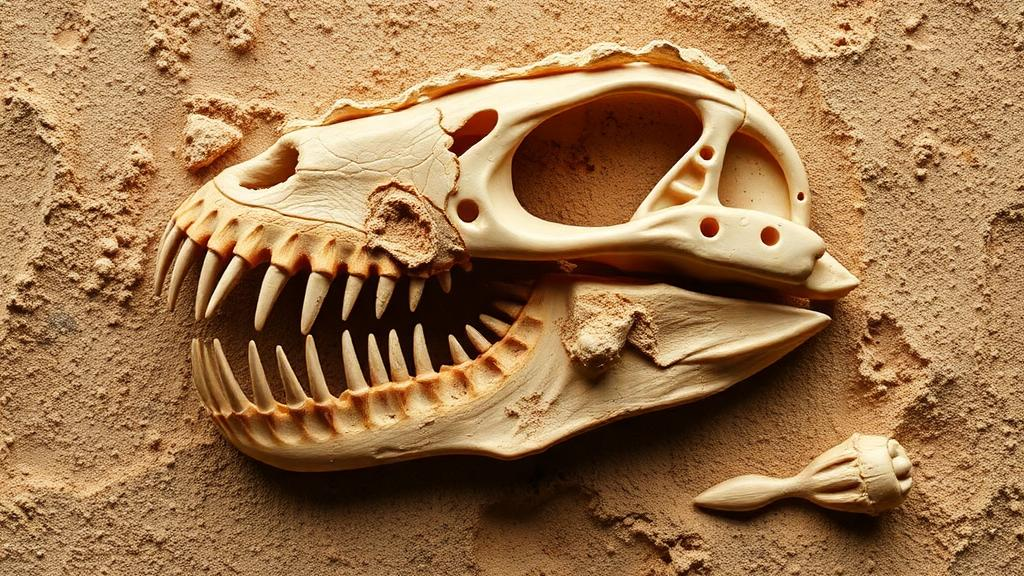
Herrerasaurids occupy a special place in the story of dinosaur evolution. They include the oldest large-bodied predatory dinosaurs known to science, animals that could reach more than five meters in length and stood on two legs, armed with robust skulls bearing serrated, blade-like teeth and forelimbs tipped with large, trenchant claws. Four species are currently recognized, all from the Carnian stage of the Late Triassic of South America: Herrerasaurus ischigualastensis and Sanjuansaurus gordilloi from the Ischigualasto Formation of Argentina, and Staurikosaurus pricei and Gnathovorax cabreirai from the Candelária Sequence of southern Brazil. Where they sit on the dinosaur family tree has been debated for decades, with proposals ranging from dinosaurs outside the main dinosaur radiation to theropods, relatives of sauropodomorphs, and most recently early-diverging saurischians that branched off before the theropod and sauropodomorph lineages split.
Until now, every herrerasaurid occurrence in both Argentina and Brazil came from rock units characterized by an abundance of rhynchosaurs. In Argentina, their fossils are confined to the Scaphonyx-Exaeretodon-Herrerasaurus Biozone of the Ischigualasto Formation, and no herrerasaurid had ever been reported from the overlying Exaeretodon Biozone. In southern Brazil, the Hyperodapedon Assemblage Zone has been subdivided into an older Hyperodapedon Acme Zone and a younger Exaeretodon sub-Assemblage Zone, in which the traversodontid cynodont Exaeretodon becomes abundant while rhynchosaurs decline sharply. Again, herrerasaurids had been documented only from the lower, rhynchosaur-dominated interval. This pattern raised an unsettling possibility: perhaps herrerasaurids were ecological specialists, dependent on rhynchosaurs as prey, and simply could not survive the turnover that swept through their ecosystems.
That hypothesis now faces a serious challenge. The new specimen was collected from the Várzea do Agudo site, also known as the Janner site, in the municipality of Agudo in the Brazilian state of Rio Grande do Sul. The fossil-bearing strata there belong to the Santa Maria Formation within the Candelária Sequence of the Santa Maria Supersequence and are of Carnian age, although the uppermost beds may extend into the earliest Norian. The exposed succession runs roughly twelve to thirteen meters thick, and fossils are restricted to the lower ten meters. The lowest three meters of red mudstones have yielded only the rhynchosaur Isodapedon varzealis, while the overlying seven meters of orange mudstones have produced a rich assemblage including Hyperodapedon, the cynodonts Exaeretodon riograndensis and Trucidocynodon riograndensis, the proterochampsian archosauriform Stenoscelida aurantiacus, the ornithosuchid Dynamosuchus collisensis, and the early sauropodomorph dinosaurs Pampadromaeus barberenai and Bagualosaurus agudoensis. It is from these orange mudstones, the interval interpreted as the Exaeretodon sub-Assemblage Zone, that the new pubis was recovered.
The identification rests on a set of anatomical features that are strikingly distinctive. The specimen preserves the complete distal end of the pubis, including a well-developed pubic boot, a structure in which the bone expands both backward and forward at its lower end. Among Triassic archosaurs, such an expanded pubic boot appears only in some pseudosuchians, theropods, and herrerasaurids, but the detailed morphology differs among these groups. In the new specimen, the posterior expansion is remarkably elongate and triangular in side view, the main axis of the boot meets the shaft at nearly a right angle, and a subtle anterior expansion is also present. The distal end is astonishingly thin, just three millimeters thick at its ventralmost point, producing an L-shaped pubis in ventral view. That combination of an anteriorly expanded, extremely thin pubic boot is currently known only among herrerasaurids. In Triassic theropods such as Coelophysis bauri, and even in the Early Jurassic Dilophosaurus wetherilli, the posterior expansion is far less developed. In poposauroid pseudosuchians such as Shuvosaurus inexpectatus, which share the thin, L-shaped distal pubis, the posterior expansion is hook-like and deflects upward, unlike the condition in the Brazilian specimen.
To test the identification rigorously, the specimen was scored into a phylogenetic data matrix combining recent analyses of avemetatarsalian archosaurs, updated with re-examinations of several taxa and a new character capturing the anterior expansion of the distal pubis. The final matrix comprised 293 morphological characters and 79 operational taxonomic units and was analyzed in TNT to recover the most parsimonious trees. The analysis yielded 540 equally parsimonious trees of 1131 steps, and in every one of them CAPPA/UFSM 0539 landed squarely within Herrerasauridae. In the strict consensus, the specimen forms a polytomy with an indeterminate Brazilian herrerasaurid, Gnathovorax cabreirai, Herrerasaurus ischigualastensis, and Sanjuansaurus gordilloi, a grouping supported in part by the anteriorly expanded distal end of the pubis. The Bremer support for the relevant nodes was low, which the author attributes to the fragmentary nature of the material and of several specimens in the matrix. Lacking features that uniquely align it with any recognized species, the specimen was referred to an indeterminate herrerasaurid.
The paleoecological implications are considerable. If herrerasaurids truly had been specialized rhynchosaur hunters, the decline of those herbivores should have spelled their end. Instead, the new occurrence demonstrates that herrerasaurids persisted through the faunal turnover that reshaped these communities, retaining a foothold even as traversodontid cynodonts rose to numerical dominance. The author notes that rhynchosaurs, although less abundant in the younger assemblages, are not entirely absent, which may have helped sustain the predators. The Várzea do Agudo assemblage already included a formidable lineup of carnivores, among them proterochampsians, ornithosuchids, ecteniniid cynodonts, and early sauropodomorphs interpreted as opportunistic omnivores that included vertebrate prey in their diets. Given that complete herrerasaurid skeletons from Brazil and Argentina show the group could attain large body sizes, herrerasaurids were likely the largest predators at the site when fully grown, suggesting they held the role of apex predators in the food webs of these changing ecosystems.
There is also a tantalizing chronological possibility. Absolute dating of the Hyperodapedon Assemblage Zone at another Brazilian locality places it in the Carnian at about 233.23 million years ago, plus or minus 0.73 million years, but the Exaeretodon-dominated strata have not yet been directly dated. In Argentina, the Exaeretodon Biozone of the Ischigualasto Formation is unequivocally younger than the biozone containing herrerasaurids, because its strata overlie those of the older interval. If the Brazilian pattern mirrors the Argentine one, then CAPPA/UFSM 0539 would be younger than Gnathovorax, Staurikosaurus, and the other Brazilian herrerasaurid records, potentially making it the youngest known member of Herrerasauridae anywhere in the world. The closest relatives known from younger strata elsewhere, including the United States, India, and Brazil, belong to the broader group Herrerasauria rather than to Herrerasauridae proper, which would make the Brazilian bone an especially significant data point in the clade’s final chapter. The author cautions that absolute dating of the Brazilian strata remains essential before any firm chronological claims can be made.
What makes the discovery resonate beyond its technical details is the picture it paints of early dinosaur ecosystems. The age of dinosaurs began not with a single dominant body plan but with a landscape crowded with competing archosaur lineages, armored pseudosuchians, crocodile-line predators, cynodont mammal relatives, and the first dinosaurs jostling for position. Herrerasaurids, the first big carnivorous dinosaurs, held their place through at least one major ecological restructuring, only to be replaced in the Jurassic by theropod dinosaurs as the dominant large terrestrial predators. A single, wafer-thin pubic bone, scanned in three dimensions and preserved in a Brazilian university collection, is enough to show that the dynasty of the earliest dinosaur predators was more flexible, and more enduring, than the fossil record had previously let on.
Subject of Research: First record of a herrerasaurid dinosaur from Exaeretodon-dominated Late Triassic strata of southern Brazil
Article Title: First occurrence of a herrerasaurid dinosaur in a traversodontid cynodont-dominated Late Triassic fauna of southern Brazil
Article References: Müller, R. T. (2026). First occurrence of a herrerasaurid dinosaur in a traversodontid cynodont-dominated Late Triassic fauna of southern Brazil. The Science of Nature, 113(6), Article 133. https://doi.org/10.1007/s00114-026-02185-1
Image Credits: AI Generated
DOI: 10.1007/s00114-026-02185-1
Keywords: Herrerasauridae, Late Triassic, Carnian, Santa Maria Formation, Exaeretodon, rhynchosaurs, phylogenetics, paleoecology, dinosaurs, Brazil, pubic boot, faunal turnover
Cite Scienmag News
Gavin Prescott. (October 19, 2026). A Single Fossil Bone Reveals Apex Predators Persisted Through a Triassic Ecosystem Upheaval. Scienmag. https://scienmag.com/a-single-fossil-bone-reveals-apex-predators-persisted-through-a-triassic-ecosystem-upheaval/
Gavin Prescott. "A Single Fossil Bone Reveals Apex Predators Persisted Through a Triassic Ecosystem Upheaval." Scienmag, 19 October 2026, https://scienmag.com/a-single-fossil-bone-reveals-apex-predators-persisted-through-a-triassic-ecosystem-upheaval/. Accessed 19 October 2026.
Gavin Prescott. "A Single Fossil Bone Reveals Apex Predators Persisted Through a Triassic Ecosystem Upheaval." Scienmag. October 19, 2026. https://scienmag.com/a-single-fossil-bone-reveals-apex-predators-persisted-through-a-triassic-ecosystem-upheaval/